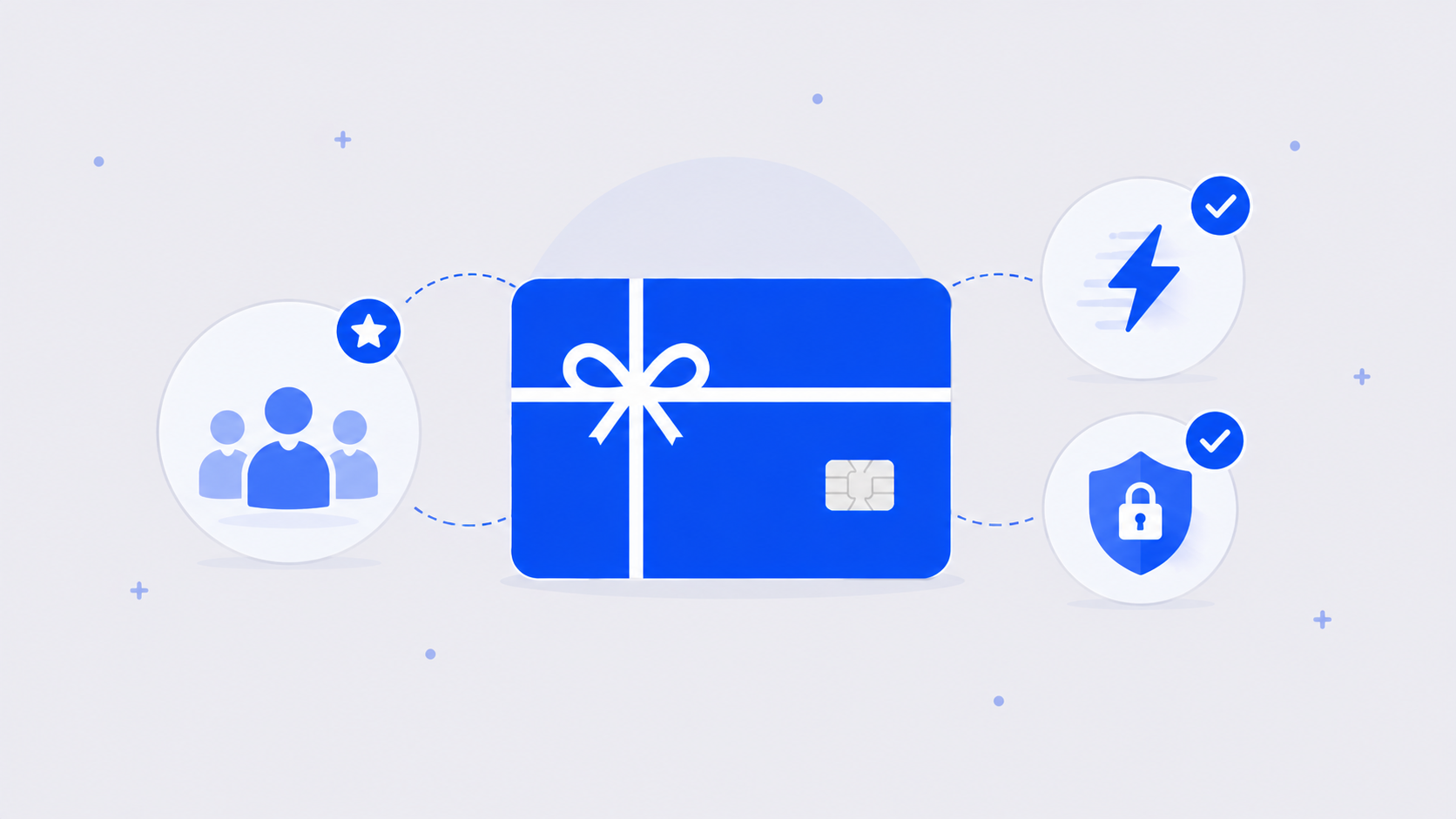
Digital gift cards for employees — also called virtual gift cards — are gift cards delivered by email instead of printed and shipped, redeemable through a web browser rather than a physical card in hand. They're the fastest, lowest-cost way to reward employees at any scale, and 81% of consumers say they'd like to receive a gift card from their employer, according to Bank of America and TSG's 2026 gift card report.
Here's what the benefits actually are, how digital compares to physical, and what to check before rolling out a virtual gift card program.
📌 TL;DR
- 81% of consumers would like to receive a gift card from their employer, and 40% haven't received one but want to, according to Bank of America and TSG's 2026 gift card report — demand is outpacing supply.
- 52% of consumers prefer email as their digital gift card delivery channel, the same 2026 report found — the exact format a virtual gift card program already uses.
- The FTC received more than 41,000 fraud reports tied to gift cards in 2024, totaling $212 million in losses — much of it linked to physical card tampering that digital delivery avoids entirely.
- Giftronaut lets you send virtual gift cards to employees instantly by email, with zero platform fees and 4,300+ brands to choose from.
What are digital (virtual) gift cards for employees?
A digital gift card for employees is a gift card delivered entirely electronically — by email, with a code or link a recipient redeems online — instead of a physical card that has to be printed, mailed, or handed over in person. "Digital" and "virtual" describe the same thing in this context: no plastic, no shipping, no physical object at any point.
Employee demand for this format is well ahead of what most companies currently offer. 81% of consumers say they would like to receive a gift card from their employer, and 40% specifically say they haven't received one but want to, according to Bank of America and TSG's 2026 gift card report — a clear gap between what employees want and what most reward programs currently deliver.
The most common formats are a Choice Card (multi-brand, recipient picks where to redeem), a closed-loop card (single brand, sender picks in advance), and a open-loop card (spends anywhere a card network like Visa or Mastercard is accepted). All three exist in digital form, and none require a physical object to change hands.
Understanding the full range of gift card types available matters before choosing one, since a single-brand card fits a narrower audience than a multi-brand card built to adapt to whoever's actually receiving it.
"Digital" doesn't mean generic, either. A virtual gift card can still carry a company's own branding, a personalized message, and a specific dollar amount tied to a specific occasion — the only thing that changes versus a physical card is the delivery mechanism, not the recipient's experience of feeling recognized.
What are the benefits of using digital gift cards for employees?
The core benefit is closing the exact gap the Bank of America and TSG data shows: 40% of consumers haven't received a gift card from an employer but want one. A digital gift card program is the fastest, lowest-friction way to close that gap without adding printing, shipping, or manual distribution to an HR team's workload.
Cost is the second benefit. There's no packaging, no postage, no physical inventory to manage, and no risk of a card getting lost in transit before it reaches an employee. Giftronaut charges zero platform fees on top of that — no subscription, no per-card charge, no per-order charge — only a 3% fee on credit card funding, with ACH and wire transfers free.
Speed is the third. A digital gift card can be created and delivered within minutes of an order being placed, compared to a physical card that has to be manufactured, packaged, and shipped before an employee ever sees it — a difference that matters most for time-sensitive recognition, like a same-day "thank you" for finishing a big project.
Flexibility rounds it out. A Choice Card lets each employee pick their own brand instead of a company guessing at one that fits everyone, and catalog settings — brand, category, country — can be configured once and reused for every future send, rather than rebuilt from scratch each time. Combined, these four benefits — closing the demand gap, lower cost, faster delivery, and more flexibility — are why digital has become the default format for employee gift card programs rather than a niche alternative to physical cards.
Administration is the fifth benefit, and it's easy to overlook until a program scales past a handful of recipients. A CSV-based recipient list, bulk editing, and reusable recipient groups mean a rewards team manages hundreds of employees the same way it manages a dozen — through the same interface, without a linear increase in manual work per additional recipient.
How do digital gift cards compare to physical gift cards?
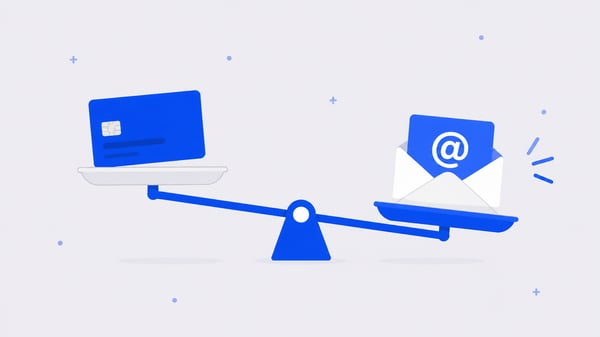
Purchasing behavior is already shifting toward digital. Physical-only gift card purchasing fell 7 percentage points year-over-year in 2025, while combined digital-and-physical purchasing grew 2 points and digital-only purchasing held steady, according to Bank of America and TSG's 2026 gift card report — physical-only buying is losing share, not digital.
The practical differences show up in three places. First, distribution: a physical card requires a mailing address and shipping lead time; a digital card requires only an email address and arrives in minutes. Second, redemption: a physical card can be lost, damaged, or left in a drawer; a digital card lives in an employee's inbox and can be resent if the original email is lost. Third, cost: physical cards carry printing, packaging, and postage costs that digital delivery eliminates entirely.
Physical cards still have a place — an in-person event where handing over something tangible matters, for example. But for most employee recognition and incentive use cases, digital removes friction on every side: for the company sending it, and for the employee redeeming it.
The clearest sign of where the category is headed: combined digital-and-physical purchasing is growing while physical-only purchasing shrinks, meaning the shift isn't toward abandoning gift cards altogether — it's toward adding a digital option that a shrinking share of buyers choose to skip.
For an HR or rewards team specifically, the comparison usually comes down to a simple question: does this reward need to be handed to someone in person, or does it need to reach them reliably and quickly regardless of location? Most recognition and incentive programs fall into the second category — a distributed team, a remote hire, or simply a company that wants a reward to land the same day a milestone happens rather than a week later once a card ships.
How fast can digital gift cards be delivered to employees?
A digital gift card can be delivered by email within minutes of an order being placed and funded — the single biggest speed advantage over any physical alternative, which requires manufacturing and shipping lead time before an employee ever receives one.
Scheduling adds control without sacrificing speed. A One-Time Order can be sent immediately or scheduled for a specific future date and time, and automated reminder emails go out seven days and one day before a scheduled order launches — giving a rewards team a final chance to catch a funding gap or bad recipient list before the send goes live.
For recurring recognition — work anniversaries, onboarding dates — a Smart Order automates the send entirely based on the trigger date, so delivery timing never depends on someone remembering to place an order manually.
After a send, a weekly delivery status report summarizes delivered and bounced counts across recent orders, so a rewards team can catch a bad email address and correct it before an employee misses a reward entirely — a level of visibility a mailed physical card simply doesn't offer once it's dropped in the mail.
Speed also compounds across a growing team. Sending ten physical cards and sending five hundred take roughly the same amount of manual effort per card — printing, packaging, and mailing scale linearly with headcount. A digital order takes the same few minutes to configure whether it's going to ten recipients or five hundred, since the marginal cost of each additional email is effectively zero.
Can digital gift cards be personalized for employees?
Yes, and the format itself supports the delivery channel employees actually prefer. 52% of consumers say email is their preferred channel for receiving a digital gift card, according to Bank of America and TSG's 2026 gift card report — exactly the format a virtual gift card program already uses by default.
Personalization goes beyond just the delivery channel. Email tokens can insert an employee's first name, last name, department, and company name directly into the message, and the subject line and sender display name can be customized so the email reads as a genuine, individual message rather than a mass send.
Card design adds a second layer: a company can use a pre-made template or upload its own logo or branded image, so the card itself reflects company identity rather than arriving as a generic, unbranded email.
For Choice Card orders specifically, the brand catalog itself can be filtered by category, country, and specific brand before sending, with those settings saved per order — meaning personalization extends to which brands an employee even sees as options, not just the message wrapped around the card.
Recipient data also supports personalization at scale rather than one email at a time. Recipients can be organized into groups — by department, location, or team — so a single campaign can carry a different personalized message per group while still going out as one coordinated send, instead of a rewards team manually customizing hundreds of individual emails by hand.
Are digital gift cards secure for employees to redeem?
Digital delivery removes an entire category of fraud that physical gift cards are uniquely exposed to. A common scam involves thieves copying the number and scratch-off PIN from physical cards on retail store racks, then returning the cards — when an employee later buys and loads that same card, the thief can spend the balance first, according to the Better Business Bureau's gift card scams study. A digital card delivered directly to an employee's inbox was never sitting on a physical rack to begin with.
Gift card fraud overall remains a serious problem. The FTC received more than 41,000 fraud reports involving gift cards and prepaid cards in 2024, totaling $212 million in losses, according to the Federal Trade Commission — most of it tied to gift cards used as a payment method in scams targeting the purchaser, not to the redemption process itself.
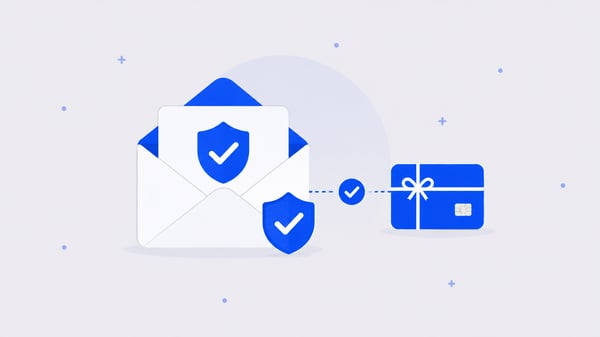
On redemption, employees verify their email through a one-time password before accessing a Choice Card or Branded Card — a step that confirms the person redeeming the card is actually the intended recipient, rather than whoever happens to have the code.
This also protects against a much simpler failure mode than fraud: a forwarded or misdirected email. If a gift card email ends up in the wrong inbox, OTP verification means whoever opens it still can't redeem the card without also controlling the intended recipient's actual email account — a safeguard a physical card, which can be redeemed by literally anyone holding it, doesn't have.
Why choose Giftronaut for virtual gift cards?
Recognition pays off in retention. Organizations with strong employee recognition programs see 31% lower voluntary turnover, according to Gallup — and closing the gap between the 81% of consumers who want a gift card from their employer and the 40% who specifically say they haven't gotten one yet starts with a platform that makes sending virtual gift cards simple enough to actually launch.
Giftronaut lets you send Choice Cards, Branded Gift Cards, Prepaid Visa cards, and International Gift Cards by email in minutes, with zero platform fees — no subscription, no per-card charge, only a 3% fee on credit card funding, with ACH and wire transfers free. Combined with 4,300+ brands across 225+ countries and recognition from G2 as a Spring 2026 Momentum Leader, Most Implementable, Easiest To Do Business With, High Performer, and Users Love Us, Giftronaut gives rewards teams a straightforward way to close that demand gap without adding operational overhead.
Team permissions round out the platform for companies where more than one person touches a rewards program. Granular fund/send/view permissions let a company invite multiple team members to collaborate on sends without every person needing full account access — useful once a digital gift card program grows past a single owner managing every order alone.

Frequently Asked Questions
Is it safe to send gift cards to employees by email?
Yes. Email delivery avoids the physical rack-tampering scams that affect printed gift cards, and recipients verify their identity with a one-time password before redeeming a Choice Card or Branded Card.
What's the difference between a digital and a virtual gift card?
Nothing — the terms describe the same thing: a gift card delivered electronically rather than printed and shipped.
Can digital gift cards be personalized with an employee's name?
Yes. Email tokens can insert first name, last name, department, and company name, and the subject line and sender display name can be customized.
What happens if an employee loses the delivery email?
The order can be resent or corrected directly from the platform without requiring a new order to be placed.
Do digital gift cards cost less than physical ones?
Yes. Digital delivery eliminates printing, packaging, and postage entirely, and Giftronaut charges no platform fees on top — only a 3% fee applies to credit card funding, with ACH and wire transfers free.
Can a digital gift card be scheduled for a future date?
Yes. A One-Time Order can be scheduled in advance, and a Smart Order automates recurring sends tied to a recurring trigger like a work anniversary.
Do employees need to download an app to redeem a digital gift card?
No. Redemption happens through a standard web browser after verifying the recipient's email with a one-time password — no app download required.
What's the best way to send digital gift cards to employees?
The best way to send digital gift cards to employees combines instant email delivery, personalization that goes beyond a generic template, and redemption security that a physical card can't match. With 81% of consumers wanting a gift card from their employer and only a fraction currently receiving one, closing that gap is a straightforward operational fix, not a major program overhaul.
Giftronaut lets you send Choice Cards, Branded Gift Cards, Prepaid Visa cards, and International Gift Cards instantly, with zero platform fees and 4,300+ brands to choose from. Try a free sample to see exactly what an employee receives before rolling out a full program.