B2B marketing examples are most useful when they reveal the decisions behind a campaign: who it targets, what problem it addresses, why the message fits, and what happens next.
B2B marketing campaign examples by channel
A channel is only a delivery method. The campaign still needs a defined audience, a useful message, one next step, and a sensible way to learn from the response.
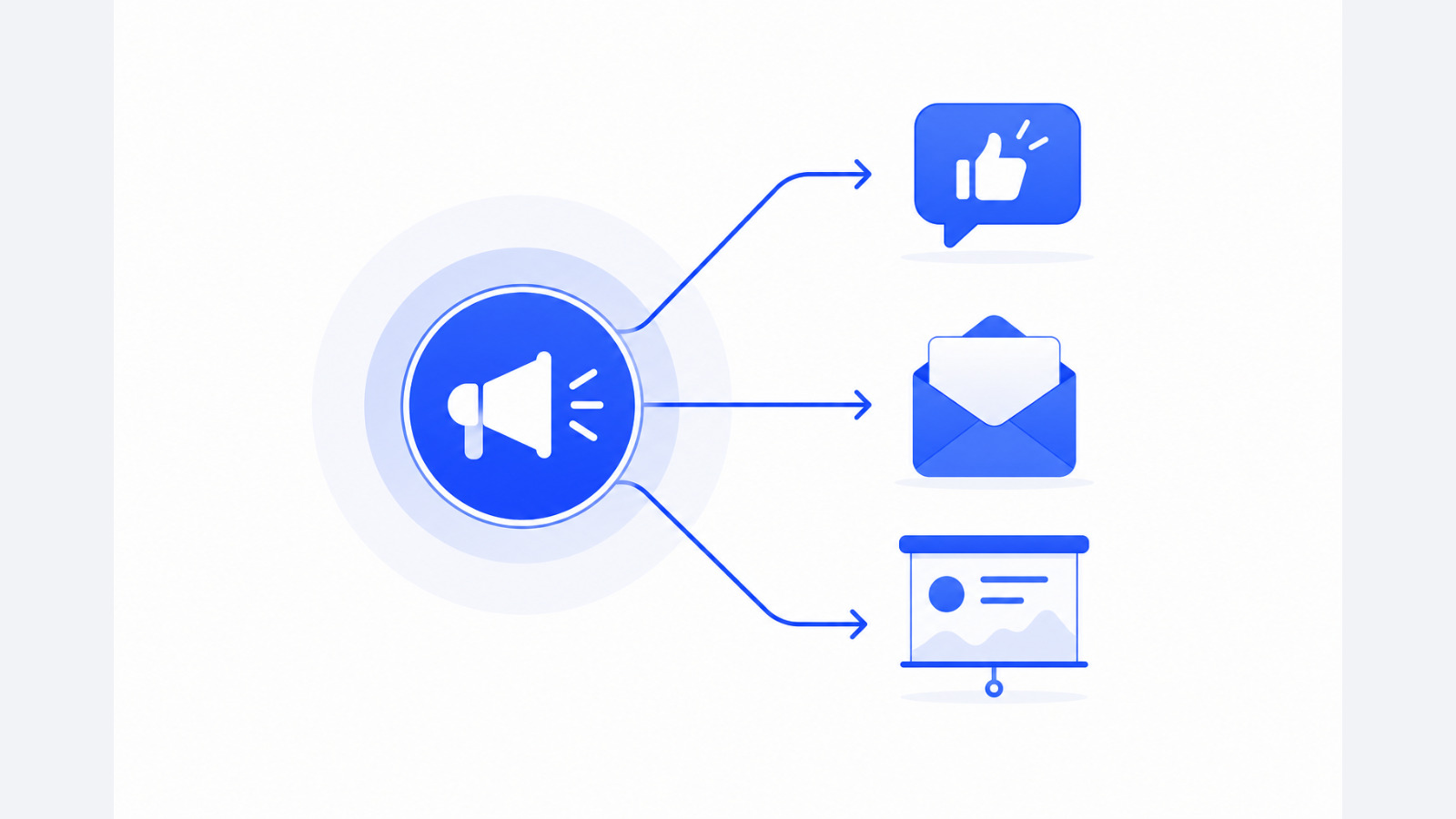
B2B marketing means marketing to businesses rather than individual consumers. Shopify’s B2B marketing guide also distinguishes broad lead-based activity from account-based marketing focused on selected companies.
Use this comparison to choose a starting point:
| Channel | Useful when you need to | Illustrative campaign | Main risk |
|---|---|---|---|
| Nurture known prospects | Answer one buying question per message | Sending identical emails to every contact | |
| Search and content | Capture active research | Explain costs, risks, or approaches | Chasing keywords without answering them |
| Reach defined professional groups | Publish a point of view for one role | Confusing reach with business progress | |
| Webinars | Explain a complex decision | Run a focused workshop or teardown | Turning education into a disguised pitch |
| Direct mail | Create attention in a crowded account | Send a useful item tied to the campaign | Offering something unrelated to the message |
| ABM | Coordinate work around target accounts | Combine content, outreach, and sales follow-up | Calling a static list “personalization” |
Picture a campaign for operations leaders who face slow approvals. “Download our brochure” gives the audience little reason to care. A workflow audit gives them a concrete outcome, while a short review call creates a logical next step.
That difference matters because the asset follows the decision. Start by asking what the buyer is trying to understand, compare, or change. Then choose the format that helps with that job.
Plan the handoff before launch, too. Someone who attends a webinar may receive a recap, a worksheet, or a conversation with sales. The right response depends on the action they took and their likely buying stage.
A campaign can use several channels without becoming a different campaign in each one. Keep the central problem and promise consistent, then adapt the execution to the channel.
Content and thought leadership examples
Content earns attention when it helps a buyer make a difficult decision with less uncertainty. It should add a useful point of view, not repeat category language in a longer format.
The following campaign patterns are illustrative designs, not claimed customer results.
The practical comparison series. A software company could compare several ways to run an employee reward program: manual rewards, prepaid cards, digital gift cards, recipient-choice models, and rewards platforms.
The useful comparison would cover setup, recipient choice, delivery, administration, and international considerations. It would also explain where each approach fits instead of forcing every row toward one winner.
That honesty is part of the marketing. Readers can tell when a comparison has been written as a sales page wearing a table as a disguise.
The original framework. A framework gives buyers a way to organize a messy issue. For example, a campaign might evaluate an incentive using relevance, timing, friction, clarity, and follow-up.
One framework can support a guide, webinar, checklist, and sales conversation. Keep it small enough to use without a twelve-tab spreadsheet.
The useful teardown. Examine a real campaign with verified details, or label a constructed scenario as hypothetical. Show the message, the audience, the intended action, and the points where a recipient could hesitate.
Weak: “Complete our survey for a chance to win.”
Stronger: “Share how your team handles remote recognition. You’ll receive a reward after completing the survey.”
The second version explains the task and the exchange. It also gives the recipient a clearer reason to continue.
The expert-led education campaign. A webinar or roundtable works better with a narrow promise than a broad theme. “How marketing and sales can agree on account qualification” gives people a practical reason to attend; “The future of marketing” does not.
Measure the quality of participation, not only registrations. Questions, attendance, audience fit, follow-up actions, and sales usefulness can reveal more than a large sign-up number.
For further inspiration, compare the specificity of the messages in these employee recognition examples. The lesson is not to copy the wording. It is to connect the gesture with the contribution.
Account-based marketing examples
Account-based marketing, or ABM, focuses coordinated marketing and sales activity on selected companies. It is a recommendation for teams with a focused market and enough account knowledge to personalize responsibly, not a universal replacement for broader demand generation.

A practical ABM campaign might follow this sequence:
- Agree on the target account list and selection criteria.
- Research each account’s structure, priorities, and likely buying concerns.
- Choose one shared campaign idea that matters to the group.
- Adapt examples for the roles involved in the decision.
- Coordinate advertising, content, outreach, events, and sales conversations.
- Assign follow-up owners before anyone launches the campaign.
- Review account engagement separately from pipeline movement.
Suppose the target group includes companies with distributed teams. Marketing might publish guidance on consistent recognition across locations. Sales could then follow up with people leaders, operations contacts, and finance stakeholders using the same central idea with different emphasis.
The people leader may care about employee choice and consistency. Operations may care about administration. Finance may focus on control and redemption conditions. One campaign can address all three, but one sentence probably cannot.
ABM also needs a stopping rule. If your account data is weak or sales cannot follow up, personalization creates work without creating useful learning.
Start with a manageable group and document the campaign’s assumptions. A later comparison with similar accounts outside the campaign can provide context, but it will not prove causation by itself. Treat the result as evidence to review, not a guaranteed uplift.
Useful ABM examples make coordination visible. The buyer should experience one connected conversation, not six teams independently proving they have the same spreadsheet.
Gifting and incentive campaign examples
Gifting and incentives work when they support a meaningful action and explain the exchange clearly. They should make a relevant invitation easier to accept, not distract from an unclear one.
Survey and research incentives. State who qualifies, how long the survey takes, what the participant receives, when it arrives, and any conditions. A reward can improve the invitation’s clarity, but it cannot make an unsuitable survey feel suitable.
Recipient choice can reduce the risk of guessing what a group wants. Giftronaut’s Choice Card lets a recipient choose an available reward and currency. Availability varies, so do not promise every brand or reward in every country.
Event attendance campaigns. Tie the incentive to a defined action, such as attending the full workshop and completing a short feedback form. Sending the reward before attendance may encourage registrations without participation; sending it much later weakens the connection.
Qualified meeting campaigns. Define what qualifies before promoting the offer. Conditions might include a relevant role, a specific use case, or a company profile that matches the campaign.
The incentive should support a good invitation, not become the entire reason to accept. Otherwise, you may attract activity that sales cannot use.
Customer research and advocacy. A team might recognize customers who provide detailed feedback during a research cycle. The message should name the contribution rather than say only, “Thanks for your time.”
What the best B2B campaigns have in common
The most useful B2B marketing examples differ in format, but their underlying decisions tend to be disciplined.
A defined audience. “B2B decision-makers” is too broad to guide a message. Identify the role, company situation, buying stage, and problem that brought the person to the campaign.
One clear promise. A campaign may have several supporting benefits, but the main reason to pay attention should be obvious quickly. Keep the landing page, email, event description, and follow-up connected.
Low uncertainty. Explain what happens after someone clicks, registers, responds, or books a meeting. Include timing, eligibility, effort, and cost when those details affect the decision.
A planned follow-up. Assign the owner, timing, and response before launch. Someone who downloads an introductory guide should not automatically receive a procurement-focused sales message.
A useful learning loop. Track the action that matches the goal, such as qualified responses, attendance, meetings, account engagement, or pipeline movement. Also review audience fit and the quality of follow-up.
Change one major variable at a time when possible. If you alter the audience, offer, landing page, and sales process together, a better result will not tell you which decision helped.
The campaign should leave your team with a clearer next move, whether the result is strong, weak, or inconclusive.
Turn B2B examples into a campaign you can learn from
Do not copy a campaign because its surface idea looks clever. Borrow the reasoning behind it: a specific audience, a useful promise, a clear exchange, and a follow-up that respects the person’s action.
Start with one problem and one next step. If you add an incentive, make the reward, timing, and conditions easy to understand. That is how a campaign becomes useful to the buyer and instructive for your team.

Frequently Asked Questions
What are B2B marketing examples a small team can start with?
Start with a focused comparison article, short email sequence, or practical webinar. Choose one audience and one buying question.
How do I create B2B marketing campaign examples for my industry?
Find a real buyer decision in your industry. Build the campaign around its risks, criteria, and next step.
Which B2B marketing campaign examples use incentives well?
Survey research, qualified meetings, event follow-up, and customer feedback campaigns can use incentives well. Explain eligibility and timing clearly.
Are B2B marketing examples useful without performance data?
Yes, when you study the audience, message, offer, channel, and follow-up. Treat the example as a hypothesis, not proof.
How can ABM improve B2B marketing campaign examples?
ABM coordinates activity around selected accounts. It works best when marketing and sales agree on targets, roles, messaging, and follow-up.
Can a Giftronaut Choice Card support a B2B marketing campaign?
Yes, recipients can choose an available reward and currency. Availability and product conditions vary by country and reward.