
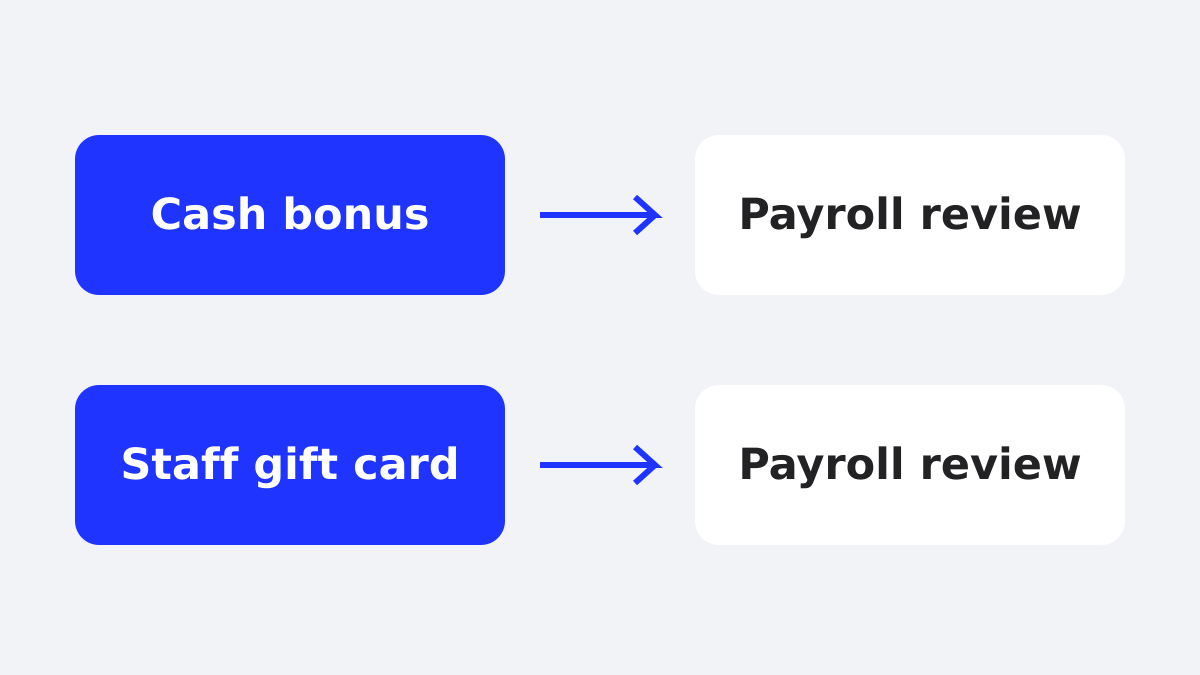
Give a Christmas bonus when the reward is compensation and payroll can process it on time. Give an employee gift when you want a separate holiday gesture, while still coordinating employee tax treatment with payroll.
Should you give employees a Christmas bonus or gift?
A Christmas bonus is the better fit when employees need cash through payroll. An employee gift is the better fit when the company wants a separate holiday gesture, provided payroll reviews the employee’s tax treatment.
Compare cash compensation with a separate reward by reviewing payroll treatment, tax handling, timing, and recipient experience.
Christmas bonus vs. gift: side-by-side comparison
The table below gives the short answer for an owner or HR manager comparing the two options.
| Decision factor | Christmas bonus | Employee gift |
|---|---|---|
| Cost planning | Set a gross amount and confirm the payroll treatment. | Reward value plus applicable funding costs. Credit-card funding carries a 3% fee; ACH and wire funding are free. |
| Employee experience | The employee receives cash through the normal pay process. | The employee receives a tangible holiday reward or chooses an available option. |
| Tax and payroll | Payroll reviews withholding and reporting for the employee’s bonus. | For employees, cash-equivalent gift cards are not excludable as de minimis benefits under IRS Publication 15-B (2026); payroll reviews withholding and reporting. |
| Speed | Payroll controls the timing and pay-cycle deadline. | Digital rewards can be sent right away or scheduled for a specific date. |
No universal preference applies to every team. The deciding question is whether the reward is intended to increase take-home pay or mark the holiday with a separate gift.
When a Christmas bonus makes more sense
A Christmas bonus fits when employees expect additional cash and your payroll team has a defined process for handling it. It also fits when leaders want the reward to support personal expenses rather than direct employees toward a particular type of purchase.
Use a bonus when:
- The reward is part of total compensation or has already been described as a bonus.
- Employees need flexibility to spend the money wherever they choose.
- Payroll has enough time to confirm the gross amount, pay date, withholding, and reporting.
- The company wants one consistent cash amount rather than a choice among gift options.
A bonus also requires clear communication. Tell employees whether the stated amount is gross or net, which pay period includes it, and when payroll will provide the final amount.
Before announcing a bonus, ask payroll whether the proposed amount fits the current pay cycle. If the company already promised a bonus in an offer letter, policy, or prior communication, HR should review that commitment before changing the reward format.
When an employee gift makes more sense
An employee gift fits when the company wants a separate holiday gesture at the end of the year. For employees, a low-value, non-cash holiday item has different de minimis treatment from a gift card, which the IRS treats as a cash-equivalent benefit. Review the employee’s treatment with payroll before announcing either reward.
Choose a gift when:
- The holiday gesture matters as much as the monetary value.
- The team includes people with different tastes or purchasing needs.
- The company wants to send rewards digitally instead of coordinating physical delivery.
- HR needs to schedule delivery for a holiday event, office closure, or final workday.
A branded gift card works when the company already knows the right brand and recipient country. A choice-based reward works better when recipients have different preferences or locations, because the sender does not have to select one brand for everyone.
For gift ideas and formats, see Christmas gifts for employees. This decision comes down to the purpose, timing, and administration of the reward.

What to check before deciding
The choice becomes clearer when you answer four operational questions before setting the budget.
- What does the stated amount mean? Decide whether the amount is a gross bonus, a net amount communicated to employees, or a gift value. Do not describe a gross bonus as the amount employees will receive.
- Who needs to be involved? Confirm the bonus amount and pay-cycle timing with payroll. For a gift, assign responsibility for ordering, recipient data, funding, and delivery checks.
- When must employees receive it? A payroll deadline controls a bonus. A gift order needs time for funding, recipient review, scheduling, and any country or brand checks.
- What happens if a reward is not used? Review the reward’s terms before ordering. If budget recovery matters, the Refund Option is selected when the order is placed and has its own redemption windows.
A small team with one pay cycle and a shared preference can manage a bonus directly through payroll. A distributed team with different locations or brand preferences needs a gift process that handles those differences.
How tax and payroll affect the choice
For employees, tax treatment differs by reward type, so payroll should review the decision before the announcement. The IRS states in Publication 15-B, 2026 that cash and cash-equivalent fringe benefits, including gift cards and gift certificates, are not excludable as de minimis benefits; some low-value, non-cash holiday gifts have different treatment.
Keep the tax discussion brief in the employee announcement, but do not skip the payroll review. For the detailed gift-card tax rules, see gift card taxation.
How Giftronaut fits the gift decision
Giftronaut’s one-time order guide explains how an employer can send digital gift cards when the decision favors a separate employee gift rather than a payroll bonus. The sender can select a branded gift card or a Giftronaut Choice Card, add recipients individually or by spreadsheet, and send rewards right away or schedule them for a specific date.
A Giftronaut Choice Card gives recipients a selection from available brands at redemption. Giftronaut offers 4,300+ brands across 225 countries, and brand availability varies by country. Giftronaut has no platform, subscription, or per-card fees, while credit card funding carries a 3% processing fee and ACH and wire funding are free.
For a year-end team, that setup supports a scheduled digital reward alongside payroll coordination. Employee gift cards remain cash-equivalent benefits; HR and payroll must confirm the tax treatment, recipient list, value, and delivery date.
A practical decision rule for year-end planning
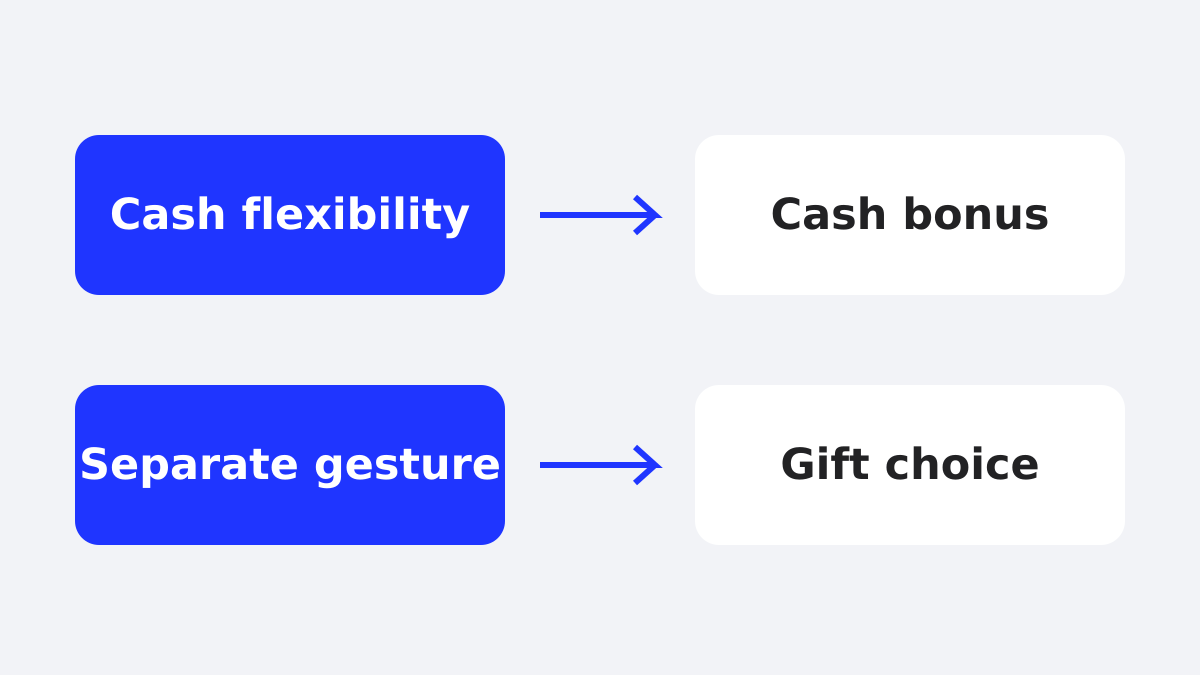
Choose a Christmas bonus when the reward is compensation, cash flexibility is the priority, and payroll has approved the amount and timing. Choose an employee gift when the goal is a separate holiday gesture, recipient choice, or scheduled digital delivery.
Before communicating the decision, have HR and payroll confirm the reward type, gross-versus-net wording, tax handling for employees, promised-bonus commitments, and final delivery date. Then send one clear message that states exactly what employees receive and when.

Frequently Asked Questions
Are employee gift cards taxable?
The IRS employer guide treats employee gift cards as cash-equivalent benefits. They do not qualify for the de minimis exclusion, so coordinate the applicable treatment with payroll.
Does credit-card funding add to the gift budget?
Yes. Credit-card funding carries a 3% processing fee. This funding cost is separate from the reward value and the recipient’s card terms.
Can employee gifts be scheduled for a particular date?
Yes. The one-time order guide supports immediate or scheduled delivery. Review the recipients, amounts and intended send date before confirming.
Can employees choose an available brand for their country?
A Giftronaut Choice Card lets recipients select an available brand and country at redemption. The reward-options guide explains the options and country-dependent availability.
Can one prepaid card be used in both Canada and the US?
Do not assume that a local card works in both countries. Review the Canada and US card guide and the specific card’s terms before choosing it for employees.