Gift card platform rules come down to three checks: whether each recipient’s country has a local catalog, whether your reward amount fits the product’s limits, and what a recipient can’t change once they confirm a choice. Check all three before you announce an amount or a brand.
I once ordered an engraved mug for a friend’s birthday, checked the preview, tapped confirm, and spotted the misspelled name when the receipt landed in my inbox. The shop was gracious about it. The mug was still final.
Gift card platforms have their own version of that moment, and it usually arrives after the budget is committed: the card works in one country, the amount you announced isn’t one the product sells, or a choice can’t be undone. None of these is hard to check up front. They’re easy to skip because a platform’s homepage talks about reach and brands, not rules.
What are the gift card platform rules worth checking first?
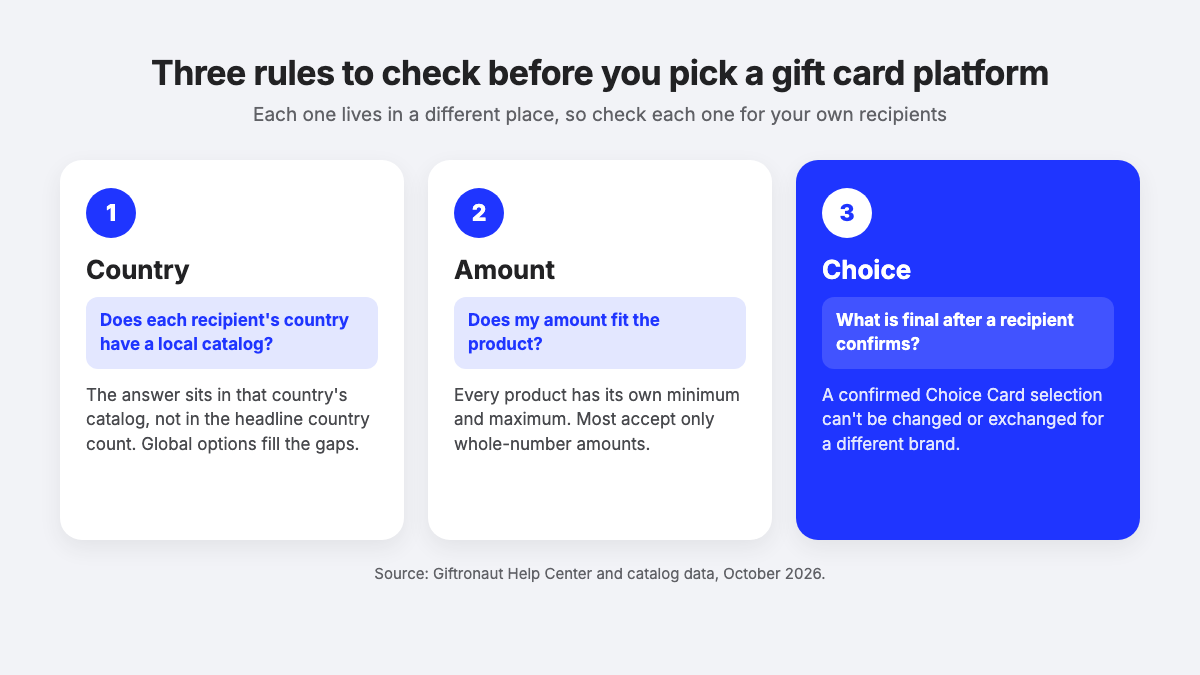
Three rules decide whether a campaign works as planned: where a card can be used, which amounts a product accepts, and what can’t be changed after a choice is confirmed. Each one lives in a different place, which is why a platform can look flexible overall and still trip a specific campaign.
| Rule | What to ask the platform | Where the answer sits |
|---|---|---|
| Country | Does each recipient’s country have a local catalog, or only a global product? | The country’s own catalog |
| Amount | Is the planned amount between the product’s minimum and maximum, in an increment it accepts? | The individual product |
| Choice | After a recipient confirms a selection, can anything change? | The redemption flow |
The rest of this guide takes them one at a time, then shows how to test a platform against your own recipient list. They don’t depend on each other, so skip to the one that worries you.
Does a platform’s country count mean every country has a local catalog?
No. A country count tells you where a platform can deliver something, and nothing about how much a recipient will find when it gets there. Giftronaut reaches 225 countries, but local gift cards exist in 71 of them, and in the rest recipients choose from global options instead.
Think of a phone plan. Roaming works almost everywhere, but a local SIM works better where you actually live. Our global options, the Global Visa Reward Card (usable in 223 countries) and the Swype Global Virtual Mastercard (usable in 202), are the roaming plan. A local catalog is the local SIM.
Depth varies a lot among the 71. In Giftronaut data from September 2026, the United States has 795 products, followed by Australia (303), India (258), France (255) and the United Arab Emirates (219). Across all 71 countries with a local catalog, 12 have 100 or more products, 17 have 50 to 99, 27 have 10 to 49 and 15 have fewer than 10. The median is 38.
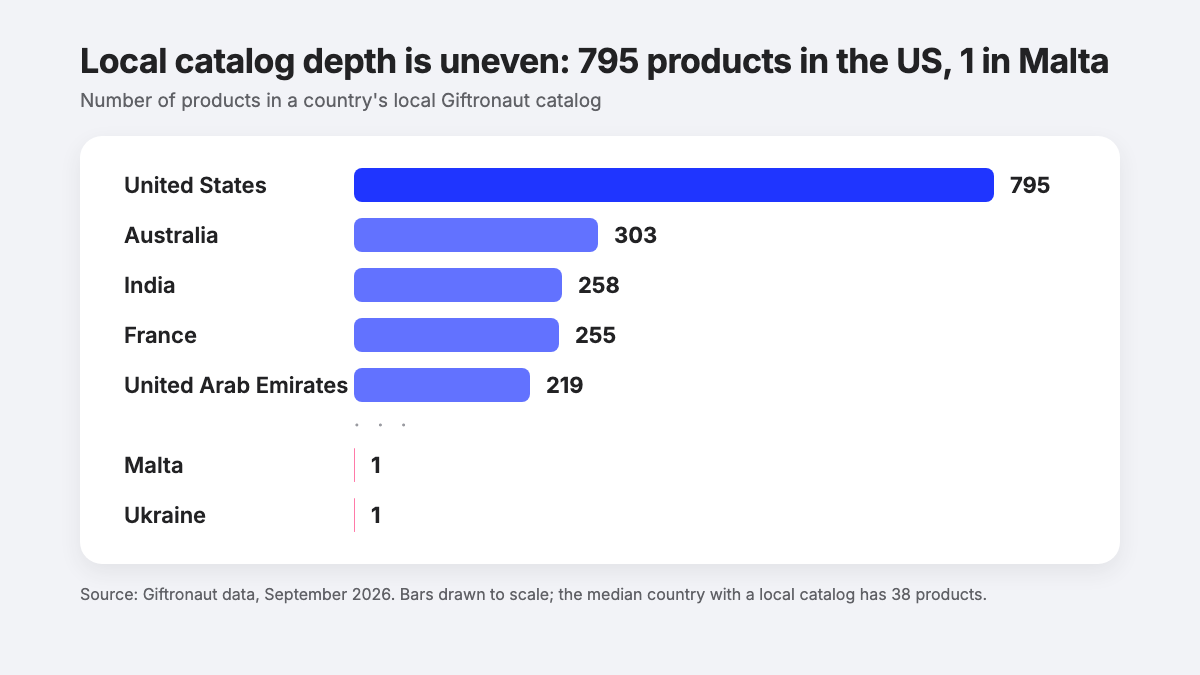
Ukraine and Malta show why the fallback needs its own check. Each has a single local product. A Malta recipient can also be rewarded with the Global Visa Reward Card. A Ukraine recipient isn’t offered it, so don’t assume a global fallback exists until you’ve checked the country.
Two other country rules sit outside catalog depth. Twelve countries covered by US sanctions are blocked outright (Afghanistan, Cuba, Iran, Iraq, North Korea, Libya, Somalia, South Sudan, Sudan, Syria, Venezuela and Yemen), and none of them has a product in the catalog. And some countries need to be enabled on your account before their gift card brands can be selected, so a country can be supported on the website and still be missing from your checkout dropdown. If that happens, request it from support@giftronaut.com.
So ask any platform for a list of your recipient countries with local and global-only marked, rather than a headline number.
Will the same brand’s gift card work in another country?
Usually not. A gift card issued for one country can’t be redeemed in another, even when the brand name is the same, because each country’s version is a separate product with its own issuer. About 98% of the Giftronaut catalog is listed for a single country.
Amazon is the clearest example. It appears in our catalog as separate products for Amazon.com, Amazon.ca, Amazon.co.uk, Amazon DE and Amazon.es, and a recipient can only use the one issued for their own country. An Amazon.co.uk card can’t be redeemed on Amazon.com in the United States.
Other brands work the same way. Apple’s support site says you can’t redeem an Apple Gift Card, App Store Card or App Store & iTunes Gift Card outside the country or region of purchase, and its example is a card bought in France that won’t redeem in the US App Store (Apple Support, checked October 28, 2026). Amazon’s US terms say neither an Amazon.com balance nor its gift cards can be applied to purchases at Amazon properties outside the United States (Amazon.com gift card terms, checked October 28, 2026).
For your plan, that means promising a category (“a dinner gift card”) rather than a brand unless you know the country of every recipient. The post on checking country-specific products before promising one brand shows the same rule applied to a holiday program.
How do denomination rules decide whether your amount works?
Every product has its own minimum and maximum, so an amount works only if it sits inside both limits for the product each recipient will use. An order outside a product’s limits can’t be sent. Some products go further and come only in fixed denominations, where the minimum and the maximum are the same value.
Two details catch people out. The first is increments: about 86% of Giftronaut products require whole-number amounts, so an amount like $25.50 can’t be ordered, while about 7% accept steps of 0.1 and about 4% steps of 0.01. The second is the floor. Among products issued in USD, which is about 22% of the catalog, roughly three quarters start at $5, and the most common maximums are $500 and $100 (Giftronaut data, September 2026).
Say a research team tells participants they’ll get $7.50 for a 20-minute interview. That amount fails on every product that requires whole numbers, about 86% of the catalog, before a single interview happens. Announcing $7 or $8 costs nothing. Changing the promise after people have qualified costs trust.
Currency adds one more wrinkle. If you send a Choice Card in a currency other than USD, the minimum and maximum apply to the reward’s USD value after conversion. If the amount lands outside the allowed range, the reward can’t be sent and you’re asked to adjust it (Giftronaut Help Center, updated October 2026).
Keep all of this separate from account funding. A funding request has a $100 USD minimum and a standard maximum of $100,000 USD, which can be raised on request. That’s the amount you load into the account, and it says nothing about what one recipient can receive. Design your tiers from the product rules outward: pick the products, read their limits, then set the amounts. If you plan to split one reward across brands, check minimum denominations before splitting a Choice Card reward.
How does Giftronaut Choice Card handle country, currency and confirmation?
A Choice Card moves the country, currency and brand decisions from you to the recipient, and it makes confirmation the point of no return. You don’t need to know where a recipient lives when you send one. They select their country and currency when they redeem.
- Country without guessing. The recipient selects the country where they intend to use the reward and sees the brands issued there. Gift cards can’t be converted from one country’s catalog to another, so the country they pick matters. The 4,300+ brands in our catalog are split by country, and each recipient sees the ones issued for theirs, alongside global options.
- Currency at redemption. Recipients choose from 51 currencies, then pick from the local brands in that currency. You can send a Choice Card in USD, CAD, GBP, EUR, DKK, AUD or AED. The value is guaranteed in the currency you sent it in, and converted at the redemption-time exchange rate if the recipient picks a different one.
- Brand choice, with splitting. A recipient can split one reward across more than one brand, for example part Amazon and part Uber.
- A final confirmation. Once a recipient confirms a Choice Card selection, the card is redeemed and can’t be changed or exchanged for a different brand. With a Branded Card, you choose the brand, country and currency when you order, and it can’t be exchanged once the code is revealed.
- A limit worth knowing. If a supported country is missing at checkout, it has to be enabled on your account first. Request it from support@giftronaut.com.
You might be wondering whether a Choice Card makes the country question disappear. It moves it, from your order form to the recipient’s screen, so the message you send them carries the weight. To preview that screen yourself, send a sample Choice Card, which is for demonstration only and can’t be redeemed for value. The post on what to check before confirming a Choice Card brand selection goes deeper on that last step.
How do you test a platform against your own recipient list?
Build a small table with one row per recipient country and fill it from the platform’s own catalog, not its homepage. Four columns are enough: how many local products the country has, what the global fallback is, what you need to settle before launch, and what the recipient must confirm.
Say a customer program covers the United States, Malta and Ukraine. Filled in with the figures above, the table looks like this:
| Country | Local products | Global fallback | Settle before launch |
|---|---|---|---|
| United States | 795 | Global options such as the Global Visa Reward Card are shown alongside | Set your amount against the products you’ll actually offer |
| Malta | 1 | Global Visa Reward Card | One local brand is thin choice, so decide whether recipients should see the global option |
| Ukraine | 1 | Not the Global Visa Reward Card | Ask support what a Ukraine recipient can be sent before you announce the reward |
Then run your planned amount through the product each row points to, and write the recipient message: select the country where you’ll use the reward, check the currency and brand, and confirm only when you’re sure. The guide to choosing a digital gift card platform covers the other criteria, such as use case, automation and reporting.
Which rule should you check first on your own campaign?
Start with the rule your campaign is most likely to break. A team with recipients in many countries builds the country table first. One that has already announced an amount checks it against a real product. One that hands recipients a choice writes the confirmation warning into the message.
These days I read the preview out loud before I tap confirm. It’s slower, and I haven’t misspelled anyone since.
Pick one country from your recipient list, open its catalog, and check one planned amount against one real product. That tells you more than any homepage will.

Frequently Asked Questions
How do I compare gift card platforms for recipients in different countries?
Ask each platform for your recipient countries with local-catalog and global-only marked, then check one planned amount against a real product and ask what is final after a recipient confirms. A headline country count can’t answer any of those three.
What happens if a recipient’s country has no local gift card?
They can be rewarded with a global option instead, such as the Global Visa Reward Card (usable in 223 countries) or the Swype Global Virtual Mastercard (usable in 202). The exception to check is Ukraine, where the Global Visa Reward Card isn’t offered, so confirm what a recipient there can receive before you promise a reward.
Which countries can’t I send gift cards to?
Twelve countries covered by US sanctions are blocked: Afghanistan, Cuba, Iran, Iraq, North Korea, Libya, Somalia, South Sudan, Sudan, Syria, Venezuela and Yemen. A blocked country can’t be used for sending or redeeming, and none of them has a product in the catalog.
Do gift card platform rules allow an amount like $7.50?
Usually not. About 86% of Giftronaut products require whole-number amounts, so $7.50 can’t be ordered on them, and every product also has its own minimum and maximum. Some products come only in fixed denominations.
Can a recipient change a Choice Card selection after confirming it?
No. Once a recipient confirms a Choice Card selection, the card is redeemed and can’t be changed or exchanged for a different brand. Tell recipients to check the country, currency and brand before they confirm.
What should I do if a country I need is missing at checkout?
Request it from support@giftronaut.com. Some countries need to be enabled on your account before their gift card brands can be selected, so a country can be supported and still be missing from your dropdown.
Do I need to know where recipients live before sending a Choice Card?
No. You don’t need a recipient’s location when you send a Choice Card, because they select their country and currency when they redeem. Still check that your priority countries have enough local choice, since depth runs from 795 products in the United States to one in Malta.