
Here’s how to calculate CAC: divide sales and marketing acquisition costs by new paying customers acquired in the same period. In a hypothetical example, $10,000 divided by 25 customers gives $400 per customer.
What is customer acquisition cost?
Customer acquisition cost, or CAC, is the average amount a business spends to acquire one new paying customer. The standard formula is: Shopify’s CAC guide describes this calculation and its first-time customer denominator. The examples below are hypothetical, with invented inputs for arithmetic illustration rather than industry benchmarks.
CAC = total sales and marketing cost ÷ number of new paying customers
CAC is an average, not a cost assigned perfectly to every customer. One customer may require a large sales effort, while another may convert after one advertisement. CAC combines the period’s costs and customers into a common planning measure.
How do you calculate CAC step by step?
Calculating CAC requires four repeatable steps: select the period, gather eligible costs, count new paying customers, and divide the costs by the customer count.
1. Pick the measurement period
Choose a period that matches your reporting needs. Common choices include a month, quarter, or year.
2. Total the eligible costs
Add the sales and marketing costs that supported customer acquisition during the period. Depending on your accounting method, this may include allocated salaries, advertising, commissions, software, agencies, content, events, and selected overhead.
3. Count new paying customers
Count customers who became paying customers for the first time during the selected period. Do not automatically count leads, website visitors, free users, renewals, or expansion purchases.
4. Divide the costs by customers
If no new paying customers were acquired, do not divide by zero or report CAC as zero. Keep the cost total and label CAC not calculable for that period; review whether a longer, consistent reporting window is appropriate.
Blended CAC
Blended CAC includes the agreed sales and marketing costs across all acquisition activity. It does not separate organic, paid, partner, referral, or outbound sources.
- Total sales and marketing costs: $60,000
- New paying customers: 150
- Blended CAC: $60,000 ÷ 150 = $400
Paid CAC
Paid CAC focuses on paid acquisition costs and the customers attributed to those activities.
- Paid advertising and related campaign costs: $18,000
- New customers attributed to paid campaigns: 30
- Paid CAC: $18,000 ÷ 30 = $600
Channel CAC
Channel CAC measures one acquisition channel at a time. A channel might be paid search, events, outbound sales, partnerships, or another defined source.
- Event costs: $12,000
- New customers attributed to events: 8
- Event CAC: $12,000 ÷ 8 = $1,500
Account for sales-cycle lag
If you compare March costs with only March customers, you may understate or overstate CAC for a business with a long sales cycle. One approach is to align costs with the customers those efforts were intended to acquire. Another is to use a longer reporting window, such as a quarter, and label the method clearly.
Which costs belong in CAC and which do not?
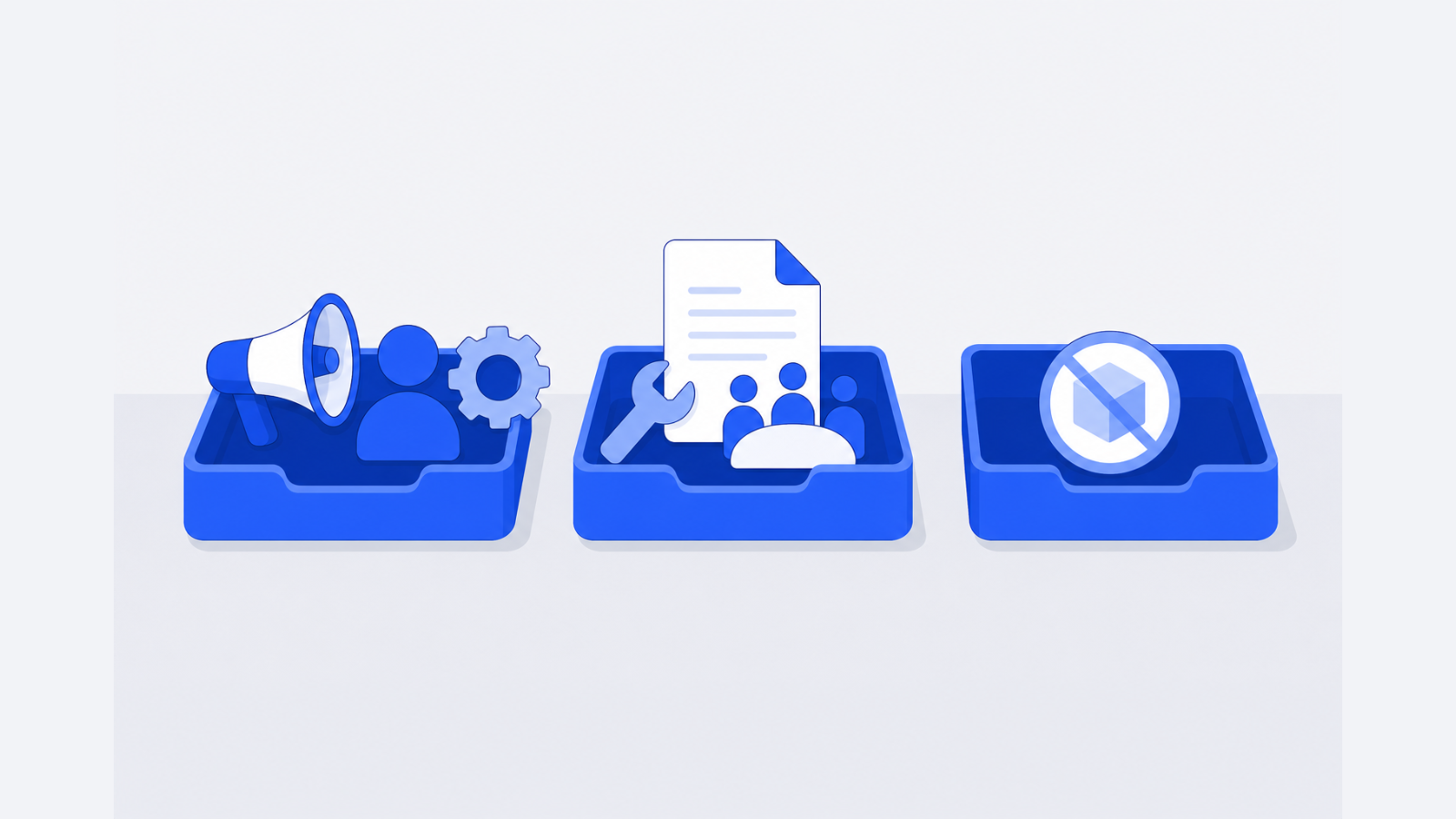
Stripe’s SaaS CAC guide, checked October 23, 2026, discusses acquisition cost categories, shared-cost allocation, timing and channel segmentation. Costs belong in this example when they support acquiring new paying customers under the documented measurement method. Some costs are included directly, some are allocated, and others are excluded because they support retention or general operations.
| Cost category | Typical treatment | Allocation note |
|---|---|---|
| Advertising spend | Include | Assign by campaign, channel, or reporting period |
| Sales and marketing salary share | Include or allocate | Use the portion tied to acquisition work |
| Sales commissions | Include | Match commissions to new business where possible |
| Marketing and sales tools | Include or allocate | Allocate shared software by users, teams, or activity |
| Agency fees | Include | Assign to the campaigns or acquisition work supported |
| Content production | Include or allocate | Include acquisition-focused work; document shared use |
| Events and sponsorships | Include or allocate | Assign costs to the event and its defined customer set |
| General overhead | Optional | Include only a documented share of acquisition overhead |
| Customer success and support | Usually exclude | Include only if the work is part of acquiring customers |
| Retention campaigns | Exclude | These support existing customers rather than new acquisition |
| Product development | Usually exclude | Include only under a clearly defined acquisition costing method |
| Taxes, financing, and unrelated administration | Exclude | Keep non-acquisition costs outside the numerator |
Prevent double-counting
Check that the same cost is not included in multiple categories. For example, an agency invoice should not be counted once as an agency fee and again as content production.
What does a worked CAC example look like for a B2B company?
A hypothetical B2B company spends $20,000 during one quarter and acquires 50 new paying customers. Its CAC is $400.
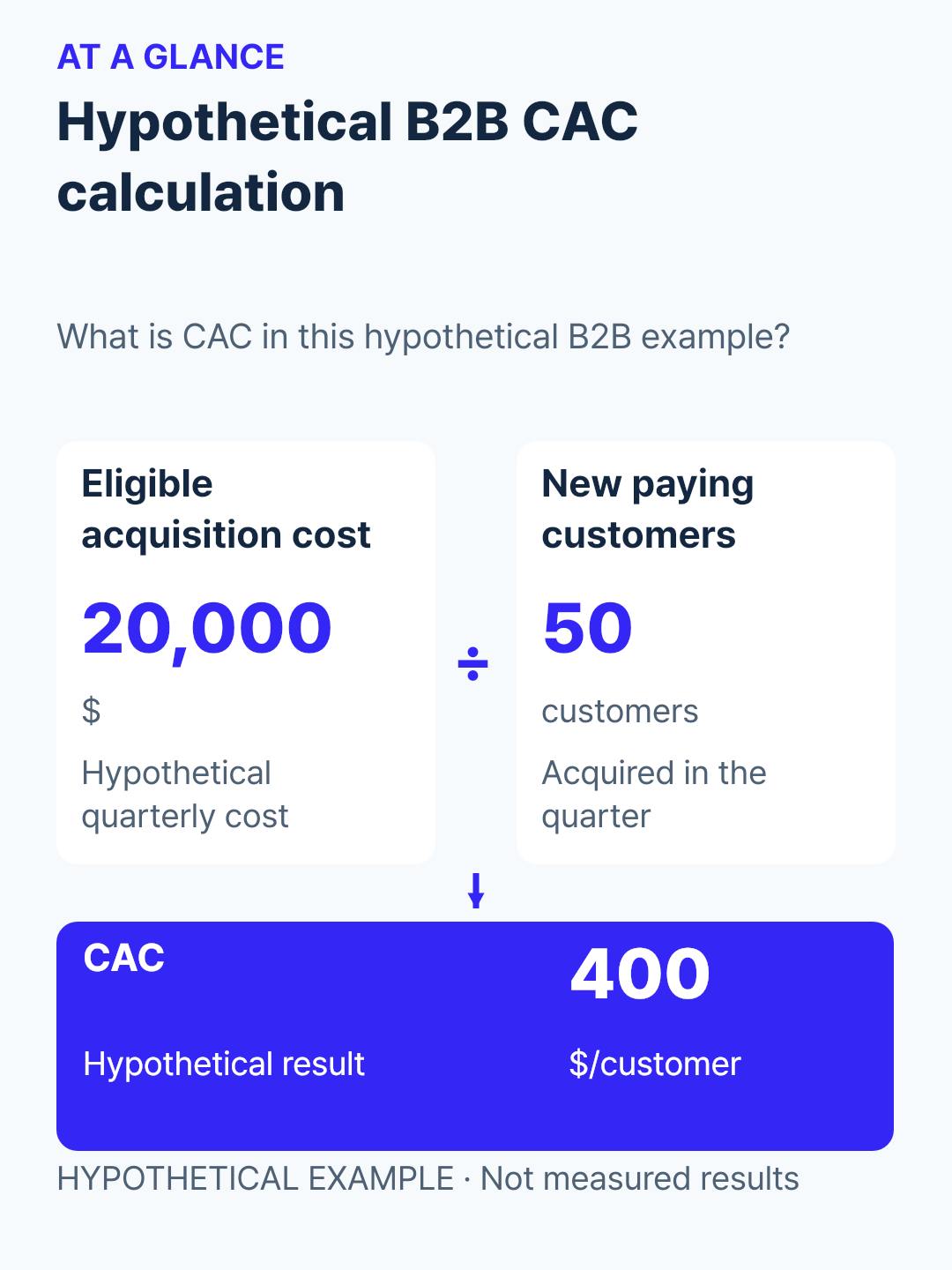
Here is the itemized calculation:
| Item | Hypothetical cost |
|---|---|
| Paid advertising | $8,000 |
| Sales salary share | $6,000 |
| Marketing and sales tools | $2,000 |
| Acquisition-focused content | $3,000 |
| Event allocation | $1,000 |
| Total eligible cost | $20,000 |
| New paying customers | 50 |
| CAC | $20,000 ÷ 50 = $400 |
Now assume the company’s sales cycle is longer than one quarter. Some of the $20,000 spent in the quarter may produce customers during the following quarter. A lagged calculation could use:
- Costs from January through March: $20,000
- Customers from April through June attributed to those efforts: 40
- Lagged CAC: $20,000 ÷ 40 = $500
Blended and channel CAC in the same example
Suppose the 50 hypothetical customers came from two channels:
| Channel | Hypothetical allocated cost | New customers | Channel CAC |
|---|---|---|---|
| Paid advertising | $8,000 | 10 | $800 |
| Other acquisition activity | $12,000 | 40 | $300 |
| Total | $20,000 | 50 | Blended CAC: $400 |
Here, every dollar and customer is assigned once. The customer-weighted result is ($800 × 10 + $300 × 40) ÷ 50 = $400. An unweighted average of the two channel CAC values would be $550 and would misstate the blended result.
How does CAC compare with LTV and payback period?
CAC measures acquisition cost. Lifetime value, or LTV, estimates the value generated by a customer over the relevant customer lifetime. Payback period measures how long it takes to recover CAC through customer-generated value.
Keep the units consistent. If CAC uses dollars per customer, LTV should also use dollars per customer. If you compare CAC with contribution margin, use contribution margin for the value side rather than mixing it with revenue without explanation.
Revenue-based LTV uses customer revenue. Contribution-margin LTV subtracts the variable costs required to serve that revenue. The second measure can be more conservative, but the chosen basis must be stated.
A simplified version of the margin-based payback calculation, checked October 23, 2026, is:
Payback period = CAC ÷ monthly contribution margin per customer
For example, with a $400 CAC and $100 in monthly contribution margin, the payback period is four months.
Do not rely on a universal CAC-to-LTV benchmark without a cited source, date, industry, and measurement method. A ratio can look attractive while hiding poor retention, high service costs, or inconsistent definitions.
Use the following distinctions when interpreting the result:
| Interpretation point | Working rule |
|---|---|
| Target CAC | Choose a target against your margin, retention and funding constraints; there is no universal target here. |
| CAC versus CPA | Specify the counted event: a paying customer is different from a lead or another action. |
| Reporting cadence | Use a consistent window and state any sales-cycle lag. |
| Shared salaries and tools | Assign an acquisition-related share using a documented method. |
Keep a reconciliation log with the source invoice or payroll record, acquisition share, time period, assigned channel and reviewer. If a source changes, record both the prior and corrected amount. This makes a trend reproducible: another analyst should be able to reconstruct the numerator and customer count without guessing which spreadsheet version was used. If costs are moved between channels, preserve the total and explain the reclassification separately from a genuine spending change.
Make CAC a consistent operating measure
CAC becomes more useful when every result carries its assumptions. Record the period, eligible costs, customer definition, attribution rule, lag method, and allocation choices alongside the final number.

Frequently Asked Questions
How to calculate CAC from a basic sales and marketing budget?
The simplest method is to divide eligible sales and marketing costs by new paying customers. Use the same period and customer definition for both inputs.
How to calculate CAC for a longer B2B sales cycle?
Use a longer period or match acquisition costs with the later customers they influenced. Label the lag method and apply it consistently.
Can calculating CAC include sales salaries and marketing tools?
Yes, the acquisition-related share of salaries and tools can be included. Allocate shared costs consistently and avoid counting them twice.
How to calculate CAC for one marketing channel?
Divide that channel’s eligible costs by the new paying customers attributed to it. State the attribution rule before comparing channel results.
How is calculating CAC different from calculating CPA?
CAC measures the cost of gaining a paying customer. CPA may measure the cost of a broader action, such as a lead or registration.
Should CAC use revenue or contribution margin when comparing it with LTV?
CAC itself is a cost per customer, while LTV can use revenue or contribution margin. Keep the units consistent and state which value basis you use.