
Gift card platform fees deserve the same scrutiny as any other purchase, and I think that’s fair. You compare prices for a new shirt or a first house to get the best value. When you buy for your company, your finance team pushes even harder to keep costs down.
How much does a typical gift card platform charge in fees? Gift card platform fees fall into six categories: platform or subscription, per card or order, funding method, cash-out, the card issuer’s terms, and currency. Which ones apply, and who pays them, varies by provider, so compare them line by line, as in our side-by-side comparison of reward platforms.
What gift card platform fees should finance compare?
Finance should compare six fee categories and note who pays each one: your company or the recipient. A platform can charge nothing in one category and a percentage in another. So one headline price on a pricing page doesn’t settle the comparison.
| Fee category | Where the cost shows up | Ask the provider |
|---|---|---|
| Platform or subscription | A monthly, annual, or setup charge to use the platform | Is there a subscription, setup, or contract fee? |
| Per card or per order | A fixed charge on certain products or actions | Which products or actions, such as resends, carry a per-card fee? |
| Funding method | A percentage added to credit card deposits | What does card funding cost, and is ACH or wire free? |
| Cash-out | A percentage when recipients take PayPal, Venmo, or a bank transfer | What is the fee, and does the sender or the recipient pay it? |
| Issuer card terms | Inactivity, purchase, or other fees set by the card’s issuer | Which fees do the card’s own terms list? |
| Currency | Conversion when the reward currency differs from your funding currency | Which exchange rate applies, and when is it set? |
Platforms that send rewards and software for selling your own store’s gift cards to customers are different purchases, so compare like with like.
Do gift card platforms charge subscription or per-card fees?
None of the reward platforms in our comparison charges a subscription fee or sets a minimum order. Per-card fees do appear, but on specific products or actions rather than on every reward.
Examples from that comparison include physical prepaid cards, prepaid cards issued in other currencies, expiring reward links, and resending or canceling a reward. So read the fee list for the products you plan to send.
Some platforms also offer custom terms for larger programs. Ask what annual volume qualifies and whether custom terms change the funding or cash-out rates.
Does funding by credit card cost more than ACH or wire?
Yes, reward platforms typically add a percentage fee to credit card deposits. Ask each provider whether ACH or wire funding is free, and how long it takes.
Payment processors price the two methods differently, too. As of November 2026, Stripe’s published US pricing lists 2.9% plus 30¢ per domestic card charge, against 0.8% for ACH Direct Debit, capped at $5.
As of November 2026, Nacha’s guide to how ACH payments work says ACH credits settle within two banking days, often sooner. Ask each provider when a deposit reaches your balance, since that date sets your earliest send.
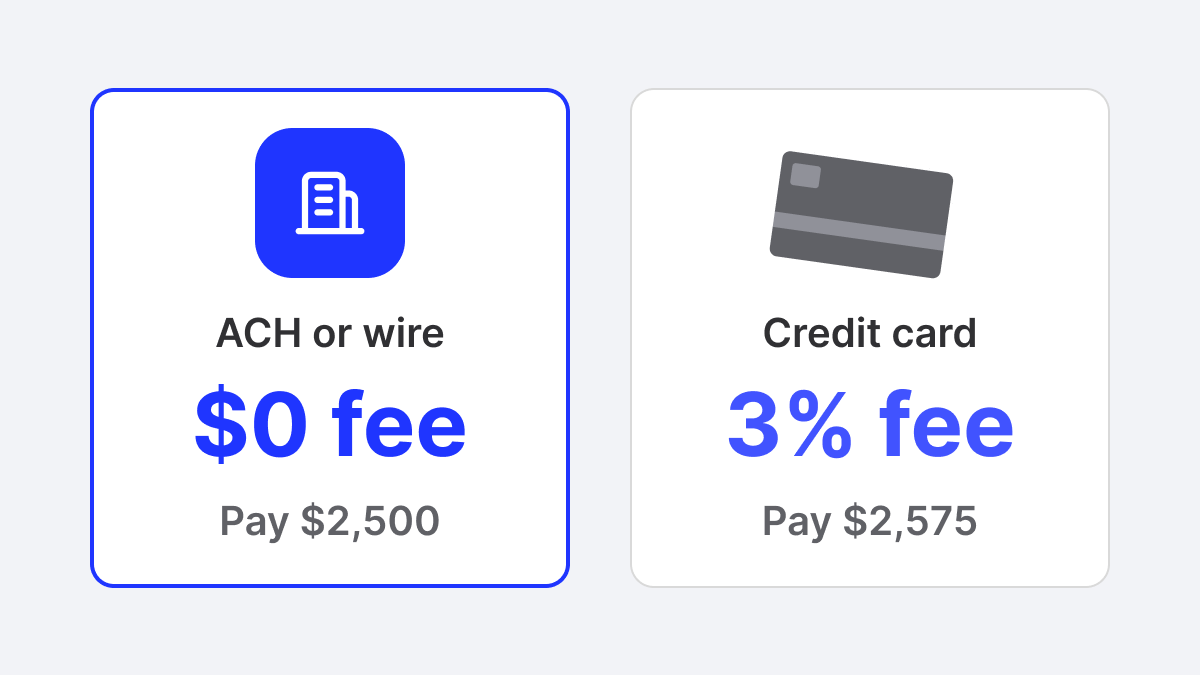
Take a $2,500 reward balance and an illustrative 3% card funding fee. A card deposit costs $2,575, while a free ACH or wire deposit costs $2,500. Separate bank charges are outside this calculation.

Who pays the fee when recipients take cash?
Cash-out options such as PayPal, Venmo, or a bank transfer carry a percentage fee on some reward platforms. Who pays it depends on the platform and the setting you choose.
On some platforms, the sender absorbs the fee; on others, it comes out of the recipient’s reward. In our comparison, platforms that let you pass the fee to the recipient charge a higher rate when the recipient pays.
Ask two follow-up questions before you approve. If the sender pays, is the fee charged only on recipients who cash out, or on every recipient with the option? And can you turn cash-out off for a single order?
Which fees come from the card issuer or the currency?
Card-level fees come from the card’s issuer and sit in the card’s own terms, separate from the platform’s fees. Check them for every product in the order.
The CFPB’s Regulation E gift card rules, in place since August 2010, limit inactivity fees on US store gift cards and general-use prepaid cards. Such a fee is allowed only after a year without use, at most once a month, and only if the card states it.
Under the same 2010 rules, loyalty, award, and promotional cards fall outside those limits. They must still state any fees on or with the card. So read each reward card’s own fee disclosure instead of assuming the limits apply.
Every card has its own fee rules. For card-level detail, see our guides to Visa gift card fees and Amex gift card fees.
Currency adds two more questions. If you send a reward in a currency other than the one you fund in, ask which exchange rate applies and when it’s set. And global prepaid cards can charge a fee when the recipient spends in another currency, so check the card’s terms.
How do Giftronaut’s fees compare on the same criteria?
Giftronaut charges no platform, subscription, or per-card fee. Its own charges are a 3% fee on credit card deposits and a fee on Payout Options, when recipients can take cash.
| Criterion | What applies | Who pays |
|---|---|---|
| Platform or subscription | None | No one |
| Per card or per order | None; no per-user or per-order fees | No one |
| Funding method | 3% on credit card deposits; ACH and wire free; $100 minimum deposit | Sender |
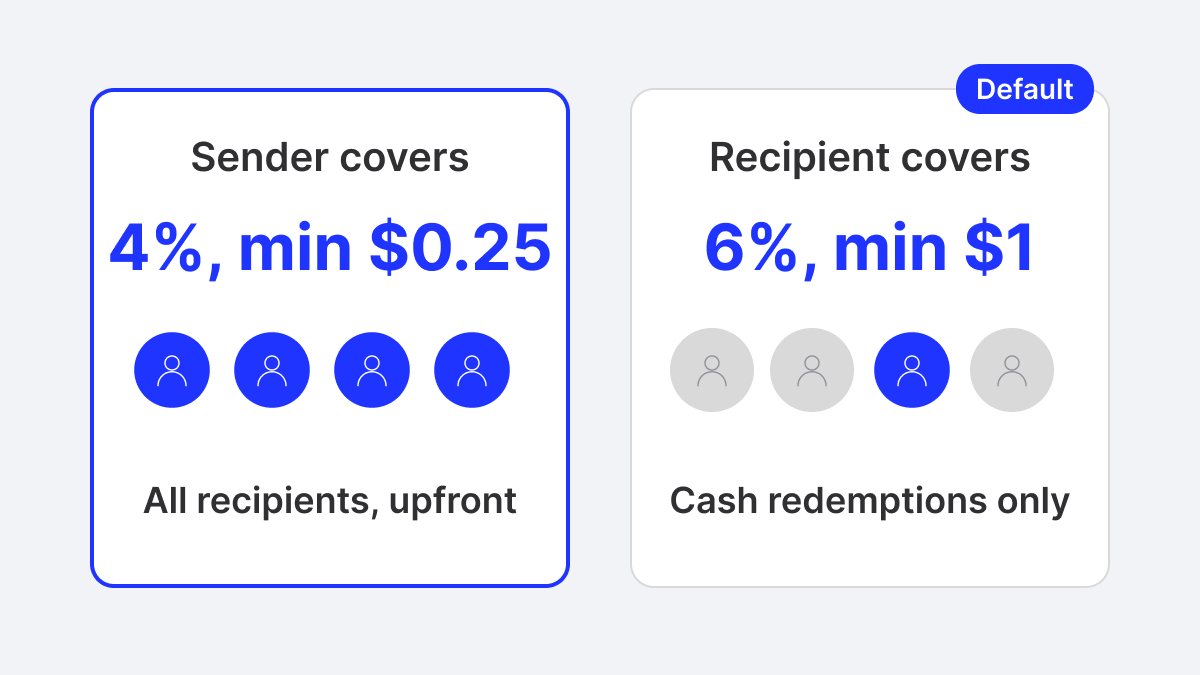
| Cash-out | Payout Options: 4% (minimum $0.25) or 6% (minimum $1) | Recipient by default, or sender on request |
| Issuer card terms | Set by each card’s issuer | Depends on the card |
| Currency | Account funded in USD; a reward sent in another currency is fixed to a USD value at the send-time rate | Sender, in USD |
Payout Options let recipients take a reward as cash through PayPal or Venmo (Venmo is US only). To have your company cover the fee, ask support@giftronaut.com to turn on sender-covered fees.
On a sender-paid Choice Card, the fee is charged for every recipient at order, including those who pick a standard gift card. Picture 100 recipients receiving $50 each. Sender coverage adds $200, or $2 per recipient. With recipient coverage, someone who takes cash receives $47, and someone who picks a gift card keeps $50.
ACH typically takes 2 to 3 business days and wire 1 business day, counted from the day your bank sends the payment. Card deposits are typically near instant during US business hours.
For recipients in several countries, a Choice Card lets each recipient pick a brand and one of 51 currencies at redemption.
What should a gift card fee approval worksheet include?
Keep face value, funding, payout, and product review in separate fields on your worksheet. Then the sheet shows the total budget and who pays each charge.
| Worksheet field | What to record | Why it matters |
|---|---|---|
| Reward value | Face value per recipient and total | Separates rewards from fees |
| Funding | Method, fee, and expected availability | Shows the sender’s deposit cost |
| Payout | Enabled status, rate, minimum, and payer | Shows when a recipient charge can occur |
| Product | Product, country, currency, and terms | Prevents broad fee assumptions |
Fill the product row for each card in the order. Name the product, recipient country, denomination, and currency, then check any stated spending, validity, or transaction fees. Note whether those terms change your budget or the recipient’s usable value.
Ask every provider the questions from the first table, and record the answers in these fields. If you can’t find a product’s current terms, pause the approval instead of assuming they match other cards.
To connect the approval sheet to a recipient list, use the bulk sending workflow.
Approve the cost before funding
Start the approval total with reward face value. Add the funding fee for your payment method, then any cash-out fees your company covers. Keep issuer card terms and currency on their own lines.
Put every provider’s answers on that sheet, and nothing beyond face value comes as a surprise. Then you’re ready to fund the account.

Frequently Asked Questions
Do gift card platforms charge per user?
It varies by platform, but none of the reward platforms in our comparison list a per-user or per-seat fee. Their charges sit in card funding, cash-out options, and specific products instead. Giftronaut has no per-user or per-order fees.
What are the fees on gift cards?
Gift cards can carry two layers of fees. The platform charges for funding, cash-out, or certain products, and the issuer sets card-level fees in the card’s own terms. Check both before you approve an order.
Are there any fees for sending virtual gift cards?
Yes, card funding fees, cash-out fees, and the card issuer’s own fees can all apply. Ask each provider for its fee list for the products you plan to send.
Is there a minimum deposit to fund a gift card platform account?
A minimum deposit is separate from a minimum order, and none of the reward platforms in our comparison lists a minimum order. Giftronaut’s minimum deposit is $100, by credit card or by ACH or wire.
Can I disable Payout Options on a Choice Card order?
Yes, leave Payout Options disabled when you create the order, and the cash route isn’t offered. With Payout Options off, no Payout Options fee applies.
How long should finance allow for ACH or wire funding before sending rewards?
As of November 2026, Nacha says ACH credits settle the same day, the next banking day, or in two banking days. Add the platform’s own processing time, and ask each provider for it.