Fake job applicants are reaching interviews at most companies now. In Checkr’s October 2026 survey of 3,000 US managers involved in hiring, 40% had interviewed a candidate later revealed to be using a fake identity, up from 31% in 2025.
Most are caught the same way: the face, voice, address, or work history stops matching from one hiring stage to the next. This guide covers 12 checks that cost nothing, when to verify identity, how to stay within the law, and who to call.
How do you spot fake job applicants?
You spot fake job applicants by checking that the person, their documents, and their history line up at every stage. One mismatch is a reason to look closer, and several together are the warning sign. Verify each claim through contacts you find yourself.
The FBI’s October 2026 alert on North Korean IT workers makes the same point. It says these workers “cannot be identified reliably with a single indicator.”
It isn’t only an IT hiring problem. The FBI’s 2022 alert named remote roles with access to financial data, and a May 2022 State, Treasury, and FBI advisory describes fake hires who charged a US company over $50,000 in 30 small payments that nobody noticed. The same checks work for an accounts payable clerk as for a developer.
From a polished resume to a stolen identity
Not every misleading application is candidate fraud. Sort what you see into four rungs, from least to most serious:
- AI-polished resume. A real person had help with the writing. That alone isn’t fraud.
- Embellished history. A real person stretches titles, dates, or skills. In Checkr’s 2026 survey, 65% of managers had uncovered a candidate who misrepresented skills or experience.
- Proxy or deepfake interview. Someone else, or altered video, stands in for the applicant on the call.
- Stolen or borrowed identity. The identity on the application belongs to another person. The FBI’s 2026 alert says most names and addresses North Korean IT workers give employers come from stolen identities. Some pay real people to use theirs.
Rungs 1 and 2 are about honesty. Rungs 3 and 4 are about identity.
How to cut fake applications before they reach your calendar
Add small hurdles that real applicants clear easily and bulk applicants skip. Ask role-specific screener questions, and check each new application against your own records before you book a call.
Indeed’s April 2026 employer guide says fake applicants tend to skip or poorly answer job-specific questions. So ask one that only a person with the experience can answer well. For an AP role, try: “Walk me through the last vendor payment you stopped, and why.”
Next, check your own records. The FBI’s January 2025 alert advises cross-checking HR systems for other applicants with the same resume content or contact details. It also notes phone numbers, especially voice-over-IP numbers, and emails reused on resumes under different names.
Where candidates come from matters too. A referred candidate comes with a coworker who already knows them. Referrals shift more of your pipeline toward people someone can vouch for.

12 free checks at each hiring stage
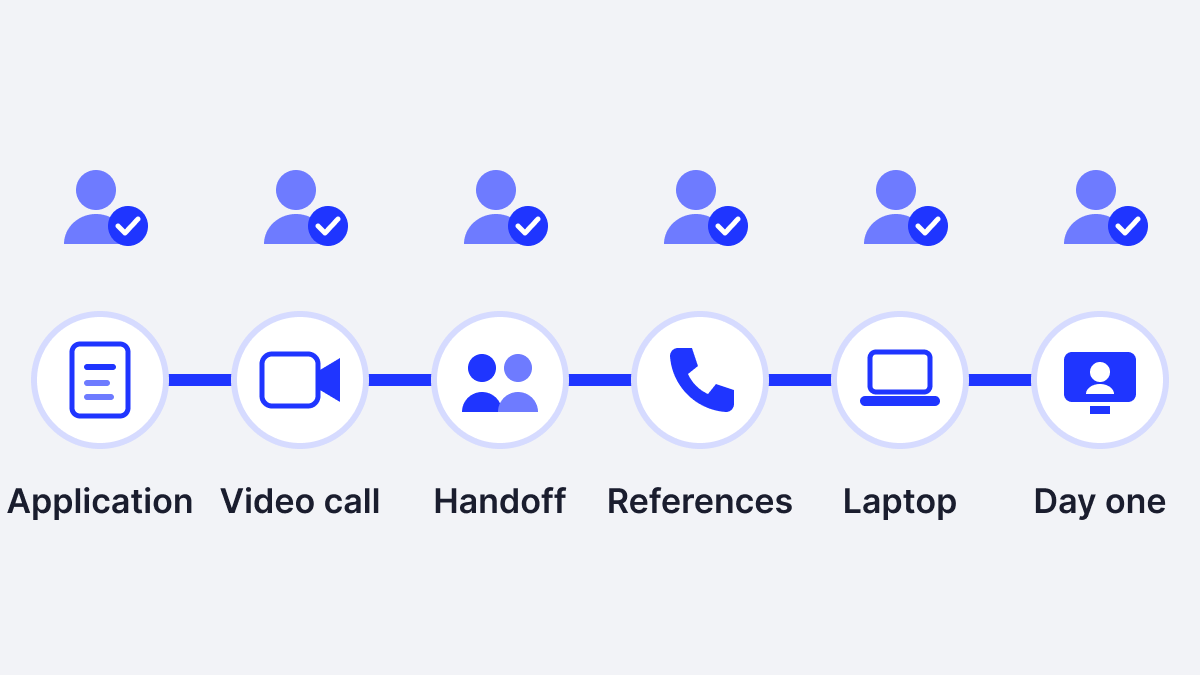
Run two or three free checks at each stage, and write down what you see. A mismatch means more when you can compare it with the next stage.
| Stage | Free check | What a fail looks like |
|---|---|---|
| Application | 1. Compare the resume with public profiles | Titles, dates, or employers differ, or profiles show different photos |
| Application | 2. Reverse image search the headshot | The same face appears under another name |
| Application | 3. Search your records and the web for duplicates | Another applicant shares the resume text, phone number, or email |
| Application | 4. Look for the same person across your open roles | Many applications in a short time, including roles that don’t fit |
| Phone screen and video | 5. Camera on, blur off, a question about location | Camera refused, or location answers don’t match the ID or resume |
| Video call | 6. Watch lip sync and ask for a hand wave | Lips and audio drift apart, or a cough doesn’t match the picture |
| Every round | 7. Take a screenshot and compare faces | A different face at a later round or on day one |
| Every round | 8. Compare voice and writing across stages | The phone voice and video voice differ, or the writing doesn’t match |
| References | 9. Verify employers and schools through contacts you find | The employer or school has no record of the person |
| Offer | 10. Ship equipment only to the ID address | A request for another address without documents, or a freight forwarder |
| First weeks | 11. Access only after the background check, then only what tasks need | Remote-access software on the laptop, or logins from several countries |
| Payroll | 12. Verify bank details for direct deposit | Bank details match another employee’s, change often, or pay in crypto is requested |
Red flags on the resume and application
The FBI’s July 2025 guidance says to cross-reference photos and contact details with social media profiles, portfolio sites, and payment platforms.
- Profile match. Put the resume next to the public profiles and compare titles, dates, and employers. An old profile isn’t proof either. The FBI’s October 2026 alert says North Korean IT workers pay to use real people’s accounts with years of history.
- Reverse image search. Run the headshot through any free reverse image search. If the same face appears under another name, ask about it before the first call.
- Duplicate search. Search your applicant tracking system for the resume’s phone number, email, and one unusual sentence. Paste that sentence into a web search too.
- Same person, several roles. Filter your applicants by name, email, and phone across open roles. Indeed’s April 2026 guide flags many applications to one company in a short time, especially for roles that don’t fit.
Red flags on the phone screen and first video call
Turn the first video call into a quiet location check. Ask every candidate the same way, so no one feels singled out.
- Location check. The FBI’s July 2025 guidance suggests having the candidate point the camera out a window. Its January 2025 alert adds “soft” questions about location or education.
Try this line: “We ask everyone this. Can you turn off the background blur and show us the view out your window?” Then ask about the area on their resume, like their commute. Flag an answer that doesn’t match the ID or resume, whatever the accent.
Deepfake and proxy checks on video
Proxies and deepfakes are common now. In Checkr’s 2026 survey, 67% of managers had encountered an interview proxy, and 38% reported AI-generated or deepfake interview content in the past year.
- Deepfake check. Watch whether lip movements match the audio, and whether a cough or sneeze lines up with the picture, signs the FBI described in 2022. Then ask the candidate to wave a hand in front of their face, which the FBI’s July 2025 guidance says can make AI-generated video glitch.
A clean wave proves nothing on its own, so treat it as one signal.
Handoffs between interviewers
Sometimes one person passes the interview and another does the job. The FBI’s July 2025 guidance warns of exactly that and recommends capturing images to compare with later meetings.
- Same face every round. Take a screenshot at each interview, and tell candidates you do this for everyone. On day one, have someone who interviewed the hire join the first video call. A soft handoff helps too: the recruiter stays on for the first minutes of the hiring manager’s call.
- Same voice and writing. Compare the phone-screen voice with the video voice, and a written task with the cover letter. Checkr’s 2026 survey gives written messages that don’t match the person on the call as one sign of suspected AI misrepresentation.
References and past employers
- Independent verification. Verify past employers and schools directly, as the FBI’s July 2025 guidance advises. Find the phone number yourself on the company’s website or in a business directory. Skip the one on the resume.
Ask HR or payroll at the employer: “Can you confirm this person worked there, and the dates?”
Offer, laptop shipping, and day one
- Ship to the ID address. The FBI’s July 2025 guidance says to ship a laptop only to the address on the employee’s ID documents. A request for any other address needs more documentation. The FBI’s October 2026 alert describes “laptop farms,” homes where paid helpers keep work devices online for remote workers.
- Access after the background check. Grant no system access until the background check is complete, per the same 2025 guidance. Then give only what the first tasks need, the principle of least privilege the FBI’s January 2025 alert recommends.
- Payroll check. For direct deposit, ask for a voided check or a letter from the bank, as the FBI’s October 2023 update suggests. Confirm the routing number belongs to a real bank. Flag bank details that match another employee’s, frequent bank changes, or requests for pay in virtual currency. The FBI’s July 2025 guidance names all three.
When should you verify a candidate’s identity?
Verify identity before the first live interview and again at the final round. Most companies check later than that.
In Checkr’s 2026 survey of US managers, only 29% of companies verify identity as soon as someone applies. Another 49% wait until after at least one live interview, and 18% until the final interview or later. By then, Checkr notes, a fake has often cleared the stages where hiring managers pay the closest attention.
The FBI’s January 2025 alert recommends identity checks during interviewing, onboarding, and throughout employment. Its October 2026 alert adds that E-Verify and live verification raise friction for North Korean IT workers.
If the role allows it, meet in person once. The FBI’s January 2025 alert advises completing as much of hiring and onboarding in person as possible. A refusal alone is only one signal.
A paid identity-verification tool earns its cost when you fill many remote roles or keep seeing incidents. Check biometric rules first.
Can you check I-9 documents remotely?
You can, but only if your company uses E-Verify and is in good standing. USCIS guidance, last updated in September 2025, lets those employers examine copies first. A live video call follows, where the employee shows the same documents.
You keep clear copies and tick the alternative procedure box on Form I-9. If you offer remote examination at a hiring site, offer it to every employee there, or to remote hires only, without a discriminatory purpose.
Without E-Verify, the remote option isn’t open to you, and physical document examination applies.
How to run these checks fairly and legally
Use one written script and run the same checks on every candidate at a stage. Flag facts that don’t match, and leave accents and origin out of it. Get written consent for background reports, and check biometric rules before any face-matching tool.
The EEOC and FTC’s 2014 joint guidance for employers says to treat everyone equally when checking backgrounds. Asking only people of a certain race about their records, for example, is evidence of discrimination.
For reports from a background-check company, the same 2014 guidance lists the Fair Credit Reporting Act steps. Give a written, stand-alone notice and get written permission first. Before rejecting someone based on the report, send them a copy of it and a summary of their rights.
Biometric tools add another layer. In Illinois, Section 15(b) of the Biometric Information Privacy Act requires written notice and a signed release before a company collects a biometric identifier. The notice must state the purpose and how long the data is collected, stored, and used.
Recording an interview has its own rules. Federal wiretap law allows a recording when one party to the call consents. California’s Penal Code requires the consent of all parties to a confidential conversation. So tell candidates before you record, and check your state’s rules with employment counsel.
The FBI’s October 2026 alert warns that aggressive controls carry “unusually high risks” of false positives that harm real employees and filter out qualified applicants. It calls name filtering and ban lists unreliable, and says they can hurt identity-theft victims.
So hand every interviewer the same script, and ask them not to invent tests on the call.
What isn’t a red flag on its own
The FBI’s October 2026 alert notes that fake-worker signals overlap heavily with legitimate remote work. None of these points to fraud by itself:
- An accent, a name, or a country of origin.
- A degree from a school outside the US.
- A typo or two. Indeed’s 2026 guide notes that some genuine candidates make minor mistakes.
- A resume polished with AI writing help.
- No LinkedIn profile, or a sparse one.
- One dropped connection or a frozen camera.
Red flags that stack up: who to escalate to
Escalate fake job applicants to your HR lead and employment counsel, and to your local FBI field office when signs of an organized scheme appear. One red flag means look closer. When several stack up and a candidate looks fraudulent, hand the case to its owner.
| Situation | Who to contact | What to send or do |
|---|---|---|
| ID, documents, or face don’t match, or a proxy is suspected | Your HR lead and employment counsel | Your stage notes and screenshots. If a background report is involved, follow the FCRA steps in the EEOC and FTC’s 2014 guidance. |
| Signs of an organized scheme: a new shipping address, remote-access tools, or another person on camera | Your local FBI field office, plus a complaint at IC3 | Per the FBI’s October 2026 alert: addresses that received a device, names, phone numbers, emails, bank accounts, IP addresses, profile links, images, and messages. |
| The candidate came through a staffing firm | The staffing firm | Ask for documentation of its background check process. The FBI’s October 2023 update says that if a firm can’t provide it, assume no check was done and run your own. |
| The applicant came through a job board | The board’s report channel | On Indeed, use the Employer Support form and list the red flags you saw, per Indeed’s April 2026 guide. |
| The person already has system access | IT, first | Limit access and preserve logs before anyone else acts. |
Keep every note, even when you don’t hire. The EEOC and FTC’s 2014 guidance says to keep hiring records for one year after they’re made or after a personnel action, whichever is later.
What to do if a fake applicant already got hired
Secure access first, then decide and report. Don’t confront the person until IT has cut access and saved the logs. The FBI’s January 2025 alert describes workers who, once discovered, held stolen data for ransom.
- Cut access and preserve evidence. The ABA Litigation Section’s March 2026 guidance lists suspending system, email, and app access, then preserving logs, system snapshots, and HR files.
- Get devices back. Ask for every company-issued device, badge, and credential, remote employees included, as the same ABA guidance advises.
- Bring in your HR lead and employment counsel. If anything points to North Korean IT workers, ask counsel about sanctions exposure. The May 2022 State, Treasury, and FBI advisory warns of legal consequences, including sanctions, for supporting this activity or processing related financial transactions.
- Report it. Contact your local FBI field office and file an IC3 complaint with the names, addresses, accounts, and messages you collected.
- Plan for pressure. The FBI’s October 2026 alert reports death threats against former managers and their families after termination. If anyone receives a threat to life, call 911.
Set up your checks before the next req opens
Fake job applicants rarely give themselves away in one moment. They show up as a voice that changed between rounds or an address that moved after the offer.
Before your next role opens, name your escalation contacts and give every interviewer the same script and the 12 checks above. Then the next mismatch reaches the right person before an offer goes out.

Frequently Asked Questions
How common are fake job applicants?
They’re common. In Checkr’s survey of 3,000 US managers involved in hiring, 40% had interviewed a candidate later revealed to be using a fake identity. And 86% said their organization saw at least one type of hiring fraud in the past year.
Can a fake applicant pass a background check?
It can happen. The FBI reports that North Korean IT workers buy accounts with identity verification providers to check that stolen personal details will pass employment background checks. So pair the background check with face, voice, and reference checks across rounds.
Is it legal to ask a candidate to show ID on a video call?
The FBI recommends having candidates hold their ID up to the camera, but that’s security guidance and doesn’t settle the legal question. The EEOC and FTC’s guidance on background checks says to treat everyone equally. Face-matching software or a recording brings in state rules, like Illinois’s biometric privacy law or California’s all-party consent rule, so ask employment counsel first.
What is a proxy interview?
A proxy interview is when someone other than the actual candidate attends the interview. In Checkr’s survey, 67% of US managers had encountered one, and 34% had confirmed it. Taking a screenshot at each round and comparing faces is the free way to catch it.
How can you identify a fake candidate in a video interview?
Watch whether the face and the audio line up, and compare screenshots across rounds. The FBI describes lip movements that don’t match the speech and coughs out of sync with the picture. A hand wave can make AI video glitch, but a clean wave proves nothing on its own.
How do I report fake job applicants on Indeed or other job boards?
Report it through Indeed’s Employer Support or another board’s help center, and list the red flags and the applicant’s details. If the case looks like an organized scheme, also contact your local FBI field office and file a complaint at IC3. Job seekers checking whether a posting is real can use the FTC’s job scam advice.
Do AI-written resumes mean the applicant is fake?
Not on their own. A resume polished with AI writing help can belong to a real person, and that alone isn’t fraud. Fake applicants show up as identity mismatches across stages, like a face, voice, or address that doesn’t line up.