
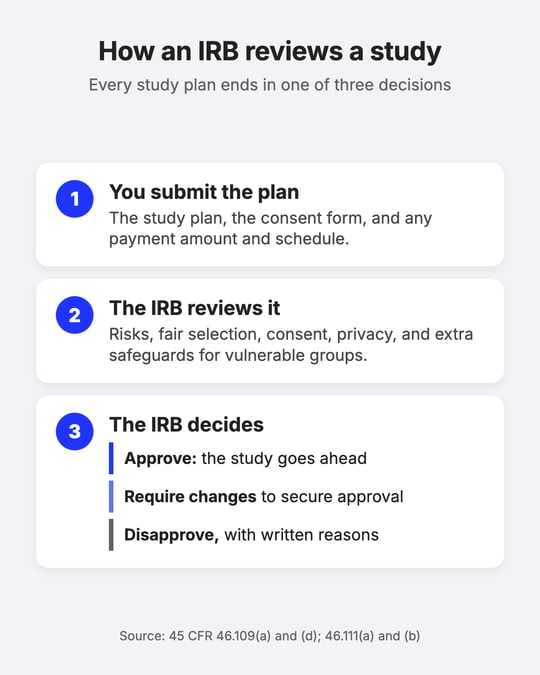
An institutional review board (IRB) is a committee that reviews research involving people before it starts, to protect the rights and welfare of the participants. It can approve a study, require changes before it approves it, or turn it down.
Before anyone moves into a new building, an inspector reads the plans. The inspector isn’t judging the architecture. They’re asking whether the people who will live there will be safe. An IRB does the same job for research: it reads the plan before the first participant is recruited, and it can send the plan back.
You may be here because a grant form, a journal or a university asked for “IRB approval” and nobody explained it. Or because you run studies at a company, want to thank participants with a gift card, and someone asked whether your IRB has signed off. Nothing here is legal advice, so your own IRB office has the final word.
What does an institutional review board do?
An institutional review board protects the people who take part in research by reviewing the study plan before anyone is recruited. FDA regulations define an IRB as “any board, committee, or other group formally designated by an institution to review, to approve the initiation of, and to conduct periodic review of, biomedical research involving human subjects”, and say the primary purpose of that review is “to assure the protection of the rights and welfare of the human subjects.”
Two sets of U.S. federal rules shape how IRBs work: FDA’s rules in 21 CFR Part 56, and the HHS policy in 45 CFR Part 46, known as the Common Rule. Under the Common Rule, an IRB has the authority to approve, require modifications in (to secure approval), or disapprove research. It has to tell the investigator in writing, and a disapproval has to come with reasons and a chance to respond.
Who sits on an institutional review board?
An IRB has at least five members with varying backgrounds, and the mix is deliberate. The Common Rule sets minimum membership in 45 CFR 46.107:
| Requirement | What the rule says |
|---|---|
| Size and mix | At least five members, with varying backgrounds to promote complete and adequate review of the research the institution commonly conducts |
| Scientific and nonscientific | At least one member whose primary concerns are in scientific areas and at least one whose primary concerns are in nonscientific areas |
| An outsider | At least one member who is not otherwise affiliated with the institution and is not part of the immediate family of someone who is |
| Conflicts of interest | No member takes part in the review of a project in which they have a conflicting interest, except to provide information the IRB requests |
The point of that mix is easy to see. A scientist can judge whether the design holds up, a nonscientist can ask whether a participant would understand the consent form, and an outside member has no stake in how the institution looks.

What does an IRB check before it approves a study?
Before approving a study, an IRB must find that risks are minimized and reasonable, participants are selected fairly, consent is sought and documented, data and privacy are protected, and vulnerable groups get extra safeguards. The Common Rule spells out each requirement:
- Risks are minimized and reasonable. Procedures don’t expose people to unnecessary risk, and the risks are reasonable compared with the expected benefits and the importance of the knowledge the study should produce.
- Selection of participants is equitable. The IRB considers the purpose of the study and the setting.
- Informed consent is sought from each prospective participant and is appropriately documented or waived.
- Data and privacy are protected. When appropriate, the plan monitors the data for participants’ safety and protects their privacy and the confidentiality of the data.
- Vulnerable groups get extra safeguards. When participants are likely to be vulnerable to coercion or undue influence, such as children, prisoners, people with impaired decision-making capacity, or economically or educationally disadvantaged people, the study needs additional protections.
That last item is where incentives enter the picture, because a payment can push on someone’s decision to take part.
Does your study need IRB review?
A survey needs IRB review only if it counts as research, and plenty of business surveys don’t. The Common Rule defines research as a systematic investigation “designed to develop or contribute to generalizable knowledge”.
Take a support team that sends a quarterly satisfaction survey to improve its own service. That’s an internal quality check, not an attempt to produce generalizable knowledge, so it likely falls outside the definition. Now picture a university lab surveying 300 of those customers to publish a paper on loyalty. That’s research, and the IRB conversation starts.
Some survey research can be exempt, for example when the information is recorded so that participants’ identities can’t readily be ascertained. But exempt isn’t the same as unreviewed: some exemptions still require limited IRB review. Whether your project counts, and whether it’s exempt, is a call to make with your IRB office before you recruit anyone.
How does an IRB treat participant incentives?
An IRB reviews participant payments like any other part of the study, checking the amount, method and timing for coercion or undue influence. FDA’s information sheet on payment to research subjects (January 2018) says payment for participation should be “just and fair.” It’s written for FDA-regulated research, so check what your own IRB asks for. Here’s what it says and what it means for your plan:
| What the guidance says | What it means for you |
|---|---|
| Payment is “a recruitment incentive,” not a benefit to weigh against risk | Don’t describe the gift card as a benefit of taking part |
| The amount and schedule of all payments go to the IRB at initial review | Put the payment plan in your first submission |
| The IRB reviews the amount and the method and timing of disbursement for coercion or undue influence | Be ready to explain why this amount, sent this way, doesn’t pressure anyone |
| Credit for payment accrues as the study progresses and isn’t contingent on finishing the entire study | Pay per session or task instead of holding everything until the end |
| A completion bonus must be reasonable and not so large that people stay in when they’d otherwise have withdrawn | Keep any bonus modest and justify it |
| All payment information, including amount and schedule, goes in the consent document | Write the amount, timing and how participants claim it into the consent form |
Here’s the arithmetic for one hypothetical study. Priya, a UX researcher, runs a four-week diary study with 40 participants, paying $10 per weekly entry plus a $10 bonus for finishing all four weeks. A participant who completes everything earns $50, the bonus is 20% of that, and the budget is $2,000 if all 40 finish. Is 20% reasonable? That’s the IRB’s call, and the study team is better off bringing the arithmetic to the review than having it asked for. For per-visit schedules, travel reimbursement and taxes in a trial, our guide to clinical trial payments goes further.
Payments to participants can also trigger tax reporting; the research participant 1099 threshold is $2,000 for 2026 and $2,100 for 2027.
How do Giftronaut rewards fit an IRB protocol?
Giftronaut rewards fit an IRB protocol when the protocol states how rewards are delivered, what amount is sent, what fees apply and how long participants have to claim. We’re not an IRB, and we can’t tell you what yours will accept, but here are the details to write down:
- Choose how participants receive the reward. Giftronaut typically delivers rewards by email, and the recipient confirms their address with a one-time verification. If your IRB limits the identifiers you collect, reward links are a separate order type that doesn’t require recipient details at order time. Your account rep or support has to enable them. Our guide to anonymous survey incentives walks through the choice.
- Match the amount you promised. Every product has its own minimum and maximum, and an order outside them can’t be sent. A fulfilled order can’t be canceled, returned, exchanged or refunded, although a scheduled order can be canceled until it’s sent. Check the amount against your consent form first.
- Tell participants how long they have to claim. The standard redemption window is 180 days. With the Refund Option, it shortens to 30, 60 or 90 days and appears in the recipient’s reward email. You choose it when you place the order, and only fully unredeemed rewards are refunded. Whatever you pick, put the deadline in the consent form.
- Keep the amount whole. Standard gift cards and prepaid cards carry no redemption fee unless the brand’s own terms say otherwise. Payout Options, which let a recipient take the reward as cash through services such as PayPal and Venmo, are the one type that does, and by default the recipient covers it: 6% with a minimum of $1 per recipient. If a participant picks a Payout Option, the fee comes out of their reward. You can cover it instead (4% with a $0.25 minimum per recipient) by contacting support, but on a Choice Card you then pay it for every recipient, including those who redeem a regular gift card.
- Reach participants in other countries. With a Choice Card, each participant selects their country at redemption and chooses from the rewards available there, from 4,300+ brands across 225 countries. Gift cards are country-specific, though, and access is blocked from 12 US-sanctioned countries, so a study recruiting there needs another plan.
The fee is the one that surprises people, because it works against the amount in your consent form. Here’s what it takes from a few hypothetical rewards when the participant chooses a Payout Option and the recipient covers the fee:
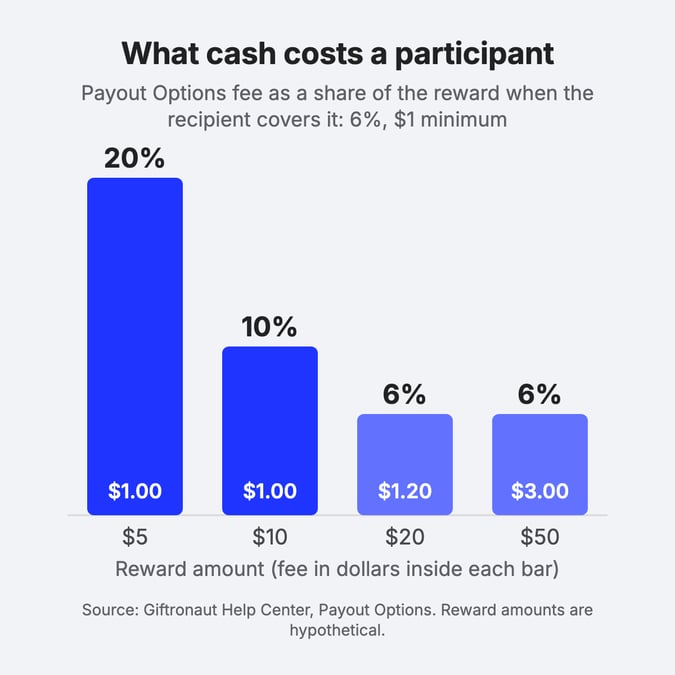
On a $5 reward, the $1 minimum takes 20%. On $10 it takes 10%, and at $20 the 6% rate applies instead, which is $1.20. If your consent form promises $10, tell participants that choosing cash can cost them $1, or cover the fee yourself, or offer gift cards only. Our post on paying research participants digitally covers the logistics, and the survey incentives guide covers what to offer.
Ask your IRB office before you buy the first gift card
Back to the inspector. Nobody resents one who reads the plans before the walls go up. The trouble starts when the inspector shows up after the building is finished.
So send your IRB the study plan and the payment plan together, before you recruit. Start with one question: does your IRB have its own guidance on participant payment? Then write down four things: the amount, the schedule, how participants receive the reward and how long they have to claim it. That’s most of what a reviewer will ask about.

Frequently Asked Questions
What is an institutional review board in plain English?
It’s a committee that reads a research plan before the study starts and decides whether the people taking part are adequately protected. Under the Common Rule it can approve a study, require changes or disapprove it.
How many people are on an institutional review board?
At least five, with varying backgrounds. The Common Rule requires at least one scientific member, one nonscientific member and one with no affiliation to the institution, in person or through immediate family.
Do you need IRB approval to run a survey?
Not always, but you shouldn’t decide that alone. The Common Rule covers research, meaning a systematic investigation designed to develop or contribute to generalizable knowledge, and some survey research is exempt. Some exemptions still involve limited IRB review, so check with your IRB office first.
Can an IRB reject a study?
Yes. Under the Common Rule an IRB can approve a study, require modifications to secure approval, or disapprove it. A disapproval comes with written reasons, and the investigator gets an opportunity to respond in person or in writing.
Does an institutional review board have to approve participant gift cards?
For FDA-regulated research, FDA guidance says the amount and schedule of all payments should go to the IRB at initial review. The IRB then reviews the amount, method and timing of disbursement for coercion or undue influence. For research outside FDA rules, follow your own IRB’s instructions and include the payment plan in your first submission anyway.
Can you pay research participants with Giftronaut gift cards?
Yes, survey and research incentives are one of the ways businesses use Giftronaut. You can send a Choice Card, where each participant picks a reward in their own country from 4,300+ brands across 225 countries, or a Branded Card. Whether your IRB accepts gift cards as payment is its decision, so put the delivery method, amount and claim deadline in your submission.
Can you send participant rewards without collecting email addresses?
Yes, with reward links. Once your account rep or support enables the Download Reward Links feature, you can order links that need no recipient details at order time. Each link is one reward, sent through your own channels, and the first person to redeem it uses it up.