
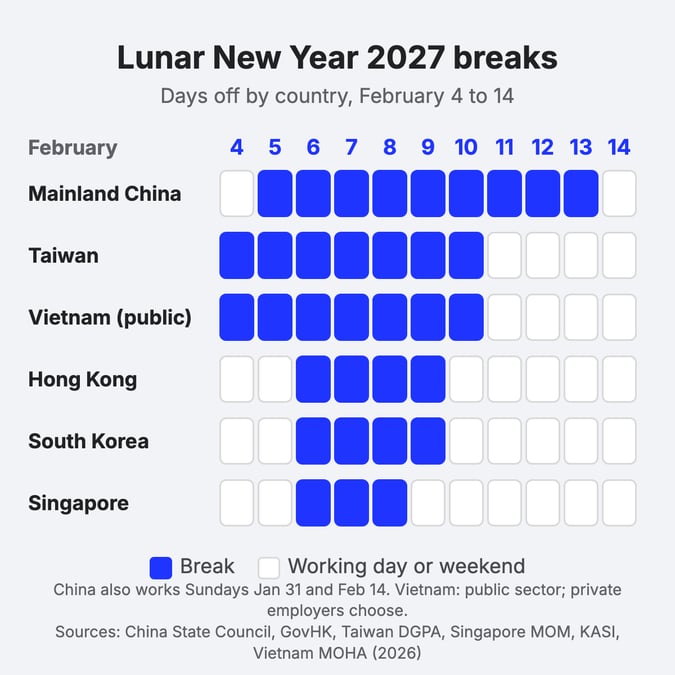
Lunar New Year 2027 falls on Saturday, February 6, and starts the Year of the Sheep (often called the Goat). The days off around it differ by country: mainland China’s break runs nine days (February 5 to 13), Taiwan’s government offices and Vietnam’s public sector take seven (February 4 to 10), South Korea four (February 6 to 9), and Hong Kong and Singapore add weekday holidays on February 8, plus February 9 in Hong Kong.
At a previous job, I sent our whole Asia team a cheerful “Happy Chinese New Year!” email, red lantern graphic and all. A colleague in Seoul replied within the hour: “Thank you! Here we call it Seollal. Our Hanoi office calls it Tết.” I had written one email for what turned out to be three holidays. She was kind enough not to mention the lantern.
Lunar New Year looks like one date on a US calendar. Across your team, it’s several holidays with different names, different days off and different customs for giving. Here’s when each office is out in 2027, how to plan work around it, and how to send gifts across several offices.
When Is Lunar New Year 2027?
Lunar New Year 2027 is on Saturday, February 6, the first day of the new lunar year on the official calendars of mainland China, Hong Kong, Taiwan, Singapore and Vietnam. Korea’s official calendar puts Seollal, its Lunar New Year’s Day, one day later, on Sunday, February 7.
The date moves every year because the festival starts with the new moon that falls between January 21 and February 20. According to Britannica, the celebrations last 15 days and end with the Lantern Festival, and young people are given money in red envelopes.
2027 is the Year of the Sheep, often translated as the Goat: in the Chinese zodiac’s fixed order of 12 animals, the Sheep follows 2026’s Horse, per Britannica’s zodiac guide. For planning, though, the date matters less than the days off. February 6 is a Saturday, and each government handled that weekend differently.
Lunar New Year 2027 Public Holidays by Country
Lunar New Year 2027 public holidays range from a long weekend in Singapore to a nine-day break in mainland China. The table shows each government’s official 2027 schedule. Several of them set the dates for public servants first and leave private employers some choice, so the sections below say who each schedule covers.
| Country or region | 2027 days off | Who it covers |
|---|---|---|
| Mainland China | February 5 to 13 (9 days) | Nationwide; Sundays January 31 and February 14 are workdays |
| Hong Kong | February 6, 8 and 9 | General and statutory holidays |
| Taiwan | February 4 to 10 (7 days) | Government offices |
| Singapore | February 6 and 7, plus Monday, February 8 | Gazetted public holidays |
| South Korea | February 6 to 9 (4 days) | Official calendar; Seollal is February 7 |
| Vietnam | February 4 to 10 (7 days) | Public sector; private employers choose |
Mainland China: nine days, plus two Sunday workdays
China’s State Council has set the 2027 Spring Festival holiday at nine days, from Friday, February 5 (Lunar New Year’s Eve), to Saturday, February 13, in its public holidays for 2027, published November 6, 2026. Part of the break is borrowed from weekends: Sunday, January 31, and Sunday, February 14, are working days, according to the full text of the State Council notice carried by Xinhua.
For a team outside China, that means a full working week (February 8 to 12) when colleagues in Shanghai or Shenzhen are away, and two Sundays when they’re at their desks. A request sent on Wednesday, February 10, will most likely sit until Sunday, February 14, when offices reopen.
Hong Kong: Saturday, Monday and Tuesday
Hong Kong’s 2027 general holidays for Lunar New Year are Saturday, February 6, Monday, February 8, and Tuesday, February 9, per GovHK. The second day of the new year falls on a Sunday, so under the Employment Ordinance the fourth day becomes a statutory holiday in its place, as the Labour Department’s 2027 list explains.
Statutory holidays apply to every employee, whatever their length of service, so private-sector staff get Monday and Tuesday off too and are back on Wednesday, February 10.
Taiwan: seven days for government offices
Taiwan’s Directorate-General of Personnel Administration (DGPA) has approved a seven-day Lunar New Year break for government offices, from Thursday, February 4, to Wednesday, February 10, 2027. The first and second days of the new year, February 6 and 7, fall on a weekend, so February 9 and 10 are make-up days off, according to the DGPA’s announcement of May 21, 2026.
The calendar applies to government agencies; private-sector holidays follow the Labor Standards Act under the Ministry of Labor’s rules, the same announcement says. Ask your Taiwan entity or partner which days it actually closes.
Singapore: two days plus Monday in lieu
Singapore’s Ministry of Manpower lists Chinese New Year on Saturday, February 6, and Sunday, February 7, 2027, with Monday, February 8, as a public holiday, in its public holidays for 2027 (June 18, 2026). MOM’s public holidays page adds the condition: February 8 is the holiday for employees whose rest day falls on February 7.
That makes Singapore the shortest break here: most teams are back on Tuesday, February 9, while Taipei and Shanghai are still away.
South Korea: Seollal, February 6 to 9
South Korea’s 2027 Seollal holiday runs four days, from Saturday, February 6, to Tuesday, February 9. Seollal covers three days (the day before, the day itself and the day after), which is February 6 to 8 on the Korea Astronomy and Space Science Institute’s 2027 calendar. Because Seollal itself lands on Sunday, February 7, Tuesday, February 9, is a substitute holiday, as the Chosun Ilbo reported from the government’s 2027 calendar announcement on June 29, 2026.
If a colleague in Seoul lists the holiday as February 7 while everyone else says February 6, both calendars are right, and the Seoul team is out from the Saturday either way.
Vietnam: Tết, February 4 to 10 for the public sector
Vietnam’s Ministry of Home Affairs has set the 2027 Tết break for civil servants and public-sector employees at seven days, from Thursday, February 4, to Wednesday, February 10: five days of Tết plus two days in lieu of the weekend. The first day of Tết Đinh Mùi is Saturday, February 6. Both come from Notice 11483/TB-BNV of October 9, 2026, as published on the government’s portal.
Private employers choose one of three ways to place their five Tết days (one day before the new year and four after, two and three, or three and two) and must tell workers at least 30 days in advance. So the dates that matter for a Vietnam team are in the notice your local entity or partner sends in early January.
United States: not a federal holiday
Lunar New Year isn’t on the US federal holiday list, so US offices stay open unless your company adds it. For other 2027 US dates, see our 2027 company holidays guide.

How Should HR Plan Around the Lunar New Year Break?
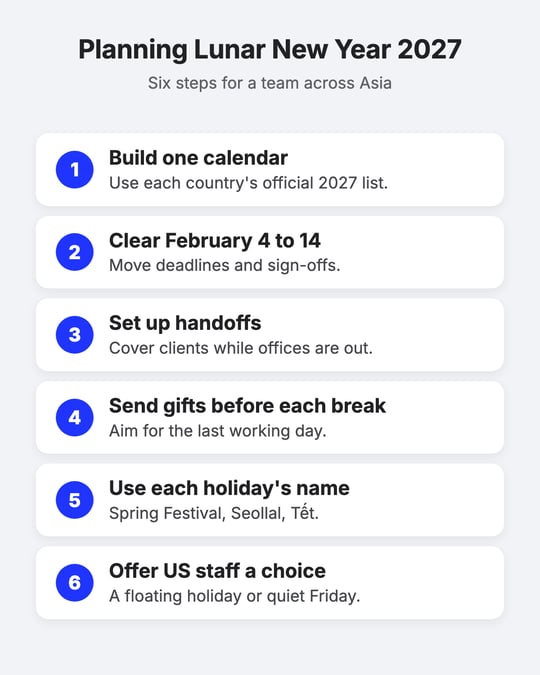
HR teams plan around the Lunar New Year break best by working from each office’s official 2027 dates, then moving deadlines, handoffs and gifts so nothing lands while people are away. Most of that planning happens in January, because three of the six breaks start before February 6 does.
- Build one calendar from the official lists. Add the dates in the table above, including China’s two make-up Sundays. For Vietnam, ask your local entity or partner which of the three Tết options it chose; the 30-day notice rule means the answer should exist by early January.
- Move deadlines out of February 4 to 14. That window covers every break in the table, plus China’s working Sunday on the 14th. Month-end close, performance reviews and launches that need sign-off from Asia belong before February 4 or from Monday, February 15.
- Set up handoffs for customers in the region. Decide who answers Hong Kong and Singapore clients on February 8 and who covers mainland China for the full nine days.
- Send gifts before the break, not during it. Aim for each office’s last working day: February 3 for Taiwan and Vietnam’s public sector, February 4 for mainland China, and February 5 for Hong Kong, Singapore and South Korea. Our guide to planning a holiday rollout across time zones and local holidays shows how to group people by send date.
- Greet each office by its own holiday name. That means Spring Festival in mainland China, Seollal in Korea, Tết in Vietnam, and Lunar or Chinese New Year in Hong Kong, Taiwan and Singapore.
- Give US colleagues who celebrate a real option. A floating holiday or a meeting-free Friday, February 5, lets them join family celebrations without spending vacation days.
It’s the same exercise as planning the December holidays, with one twist: every office marks the same new moon, yet the breaks are spread across ten days.
Lunar New Year Gift Card or Red Envelope: What Works for Employees?
A digital gift card works as a Lunar New Year gift for employees when it arrives before the holiday with a warm message. Cash in an envelope suits a manager handing it over in person. A gift card suits a team spread across several offices, where nobody shares a desk on the last day before the break.
Human Resources Online’s guide to inclusive Chinese New Year gifts makes the same case for letting people choose. It suggests gift cards for supermarkets, lifestyle retailers and e-commerce platforms, e-wallet credits, and halal-certified or vegetarian snacks, clearly labeled, for teams that span different faiths.
Lunar New Year gifts for coworkers are a different job. The same guide suggests keeping peer gifts affordable and optional, such as mandarin oranges or a handwritten note, so nobody feels pressure to give one back.
Two more checks before you choose an amount. Client gifts can run into a recipient’s own gift limit, so ask about one before you pick a value. And in the US, gift cards given to employees count as taxable wages however small, according to IRS Publication 15-B, so tell payroll before the order goes out. Outside the US, ask your local payroll provider how gifts to employees are treated.
What Should a Lunar New Year Message to Employees Say?
A Lunar New Year message to employees works best when it uses the local name of the holiday, names the person’s actual break, and keeps business out of it. Most of the warmth comes from the first two.
- Weak: “Happy Chinese New Year to our APAC team! Please wrap up deliverables before you leave.”
- Strong: “Happy Tết to the Hanoi team. Thank you for a year that included the new client launch. Enjoy every day of the break with your family.”
A few short versions to adapt:
- For an all-company note: “Happy Lunar New Year to everyone celebrating this week, in Seoul, Singapore, Taipei, Hong Kong, Shanghai and Hanoi. Wishing you a healthy, lucky Year of the Sheep.”
- With a gift card: “A small Lunar New Year thank-you, in an amount chosen with luck in mind. Pick something you’ll enjoy over the holiday.”
Our holiday gift card message templates add redemption instructions for cards that arrive by email.
How to Send Lunar New Year Gift Cards to Several Countries
Giftronaut sends Lunar New Year gift cards to a whole team in one order, and its countries catalog lists mainland China, Hong Kong, South Korea, Singapore, Taiwan and Vietnam in Asia Pacific, each in its local currency. Our catalog spans 4,300+ brands across 225 countries.
- Let each person pick their country. With a Giftronaut Choice Card, recipients select their country when they redeem and choose from the rewards available there. Gift cards are country-specific and can’t be redeemed in another country, so letting people choose avoids sending a Singapore card to someone in Hong Kong.
- Schedule it for the last working day. A one-time order can go out right away or be scheduled for a specific date and time, as the Help Center’s ordering guide shows. A scheduled order can still be canceled until it’s sent.
- Write the message in their language. Reward emails can be translated into any of 15 languages, including Vietnamese.
- Deliver it by email or reward link. Rewards go out by email, SMS or reward link. SMS reaches only US and Canadian mobile numbers, so use email or a reward link for colleagues in Asia.
For more on sending rewards abroad, see our guide to international gift cards.
Planning Lunar New Year 2027 One Office at a Time
My Seoul colleague got a second email that year, with the right name in the subject line. These days I write the greeting last, after I’ve asked each office two things: what the holiday is called there and which days they’re off.
Start with the table above. Add each office’s 2027 dates to your shared calendar this week, ask your Vietnam partner which Tết option it chose, and set every gift to send on that office’s last working day before the break.

Frequently Asked Questions
When is Lunar New Year 2027?
Lunar New Year 2027 is Saturday, February 6, in mainland China, Hong Kong, Taiwan, Singapore and Vietnam. Korea’s Seollal falls on Sunday, February 7. It starts the Year of the Sheep.
How long is the Chinese New Year 2027 public holiday in China?
Mainland China’s Spring Festival break runs nine days, from February 5 to 13, 2027. Sunday, January 31, and Sunday, February 14, are make-up working days.
Is Lunar New Year a federal holiday in the US?
No. Lunar New Year isn’t on the US federal holiday list, so offices stay open unless the employer adds it. A floating holiday is one way to give colleagues the day.
Can you give employees a gift card instead of a red envelope?
Yes. A digital gift card sent before the break with a short greeting suits a team spread across several offices, where nobody can hand over an envelope in person. Human Resources Online’s guide to inclusive Chinese New Year gifts also suggests gift cards.
When should you send Lunar New Year gifts to employees in different countries?
Send them on each office’s last working day before its break. For 2027 that’s February 3 for Taiwan, February 4 for mainland China, and February 5 for Hong Kong, Singapore and Korea.