
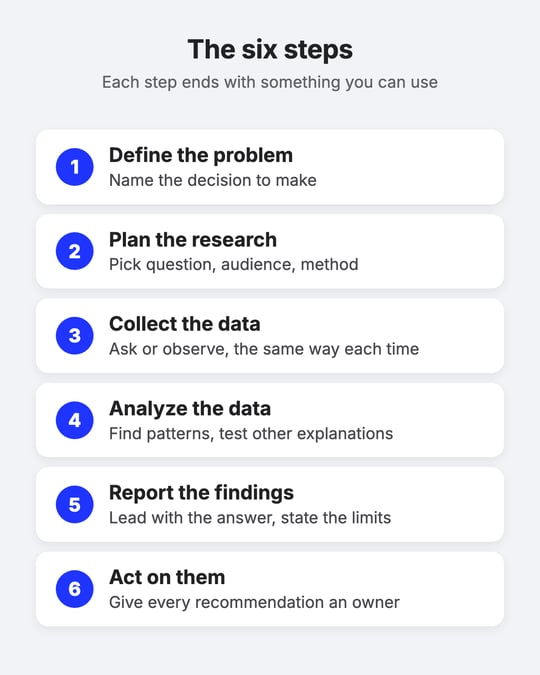
The market research process is the sequence that takes you from a business question to a decision backed by evidence. A common version has six steps: define the problem, plan the research, collect data, analyze it, report the findings and act on them.
At a previous job, I spent a week polishing a customer survey without ever writing down what it was for. The results arrived three weeks later, the marketing lead asked what to change, and nobody in the room could say. The data was fine. I had never picked the decision it was supposed to serve.
If your last study ended in a shrug like that, the cause is usually the order of the work, and getting the order right is most of what the market research process is for.
What are the steps in the market research process?
The market research process has six steps: define the problem, plan the research, collect the data, analyze it, report the findings and act on them. Quantilope and Cvent each list six, while SmartBug lists five by combining analysis and reporting into one step. The order is the same in all three.
| Step | The question it answers | What you end with |
|---|---|---|
| 1. Define the problem | Which decision are you trying to make? | One primary research question |
| 2. Plan the research | Who do you need to hear from, and how? | A method, an audience, a budget and a deadline |
| 3. Collect the data | What do people say or do? | Raw responses, notes or behavior data |
| 4. Analyze the data | Which patterns hold up? | Findings, with their limits |
| 5. Report the findings | What did the study show? | A report someone can decide from |
| 6. Act on them | What changes now? | An owner and a next step |
Think of cooking dinner for guests: pick the meal, shop for exactly that, then cook and serve it. Shop first and you come home with a full cart and nothing to cook.
Treat the six steps as a working order, not a rulebook. New evidence can change the question, the audience or the method halfway through. When it does, write down what changed and how it affects the findings.
How do you define the problem and plan the research?
Start by naming the decision the research will change, because that decision tells you what to ask. Then plan the study around it: one primary question, a defined audience, a method that can answer it, and a budget that includes participant rewards.
Step 1: Write one primary question
A business problem describes the situation. A research objective describes what you need to learn. Put the decision beside both and the purpose of the study gets hard to miss.
| Business problem | Research objective | Possible decision |
|---|---|---|
| Trial users leave before upgrading | Identify where hesitation begins | Change onboarding, pricing communication or product guidance |
| Buyers compare several providers | Learn which criteria shape the choice | Adjust positioning or sales materials |
| Employees respond unevenly to recognition | Understand reward preferences and barriers | Change the recognition format or delivery |
Choose one question to guide the whole study, such as “Why do customers abandon checkout?” or “Which features matter most when buyers compare providers?” List secondary questions underneath and rank them. If no answer to a question would change the decision, cut it or save it for the next study.
Then set boundaries: audience, geography, behavior, time period and deadline, plus what the study won’t cover. A team studying reward preferences might limit itself to full-time employees at companies with at least 50 staff and leave out contractors and former employees. Boundaries keep the conclusions honest, because research describes what a defined group said under defined conditions, not what every customer or employee thinks.
Step 2: Check what already exists, then choose a method
Check what already exists before you pay to collect anything new. The US Small Business Administration says existing sources “can save you a lot of time and energy” but “might not be as specific to your audience as you’d like,” while direct research “can be time consuming and expensive.” Existing sources suit general questions such as industry trends. Direct research suits questions about your own customers.
When you do collect new data, match the method to the answer you need. Qualitative methods explain motivations, quantitative ones measure patterns, and mixed methods combine both. Our guide to qualitative vs quantitative research covers how to choose.
| Research need | Suitable method | What it can reveal |
|---|---|---|
| Understand motivations | Interviews | Why people behave a certain way |
| Explore an unfamiliar problem | Focus groups or open-ended feedback | Language, reactions and possible themes |
| Measure preferences | Structured survey | How responses vary within a sample |
| Compare two experiences | Experiment or message test | Which version performs better under similar conditions |
| Observe behavior | Product or website data | What people actually do |
A survey can show that customers dislike onboarding without revealing the moment that caused the frustration. Interviews can expose that moment without showing how common it is. If your audience is other businesses, the B2B market research guide covers reaching decision makers and the questions to ask them.
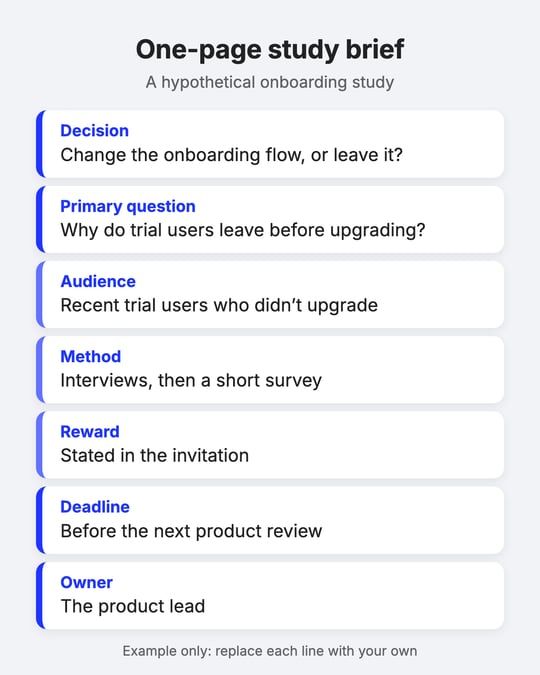
Settle the participant reward in this step too, because the amount, the delivery method and the countries involved shape your budget and your invitation. Then put the plan on one page before fieldwork starts: the decision, the primary question, the audience, the method, the reward, the deadline and the person who owns the next step. In the example below, a product team decides whether to change its onboarding flow, asks why trial users leave before upgrading, and interviews recent trial users who didn’t upgrade before the next product review.
How do you recruit participants and collect the data?
Recruit people who resemble the audience your decision affects, test your questions on a few of them, then collect data the same way for everyone. A convenience sample of customers, employees or followers is acceptable when you say who they are and what they can’t tell you.
Recruit for relevance, not convenience
Set screening criteria before outreach begins: role, industry and company size, geography, product usage or recent behavior. A large sample isn’t automatically a useful one, because the people easiest to reach are often existing customers or followers whose relationship with you shapes their answers. If the criteria change halfway through, record the change and its likely effect in the report. Channels, screeners and scheduling have their own guide on how to recruit participants for research.
Ask questions that don’t steer the answer
Test the survey or interview guide before launch and remove anything confusing, leading or repetitive. A leading question supplies the verdict, while a neutral one lets the participant reach their own:
- Leading: “How satisfied are you with our fast and helpful support?”
- Neutral: “How satisfied are you with our customer support?”
Two habits help in every format. Put easy questions first and test the survey on a phone, and ask every interviewee the same core questions while leaving room for follow-ups.
Pay participants without steering their answers
Tell people what the reward is, and when it arrives, before they agree to take part, then pay on those terms. Keep the reward separate from the research message: explain why their view matters without hinting at the answer you’d like.
One retailer’s card suits some participants and not others, especially across countries. A Giftronaut Choice Card lets each participant pick a brand from their own country’s catalog, so you don’t need to know where they live when you send it. Choosing a specific brand changes the rule: Giftronaut gift cards are country-specific and can’t be redeemed in another country, so check a product’s country before you offer it.
Giftronaut delivers rewards by email, by SMS to US and Canadian mobile numbers, or as reward links you hand out yourself. Reward links suit studies where your survey tool decides who qualifies: you give one link per validated completion, and the order needs no participant details. The account must be pre-funded and the Download Reward Links feature enabled first, as the Help Center explains. To see what participants see, send yourself a sample Choice Card; it can’t be redeemed for value. If you recruit through a research platform instead, check who pays participants on those platforms before you promise a reward.
Set response-quality rules in advance
Decide how you’ll handle repeated submissions or contradictory answers before the study starts. A fast completion alone doesn’t prove a response is invalid. Define exclusion rules before analysis, document each exclusion and keep the original records, so you never quietly drop answers that challenge your expectations.
How do you analyze market research data?
Analysis means organizing the evidence before you look for a story: clean the data, find the patterns, then test them against other explanations. Hunting for a dramatic conclusion first is how weak findings end up in confident slides.
For interviews and open-ended answers, label recurring ideas with codes and group the codes into themes such as price uncertainty, implementation effort or lack of trust. For survey and behavior data, check for missing responses, duplicate entries, inconsistent categories and unusual values before you compare groups, and report the sample size next to every result.
Then ask four questions of each pattern:
- How often does it appear, and in which groups?
- How big is the difference?
- What else could explain it?
- What result would weaken your reading?
Small differences can be normal noise, especially in a small sample. Don’t present a sample result as a market-wide fact unless the study design supports it.
How do you report findings and act on them?
A research report should lead with the answer to the primary question, then give the evidence, the limits and the action the evidence supports. Keep findings and recommendations on separate lines, so a reader can disagree with one without rejecting the other.
Take a hypothetical study of a pricing page:
- Finding: participants understood what the product does but couldn’t explain how it’s priced.
- Recommendation: rewrite the pricing section and test the new version with another sample.
A decision-ready report has six parts:
- Decision context: what the team needed to decide
- Method: who took part, how the data was collected and when
- Key findings: the strongest patterns, with the evidence
- Limitations: what the study can’t establish
- Recommendation: the action the evidence supports
- Next step: what to test, change or investigate next
Short participant quotes make a pattern memorable, but they should support the analysis, not replace it. Then close the loop: give every recommendation an owner and a date, and note what happens after the change. That record is the starting evidence for your next study.
Start with the decision, then size the study to fit
Now the first line of any research brief I write is a sentence that starts “This study will help decide whether...”. It’s the shortest line in the document and the one people argue about longest.
You don’t need a big study to try this. Pick one decision this week, write its primary question in a sentence, and choose the smallest method that could answer it. Then record what you learned, what is still uncertain and who owns the next move.

Frequently Asked Questions
What is the market research process?
The market research process is the sequence of steps that turns a business question into evidence and a decision, from defining the problem to acting on the findings.
How many steps does market research have?
The guides we checked list five or six steps, in the same order. SmartBug lists five by combining analysis and reporting, while Quantilope and Cvent list six. Pick the version that matches how your team works.
Should market research start with existing data or new data?
Start with existing data. The US Small Business Administration says existing sources can save time and energy, though they may not be specific to your audience. Collect new data when the question is about your own customers.
Which market research method fits your question?
Use interviews to understand why people behave a certain way, surveys to measure how common a view is, and experiments to compare two versions. Combine methods when you need both depth and scale.
How do you recruit participants for market research?
Recruit people who match the audience your decision affects. Set screening criteria before outreach, record any change during recruitment, and state who your sample doesn’t represent.
Should you pay participants in market research?
Yes, when the study asks for real time or effort. A reward can encourage participation if its terms are clear and fair, so state it before people agree and keep it separate from the questions.