Sales and promotions are short, time-limited offers that give buyers a reason to act now: a discount, coupon, free gift, rebate, or contest. Most target end customers. Trade promotions target the resellers and sales staff who sell your product.
What is a sales promotion, and how is it different from a sale?
A sales promotion is a short-term offer that cuts the price or adds value to get action now. A sale, meaning a price cut, is one kind of promotion. Coupons, free gifts, rebates, contests, and free trials are others.
As of October 2026, Lumen Learning’s Principles of Marketing chapter on sales promotions gives a classroom definition. Promotions provide “incentives or extra value to distributers, sales staff, or customers over a short time period.” The chapter names “two types of sales promotions: consumer and trade.”
Consumer promotions target the people who buy and use the product. Trade promotions target wholesalers, retailers, and your own sales team, through tools such as sales contests and trade allowances. This guide covers consumer promotions.
One more distinction saves confusion in planning meetings. A discount is the price cut itself. The promotion is the whole offer around it: who qualifies, for how long, and on what terms.
8 types of sales promotions, with an example of each
Every sales promotion method does one of two things: it cuts the price, or it adds value at the same price. That choice changes your margin and how buyers see your brand. Use the table to shortlist two or three types for your goal.
8 consumer promotion types, ordered by the goal they serve
| Type | Example | What the customer does | Best for | Cost to watch |
|---|---|---|---|---|
| Free trial or sample | A 14-day free trial of a paid plan | Tries the product before paying | Win new customers | Product given away, and trial users who never buy |
| Coupon or promo code | 15% off a first order with a welcome code | Enters a code at checkout | Win new customers; bring customers back | Discount on orders that would have happened anyway, and codes shared beyond your audience |
| Free shipping | Free shipping on orders over $75 | Places an order that meets the threshold | Convert hesitant buyers | Shipping cost on every qualifying order |
| Rebate | $20 back after the buyer submits a receipt | Pays the full price, then claims money back | Convert hesitant buyers | Claim handling and the payout itself |
| Gift with purchase | A $10 gift card with any $100 order | Buys, then receives a product or a gift card | Raise order value | The gift’s cost, and delivering it |
| Buy one, get one (BOGO) or bundle | Buy one, get the second at half price | Buys two or more items together | Raise order value; clear stock | Margin on the second item |
| Price discount or flash sale | 25% off last season’s stock for 48 hours | Buys before the deadline | Clear stock | Margin on every unit, and buyers who learn to wait for the next sale |
| Contest or sweepstakes promotion, including event giveaways | A monthly prize draw for newsletter subscribers | Enters by signing up, buying, or sharing contact details | Bring customers back; build a list | Prizes, delivery to winners, and the rules you publish |
Examples are illustrative. Coupons, free shipping, rebates, BOGO deals, and flash sales cut what the buyer pays. Free trials, gifts with purchase, and contests add value while the price stays the same.
The list isn’t new. As of October 2026, Lumen Learning’s textbook names samples, coupons, point-of-purchase displays, premiums, contests, loyalty programs, and rebates as the common consumer techniques. Its “premium,” a product or offer a buyer receives when buying another product, is what the table calls a gift with purchase.
The same chapter lists free shipping, bundle pricing, coupons, and sweepstakes among common online promotions. A giveaway at a trade show or conference works like a sweepstakes: people enter for a chance at a prize and leave their contact details.
How do you choose a sales promotion for your goal?
Start from the goal, then pick the offer. An offer that wins new customers is different from one that clears stock or raises order value. Pick the type that changes the behavior you need, at a cost you can carry.
- Win new customers: a free trial, sample, or welcome code lowers the risk of a first purchase. For reward-based first-order offers, see these ideas on using gift cards for customer acquisition.
- Convert hesitant buyers: free shipping or a rebate answers a cost objection at checkout without a permanent price cut.
- Raise order value: a gift with purchase or a bundle rewards a bigger basket. A tiered discount, such as spend $100 and save $15, ties the price cut to basket size.
- Clear stock: a time-limited discount or a BOGO deal on the items you need to move. Set an end date and a unit cap, so the price cut stays on the stock you planned.
- Bring customers back: a coupon for the next order, a contest for existing subscribers, or a loyalty program built for repeat business.
A worked example: 20% off or a $10 gift?
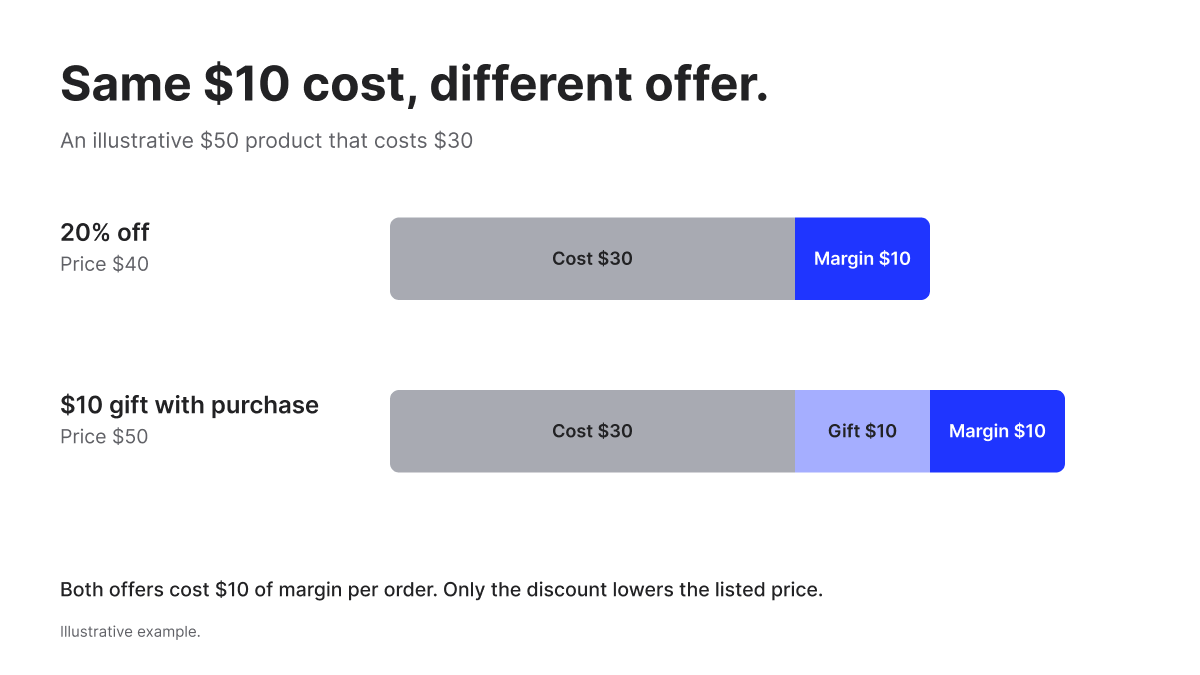
Here’s the math on an illustrative $50 product that costs you $30. Each full-price sale earns $20 of gross margin.
Take 20% off, and the price drops to $40 while the margin drops to $10. That discount just cost half your margin, so you now need two sales to earn what one full-price sale did.
A $10 gift with purchase also costs $10 of margin per order. But the listed price stays at $50, and the offer can end without a price increase.
So for a 48-hour push to price-sensitive local shoppers, which works: a sitewide discount, a coupon, or a gift with purchase? At the same $10 cost, each one reaches a different group of buyers.
- Sitewide discount: every buyer gets it, including people who would have paid full price.
- Coupon: only people who have the code get it, so you control who sees the saving.
- Gift with purchase: it pays out only when an order meets your threshold, so it also lifts basket size.
Which one works for you depends on your buyers. Run two of them against the same baseline and keep the winner for the next round.
How do rewards work as a sales promotion?
Some promotions pay out a reward after a qualifying action, such as a purchase, sign-up, referral, rebate claim, or sweepstakes win. Delivery is the part you have to plan. The reward has to reach the right person, in a form they can use, where they live.
Before launch, decide the qualifying rule, such as a first order over $100, and how you’ll prove it, such as an order ID. Then pick the channel and the timing. It can go by email, SMS, or a link through your own tools, right after the action or on a scheduled date.
Two design lessons from our order data
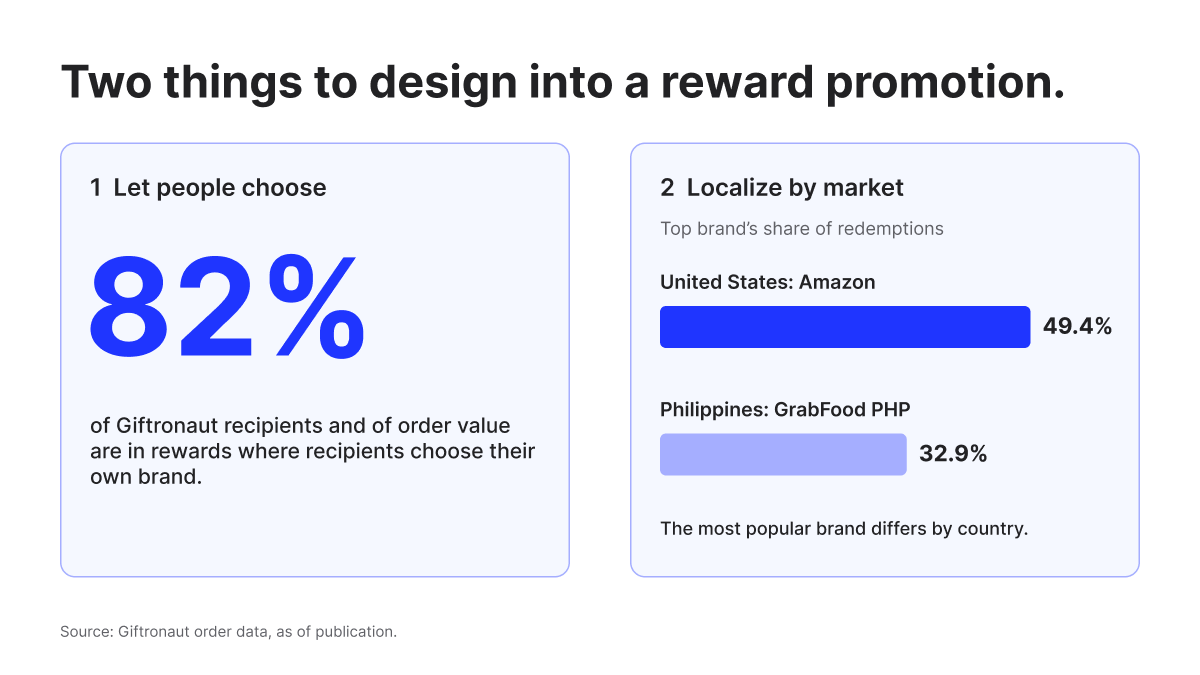
If your promotion pays out a reward, let people choose it. In Giftronaut order data, as of publication, rewards where recipients choose their own brand account for 82% of recipients and 82% of total order value.
If the promotion runs in more than one country, don’t pick one brand for everyone. In Giftronaut recipient-choice redemptions, as of publication, the most popular gift card brand varies by country. Amazon accounts for 49.4% of redemptions in the United States, while GrabFood PHP leads in the Philippines at 32.9%.
One way to apply both lessons is a reward that leaves the brand open until redemption. With a Giftronaut Choice Card, the brand is selected at redemption, not at order time. You don’t need to know the recipient’s location when you send it. With a Branded Gift Card, you select the brand at order time instead.
If you run the reward on Giftronaut, the timing decision above comes down to the order type. Send a one-time order now or on a scheduled date, or set up a Smart Order for recurring or event-based rewards.
For the channel, Giftronaut lets you send rewards by email or by text message, with SMS limited to US and Canadian +1 mobile numbers. You can also download reward links and send them through your own CRM, marketing automation, chat, or SMS.
Reward links don’t require recipient details at order time, which suits offers where you don’t collect an email address. For gift card tactics such as referral rewards and loyalty programs, see how to use gift cards for business promotions.
See How a Choice Card Works
Open a sample Choice Card to see what your customers receive.
Sales promotion strategies: how to plan and launch one
Write down how you’ll measure the promotion before you design the offer. A promotion plan fits on one page with six fields. Fill them in this order, and leave the creative for last.
In 1990, Magid Abraham and Leonard Lodish wrote about measuring promotions in a Harvard Business Review article. What matters, they wrote, is “the incremental sales of a product over and above those that would have happened without the advertising or promotion.”
In the same 1990 article, they noted that statistics such as coupon redemptions don’t measure that. A promotion with thousands of redemptions can still add little to what you would have sold anyway.
One-page promotion brief
| Field | What to decide | The check before launch |
|---|---|---|
| 1. Baseline and measure | What you expect to sell with no promotion, and the one number that counts as lift | You have a comparison: the same period last year, recent weeks, or a group that won’t see the offer |
| 2. Goal and audience | The one behavior to change, and who has to change it | The goal matches one of the five goals above |
| 3. Offer and break-even | The type from the table of 8, and the extra units you need to break even | You’ve run the margin math from the worked example |
| 4. Terms and where they appear | Eligibility, dates, limits, and exclusions | The terms sit next to the offer on every channel that carries it: site, email, and SMS |
| 5. Fulfillment and support | Stock or reward funding, delivery, and how long support stays open | For reward-based offers only: support and the measurement window run at least a week past the last send |
| 6. End date and stop rule | When it ends, the cap, and what result means you run it again | The end date is in the terms, and the stop rule is written down before launch |
Two fields need more than a checkbox. For field 4, the FTC’s 1971 Guide Concerning Use of the Word “Free” sets the US standard for “free” offers. All terms, conditions, and obligations should be “set forth clearly and conspicuously at the outset of the offer.”
The same guide says a footnote marked by an asterisk next to the offer doesn’t count as disclosure at the outset. So put the conditions beside the offer itself, in the email, on the product page, and in the SMS.
For field 5, plan for the gap between sending a reward and its use. In Giftronaut order data, as of publication, recipients who redeem do so an average of 7.6 days after the reward is sent. So for reward-based offers, keep support and your measurement window open at least a week past the last send, not just to the end date.
What are the risks of sales promotions for margins, brand, and trust?
Promotions cost more than the discount itself. Frequent deals can teach customers to wait for the next one and can cheapen the brand. In the US, misleading “free” or “sale” claims also run against FTC guides.
- Margin: every unit sold at the promotional price earns less, including units that would have sold at full price. Size the offer with the worked example above before you commit.
- Waiting for the next deal: as of October 2026, Lumen Learning’s textbook warns that “savvy customers will hold off purchasing until the next promotion.” It adds that too many freebies signal a product isn’t prestigious or “limited.”
- Fulfillment and support load: extra orders, rebate claims, and prize winners all need handling. Staff for the whole promotion window.
- Legal: the wording of a “free” or “sale” offer has rules of its own in the US, set out below.
Two FTC guides cover “free” and “sale” claims in the US. The 1971 guide on the word “free” defines the regular price of the item a buyer must purchase. It’s the price you openly sold it at “for a reasonably substantial period of time, i.e., a 30-day period.”
The FTC’s 1967 Guides Against Deceptive Pricing cover former-price claims. A former price must be “the actual, bona fide price” offered “for a reasonably substantial period of time.” When an ad just says “Sale,” the reduction must not be “so insignificant as to be meaningless.”
These are US guides. If you run the promotion in other countries, check the local rules on price and “free” claims before launch.
Start your next promotion with the baseline
Before your next promotion, open the one-page brief above and fill in field 1 first. Write down what you expect to sell with no promotion and the one number that counts as lift. Then work down the other five fields in order, and leave the creative for last.
Deliver Promotion
Rewards by Email, SMS,
or Reward Link
See how reward-based promotions work on the marketing use case page.
Frequently Asked Questions
What is the difference between a sales promotion and a discount?
A discount is one type of sales promotion: a cut in price. A sales promotion is the whole time-limited offer, and it can also add value through a free gift, a rebate, or a contest. Its terms set who qualifies, for how long, and on what conditions.
What is the difference between a sales promotion and a sales incentive?
A consumer sales promotion rewards the buyer, while a sales incentive rewards your own salespeople for selling. As of October 2026, Lumen Learning’s Principles of Marketing textbook files sales contests under trade promotions, so the two overlap in textbook terms. For the seller side, see these tips for running spiff programs.
Why do sales promotions, like flash sales, have a time limit?
The time limit is what separates a promotion from a new regular price. As of October 2026, Lumen Learning’s textbook describes sales promotions as offers “over a short time period.” In the US, the FTC’s 1967 pricing guides also tie a “was” price to one offered “for a reasonably substantial period of time.”
Is a gift with purchase better than a discount?
Not always; it depends on the behavior you want. On an illustrative $50 item, a $10 gift and $10 off both cost $10 of margin per order. The gift keeps the listed price and pays out only on qualifying orders; a discount is simpler to explain and reaches every buyer.
Why didn’t my discount promotion increase sales?
Check three things: the baseline, the size of the offer, and who saw it. Compare against what would have sold with no promotion, and confirm the offer reached the people whose behavior you wanted to change. In the US, the FTC’s 1967 pricing guides say an advertised sale should be large enough that buyers see a genuine saving.
How do promotional gift cards for signing up work?
The sign-up is the qualifying action, and the gift card is the reward you deliver after it. Before launch, decide how you’ll confirm the sign-up, which channel carries the reward, and whether it goes out right away or on a scheduled date.