
Sending gift cards to employees in another country works completely differently than sending them domestically: brand availability, currency, and even redemption rules change by region. The fastest way to get it right is a multi-brand Choice Card paired with a platform that handles currency conversion and country-specific catalogs for you, instead of manually researching what’s redeemable where. Giftronaut sends gift cards to employees in 225 countries, no local bank account required.
Here’s what actually changes when you send gift cards to employees across borders — including two situations that trip companies up most often: sending Apple gift cards globally and sourcing localized gift cards for employees in a specific country.
📌 TL;DR
- Giftronaut sends gift cards to employees in 225 countries, no local bank account required.
- Apple Gift Cards redeem only in the country or region where they were purchased.
- Gift cards account for 30% of program allocations in North America and 34% in Europe (IRF).
- Recipients redeem from an email link, with no app to install and no sign-up.
What does it mean to send gift cards to employees globally?
Sending a gift card to an employee in another country means the brand catalog, currency, and redemption process can all be different from what you’d expect at home. A retailer that’s a household name in the U.S. — say, Target or Kohl’s — often has no presence at all in the country where a remote employee lives, and a card denominated in USD may not convert cleanly into the local currency an employee actually spends.
This isn’t a niche problem anymore. Gift cards account for 30% of incentive program budget allocations in North America and 34% in Europe, according to the Incentive Research Foundation’s 2026 Industry Outlook, which gathered responses from organizations across Canada, the U.S., France, Germany, Italy, Spain, Sweden, and the U.K. — eight countries spanning two continents, in a single survey of reward program managers.
Three things change the most when a gift card crosses a border: brand availability (a card is only useful if the recipient can actually spend it locally), currency (a card denominated in the wrong currency either loses value in conversion or confuses the recipient about what it’s actually worth), and redemption rules (some brands, as covered below with Apple, restrict redemption to the country where the card was issued).
Understanding the different types of gift cards available matters more internationally than domestically, because a single-brand card that works perfectly for a U.S. team can be completely unusable for a teammate in another country — while a multi-brand card built around local catalogs solves that problem by design.
None of this means international rewards are harder to justify — if anything, the retention case for getting it right is stronger for distributed teams, who have fewer everyday touchpoints with company culture than an in-office employee does. A reward that clearly reflects local relevance does more work per dollar spent than the same reward sent without any localization at all.
How do you send gift cards to employees in different countries?
The practical process has three steps: confirm which brands are actually available in the recipient’s country, choose a currency that matches where they spend, and send through a platform that supports that country natively rather than assuming a U.S. catalog will translate.
This has become a standard HR task, not an occasional one. 80% of business leaders reported receiving employee requests to relocate or work while traveling in the past year, according to Remote’s 2025 Global Workforce Report — meaning the "where does this employee actually live right now" question has become a moving target for a growing share of companies, not a fixed fact set once at hiring.
Practically, this means building your recipient list with country as a required field, not an afterthought. A recipient record tied to a country lets a platform automatically apply the right catalog and currency instead of a rewards manager manually researching brand availability for every send.
Automation matters even more across time zones and countries. A Smart Order tied to a recurring event — a work anniversary, an onboarding date — fires automatically regardless of which country the recipient is in, removing the need for someone to manually track international send timing across a dispersed team.
The biggest mistake companies make sending internationally for the first time is reusing a domestic recipient list and card type without checking country-level availability first — which is exactly what leads to the Apple Gift Card problem covered next.
It also helps to separate the send date from the recipient’s local time zone. A card scheduled for 9am in the sender’s time zone can land at 9pm or later for a recipient elsewhere, which matters for time-sensitive occasions like a live team celebration. Scheduling a One-Time Order with the recipient’s local time in mind, rather than the sender’s, keeps the delivery moment aligned with when it’s actually meant to be felt.
Can you send Apple gift cards to employees globally?
No — not the same card. Apple Gift Cards, App Store Cards, and App Store & iTunes Gift Cards can’t be redeemed outside the country or region where they were purchased, according to Apple’s own support documentation. A card bought in the U.S. shows an error if a recipient in France tries to redeem it — Apple’s support page uses that exact example, noting a France-purchased card can’t be redeemed on a U.S. storefront, and the same restriction applies in reverse.
This makes Apple Gift Cards one of the clearest examples of why single-brand, region-locked cards create friction for distributed teams. A closed-loop card like an Apple Gift Card works fine for a fully domestic team, but sending the exact same card type to employees in five different countries means either purchasing five region-specific versions or accepting that some recipients simply can’t redeem what they were sent.
If Apple products are genuinely what a global team wants, the workaround isn’t sourcing region-specific Apple cards one country at a time — it’s sending a multi-brand card that includes Apple as one option within each recipient’s local catalog, so an employee in Germany sees Apple available through their own country’s storefront rather than through a U.S.-purchased card that won’t work.
This same region-lock logic applies to many single-brand digital gift cards, not just Apple’s — always verify a brand’s official redemption policy before assuming a card purchased in one country works for a recipient in another.

How do you send localized, country-specific gift cards to employees?
Localization means the brand catalog an employee sees matches what’s actually available and relevant in their own country — not a translated version of a U.S. catalog.
This is increasingly a structural, not occasional, need. 55% of companies employing workers internationally already use an Employer of Record (EOR) to manage that workforce, and 76% of leaders using an EOR report being happy with the model, according to Remote’s 2025 Global Workforce Report. Companies structured enough to manage international employment formally are exactly the companies that need their reward programs to match that same level of localization — a generic single-country catalog undercuts the effort already put into compliant global employment.
Practically, localization happens at the catalog level. The Choice Card catalog can be filtered by category, country, and specific brand before a send, with those settings saved per order — meaning a rewards team configures a country’s catalog once and reuses it for every future send to that location, rather than rebuilding it each time.
Country-specific catalogs are available for the U.S., Canada, UK, Australia, UAE, Germany, France, Spain, India, the Philippines, Sweden, Belgium, and more — covering the markets where distributed teams are most commonly based. For a country not covered by a dedicated catalog, an International Gift Card extends reach without forcing a single U.S.-only brand onto an employee who can’t use it.
What currency and cost issues come up when sending gift cards abroad?
Currency conversion is where international gift card programs quietly lose value if nobody is watching for it. Cross-border money movement routinely carries costs well beyond domestic transfers — as one concrete example, PayPal charges a standard 2.9% domestic rate plus an additional 1% international fee on cross-border business transactions, pushing the effective rate to roughly 3.9%, according to PayPal’s own fee documentation. That’s a meaningful cut on every dollar sent, and it compounds the more frequently a company sends rewards internationally.
Gift cards sidestep part of this problem by design, but only if the platform guarantees the exchange rate at send time. Giftronaut guarantees the value of Choice Cards sent in non-USD currency at the exchange rate in effect when the order is sent — so the amount funded and the value delivered stay aligned, instead of fluctuating with the market between funding and delivery.
Multi-currency support matters just as much as the guarantee itself. Giftronaut supports CAD, GBP, EUR, DKK, AUD, and AED in addition to USD, which covers the majority of markets where distributed teams are commonly based without requiring a separate account or vendor relationship per currency.
Before committing to an international gift card program, confirm two things with any provider: whether the exchange rate is locked at send time or floats until redemption, and whether currency conversion carries any additional fee on top of the card’s face value. Those two answers determine whether an international program actually delivers the value a company thinks it’s sending.
Which gift card type works best for a global workforce?
For a genuinely global workforce, a multi-brand Choice Card outperforms single-brand cards because it adapts its catalog to each recipient’s country automatically, rather than requiring a company to pick one brand that has to work everywhere — a brand that, as the Apple example shows, often doesn’t.
An open-loop card like a Prepaid Visa is the next-best option for markets not covered by a country-specific catalog, since it spends anywhere Visa is accepted rather than at one retailer — though Prepaid Visa is currently limited to U.S. digital delivery, so it fits a company’s domestic recipients better than a fully international rollout.
Single-brand Branded Gift Cards still have a place internationally, but only for brands confirmed to operate — and allow cross-border redemption — in every country you’re sending to. Skipping that verification step is exactly what leads to the Apple Gift Card mismatch described earlier.
For companies with recipients spread across a handful of core countries, combining a Choice Card with country-specific catalog filtering covers the vast majority of use cases. For companies with employees in countries outside any dedicated catalog, an International Gift Card fills the gap without leaving those recipients out of the program entirely.
A useful test before rolling out any card type internationally: pick three recipients in three different countries and ask whether each one can actually redeem what you’re about to send, using the retailer’s own country-specific storefront or catalog. If the answer is no for even one of them, the card type needs to change before the send does — not after a recipient reports the problem.
Why choose Giftronaut for sending gift cards to employees globally?
Global recognition programs carry real retention stakes. Organizations with strong employee recognition programs see 31% lower voluntary turnover, and well-recognized employees are 45% less likely to have left their company after two years, according to Gallup — figures that apply just as much to a distributed international team as a single-office one, if not more, given how easy it is for remote international employees to feel disconnected from company culture.
Giftronaut is built for that distributed reality. Country-specific catalogs cover the U.S., Canada, UK, Australia, UAE, Germany, France, Spain, India, the Philippines, Sweden, Belgium, and more, with multi-currency delivery in CAD, GBP, EUR, DKK, AUD, and AED alongside USD — all guaranteed at the send-time exchange rate.
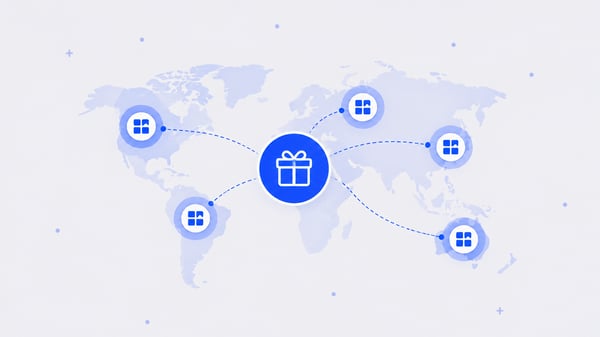
Zero platform fees mean funding an order in one currency and guaranteeing its value in another doesn’t cost extra on top of the face value — only a 3% fee applies to credit card funding, while ACH and wire transfers are free. Combined with 4,300+ brands across 225 countries and recognition from G2 as a Spring 2026 Momentum Leader, Most Implementable, Easiest To Do Business With, High Performer, and Users Love Us, Giftronaut gives global rewards teams one platform instead of a patchwork of country-specific workarounds.

Frequently Asked Questions
Which countries can Giftronaut send gift cards to?
Giftronaut gift cards are redeemable across 225 countries, with country-specific brand selections. The Choice Card catalog can be filtered by country before sending.
Does Giftronaut charge platform fees on international gift card orders?
No. There are no platform fees, contracts, or subscriptions. You pay the face value of the cards you send, plus a 3% processing fee only if you fund by credit card. ACH and wire funding have no fees.
What card types can be sent to employees outside the United States?
Choice Cards, Branded Gift Cards, and International Gift Cards. Prepaid Visa is currently limited to U.S. digital delivery.
Why do single-brand gift cards fail for employees abroad?
Many retail brands operate in only a few countries. Apple cards redeem only in the country of purchase. A multi-brand Choice Card avoids both problems.
What information do you need to send a gift card to another country?
Each recipient needs an email address, because Giftronaut delivers by email. Upload a spreadsheet to send to many recipients at once.
Is an email address required to send a gift card internationally?
Yes. Giftronaut delivers the reward link by email, and recipients verify their email address before redeeming. No app or sign-up is required.
What’s the best way to send gift cards to employees in any country?
The best way to send gift cards internationally combines a country-aware catalog, a guaranteed exchange rate, and a card type flexible enough to avoid the region-lock problems that trip up single-brand cards like Apple’s. Getting any one of those three wrong turns a well-intentioned reward into a card an employee can’t actually use.
Giftronaut lets you send Choice Cards, Branded Gift Cards, Prepaid Visa cards, and International Gift Cards across 225 countries, with zero platform fees and multi-currency support built in. Try a free sample to see exactly what an international recipient receives before rolling out a global program.