Venmo API access isn’t open to new businesses: Venmo retired its Developer and Payouts APIs, and its business tools now run through PayPal. To send Venmo payouts from your own system today, use PayPal’s Payouts API (US recipients, USD only, access on request) or a rewards platform API that offers Venmo as a payout option.
The first time I met a friend for lunch at her new office, my map app walked me straight to a polished brass sign that said MAIN ENTRANCE, screwed into a wall of fairly new bricks. I walked around the block twice. On the second lap, a doorman by a side door gave me a small wave: “Everybody tries that one.”
Searching “Venmo API” feels a lot like that. Old docs, GitHub projects and forum threads still point at a door Venmo closed to new businesses years ago. The ways in now are around the side, and the one you need comes down to a simple question: do you want to take Venmo payments, or send them?
Does Venmo Have an API You Can Use Today?
Venmo doesn’t offer an API that a new business can sign up for. Its own developer page said its “Developer and Payouts APIs have been retired, and we are no longer able to provide access to businesses who may want to start using it” (Venmo developer page, archived August 2025). Businesses that were granted access in the past, “generally prior to 2016,” kept it. Everyone else has to go another way.
That page is gone now. The old developer and docs addresses on venmo.com redirect to Venmo’s business profiles page, and Venmo’s integration docs sit on PayPal’s site. That makes sense once you know who you’re dealing with: the Venmo user agreement is “a contract between you and PayPal, Inc.”
A Venmo business profile doesn’t change the picture. The same agreement describes it as something “you can use to receive payments for the sale of goods and services.” It’s built for getting paid, not for sending money out of your systems.
So when someone on your team says “let’s just use the Venmo API,” the useful follow-up is: to do what?
Accepting Venmo vs Sending Venmo Payouts: Which Do You Need?
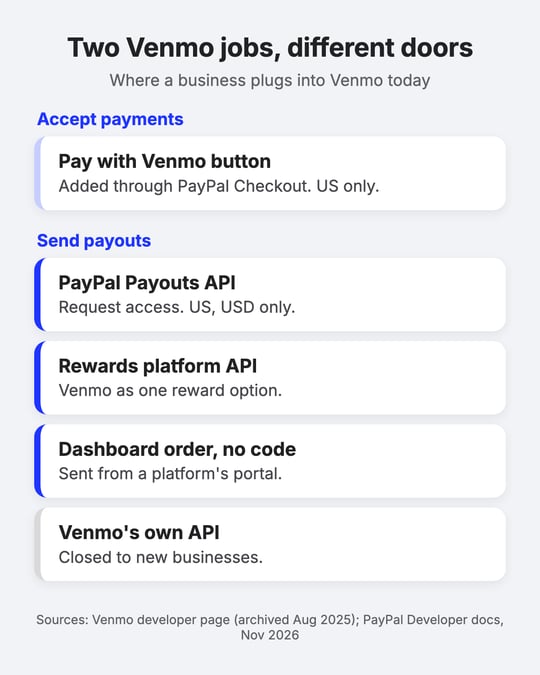
Accepting Venmo and sending Venmo payouts are two separate integrations, and PayPal handles each one with a different product. Which one you need decides everything that follows.
| Your job | The route today |
|---|---|
| Take Venmo payments in your app or checkout | Pay with Venmo, added to a PayPal Checkout integration. US merchants and US consumers only, and payers need the Venmo app |
| Send money to people’s Venmo accounts | The PayPal Payouts API, or a rewards platform API that offers Venmo. US recipients and USD only |
| Send Venmo occasionally, without code | A rewards platform’s dashboard, one order at a time |
If you’re on the accepting side, PayPal’s Pay with Venmo guide is where to start. If you’re sending money out, to research participants, customers who earned a reward, contest winners or app users, you have three real options, and two of them involve an API.
How to Send Venmo Payouts With the PayPal Payouts API
The PayPal Payouts API is PayPal’s own way to send money to Venmo users from your code, and the same integration pays PayPal accounts too. According to PayPal’s Payouts overview, recipients “can claim payments through PayPal or Venmo with just an email or phone number,” and one API call can carry a whole batch.
Here’s what your team will run into:
- Access is by request. “To use PayPal Payouts, you’ll need to request access,” the overview says. You can build and test in PayPal’s sandbox while you wait.
- Venmo payouts are US-only. PayPal says “Venmo can be used for payouts in the US using USD only,” and Venmo notifications need a US mobile number. PayPal payouts reach 96 countries (PayPal Payouts overview), so a mixed list may need both wallets.
- Venmo users are addressed differently. You set the recipient wallet to Venmo and pass a phone number or Venmo handle. For a handle, the recipient type is `USER_HANDLE`.
- People without Venmo can still be paid. A recipient with no Venmo account gets instructions to create one and claim the payout.
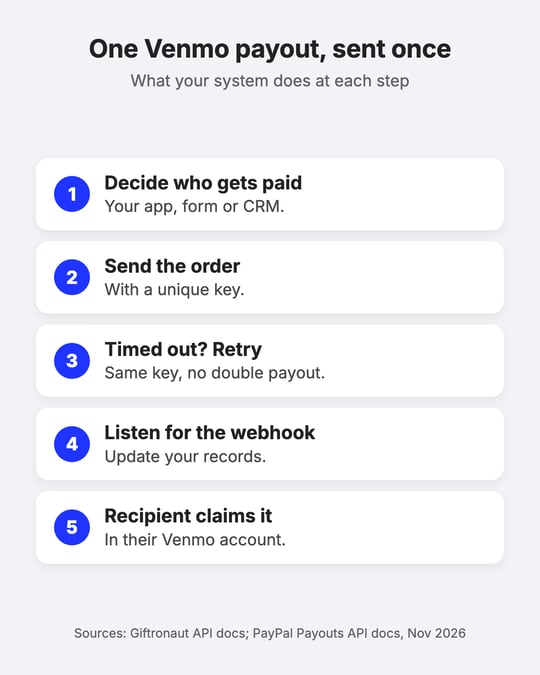
- Duplicate protection is your job. The `sender_batch_id` prevents duplicate requests, and after a server error you retry with the same ID within 30 days.
- Status arrives by webhook. PayPal suggests webhooks for status updates instead of polling the API over and over.
PayPal sets its own Payouts fees, so price a full batch with PayPal before you compare routes. If you’re weighing payout APIs more broadly, our guide to PayPal alternatives for business payouts covers the other categories.
How to Send Venmo Payouts Through a Gift Card API
A gift card API that includes Payout Options (the rewards platform route) sends Venmo as one reward option, next to gift cards and prepaid cards, through the integration you’d build anyway. That’s the better fit when Venmo isn’t the only thing you send: a research team paying US participants by Venmo and international ones by gift card, or a referral program that lets each customer pick.
The Giftronaut API sends gift cards, prepaid cards, Choice Cards and Payout Options from your own product. Our API docs describe two ways to send Venmo:
- Venmo directly. Create a single-brand Branded Card order with the Venmo product, and every recipient gets Venmo.
- Venmo as a choice. Send a Choice Card with Payout Options switched on, and each recipient picks Venmo or PayPal where available, or a gift card from the brands in their country.
The conditions come from our PayPal and Venmo Payout Options page:
- Who can receive it: recipients in the United States with a Venmo account and a verified mobile number. They don’t need a Giftronaut account.
- Amounts: USD, from $1 to $1,000 per reward.
- The fee: 4% (minimum $0.25 per recipient) when you cover it, or 6% (minimum $1) taken from the reward when the recipient covers it. Recipients cover it by default, and a payout sent directly always carries the fee. Standard gift cards and prepaid cards carry no redemption fee unless the brand’s own terms say otherwise.
Take a research team paying 300 US participants $20 each. If the team covers the fee, that’s $0.80 per person, or $240 on top of $6,000 in rewards. If participants cover it, each one receives $18.80, because 6% of $20 is $1.20. Our post on who should cover the Payout Options fee walks through that choice.
The engineering safeguards match PayPal’s, under different names. Every Giftronaut order needs an `idempotencyKey`, and a repeated key is rejected with `409 DUPLICATE_IDEMPOTENCY_KEY` instead of creating a second order. Idempotency keys never expire, and after a timeout you can look the order up by that key. Webhooks are signed with HMAC-SHA256, retried up to 5 times, and carry an `eventId` for deduplication.
Testing is self-serve. The Giftronaut sandbox needs no business review, starts with a $10,000 virtual balance, and sends no emails to real recipients. Production needs a standard business verification and is typically enabled within one business day, and both environments need your server IPs on an allowlist. For the integration itself (authentication, the catalog, test orders and status checks), follow our gift card API guide; nothing about it changes when the reward is Venmo.
If your security team reviews vendors before an API goes live, Giftronaut has completed a SOC 2® Type 2 audit. The report “covers May 28, 2026 to August 28, 2026, and the self-serve portal, gift card ordering and delivery, the recipient redemption experience, reporting, and API-based gift card distribution” (how to request it).
Should You Use an Unofficial Venmo API Library?
Unofficial Venmo API libraries are a weak foundation for business payouts, even though they show up near the top of the search results. One Python library that ranks for this search says so in its own README: “This is an individual effort and is not PayPal/Venmo sponsored or maintained.”
It signs in with a Venmo username and password, then a two-factor code. That means your payouts would run through one person’s account, on code that nobody at Venmo maintains, and the day it breaks there’s nobody to call.
Venmo’s user agreement also bars using “any robot, spider, other automatic device, or manual process to monitor or copy our websites without our prior written permission.” Read that clause with your legal team before a script sits between your company and anyone’s money. For a weekend side project, these libraries are interesting. For paying customers or study participants, use a route that someone signs a contract for.
Which Venmo Payout Route Fits Your Team?
The right Venmo payout route comes down to two things: what else you send, and who will own the integration.
| Route | Fits when | Watch for |
|---|---|---|
| PayPal Payouts API | You only send cash to PayPal and Venmo users, and your engineers will own the integration | Access on request, Venmo is US and USD only, PayPal’s fees |
| Rewards platform API | You send Venmo plus gift cards or prepaid cards, or some recipients live outside the US | The platform’s payout fee and Venmo’s US-only limit |
| Dashboard order, no code | Payouts are occasional, or a person decides who gets paid | Someone places each order by hand |
Before anyone writes code, get answers to these:
- Is everyone on the list in the US? If not, Venmo can’t be the only option they get.
- Venmo alone, or next to gift cards? Venmo alone fits a direct payout; a mix fits a Choice Card.
- Who pays the fee? Decide before launch, and put it in the budget or the reward message.
- How long is approval? PayPal Payouts access is by request; a Giftronaut sandbox app works once its IP is approved.
The general build checklist (retries, status handling and pre-launch tests) is the same for any reward, and our gift card API guide covers it.
If you plan to send in big bursts, read up on API rate limits as well. And if you’re still deciding between cash and gift cards for your people, our comparison of PayPal, Venmo or gift cards for employee rewards covers that choice.
Before You Promise Venmo Payouts to Anyone
I still meet that friend for lunch, and I still trust the map. I just look at the actual door on street view before I set off. For a payment route, the street view is the page that tells a new business how to get access today. If you can’t find one, you’re standing at the brass sign.
Your next step is small. Write down who you’re paying, in which countries, and whether Venmo is the only option they’ll get. That one list tells you whether you need the PayPal Payouts API, a rewards platform API or no code at all, before anyone opens a Venmo API tutorial.
Frequently Asked Questions
Can I automate Venmo payments for my business?
Yes, but not through Venmo itself. The PayPal Payouts API sends batches to Venmo users in the US, and rewards platform APIs such as Giftronaut’s offer Venmo as a payout option.
Is the Venmo API still available?
Not to new businesses. Venmo’s developer page said its Developer and Payouts APIs were retired. Only businesses with earlier access, generally before 2016, kept it.
Can Venmo be integrated with PayPal?
Yes. Businesses add the Pay with Venmo button through PayPal Checkout to accept payments. To send money to Venmo users, they use the PayPal Payouts API.
Can I send Venmo payouts to people outside the US?
No. PayPal says Venmo payouts work in the US using USD only, and Giftronaut’s Venmo option is for US recipients. For other countries, Giftronaut offers PayPal International in 110 countries and gift cards in 225 countries.
Do recipients need a Venmo account to get a payout?
Yes, to receive the money. On Giftronaut, Venmo recipients need a Venmo account and a verified mobile number. Through PayPal Payouts, people without an account get instructions to create one and claim it.
Do I need a separate Venmo integration if I already use a gift card API?
Not if your gift card API includes Payout Options. The Giftronaut API sends Venmo directly as a Branded Card order, or inside a Choice Card next to gift cards, for US recipients only.
Can I test a Venmo API integration before going live?
Yes. PayPal offers a sandbox for testing Payouts. Giftronaut’s self-serve sandbox starts with a $10,000 virtual balance and sends no emails to real recipients.