A rebate is a partial refund you get after you buy something: you pay the full price at checkout, then claim part of that money back by sending proof of purchase to the company offering it before the offer’s deadline.
Somewhere in a kitchen drawer right now, there’s a rebate form that never got mailed. Maybe it’s in yours.
You’re far from alone. In a 2004 University of Florida study of more than 1,200 people, 60% of those who didn’t redeem a rebate said they procrastinated or simply forgot.
What is a rebate and how does it work?
A rebate is a partial refund paid after a purchase, in exchange for proof that you bought the product.
Think of it as an IOU from the seller: pay full price today, show your receipt, and get part of your money back later. The IOU is real, but it only pays out if you cash it in.
Manufacturers, retailers, utilities and government programs all offer rebates to shoppers. Businesses also pay volume rebates to distributors and resellers that hit purchase targets.
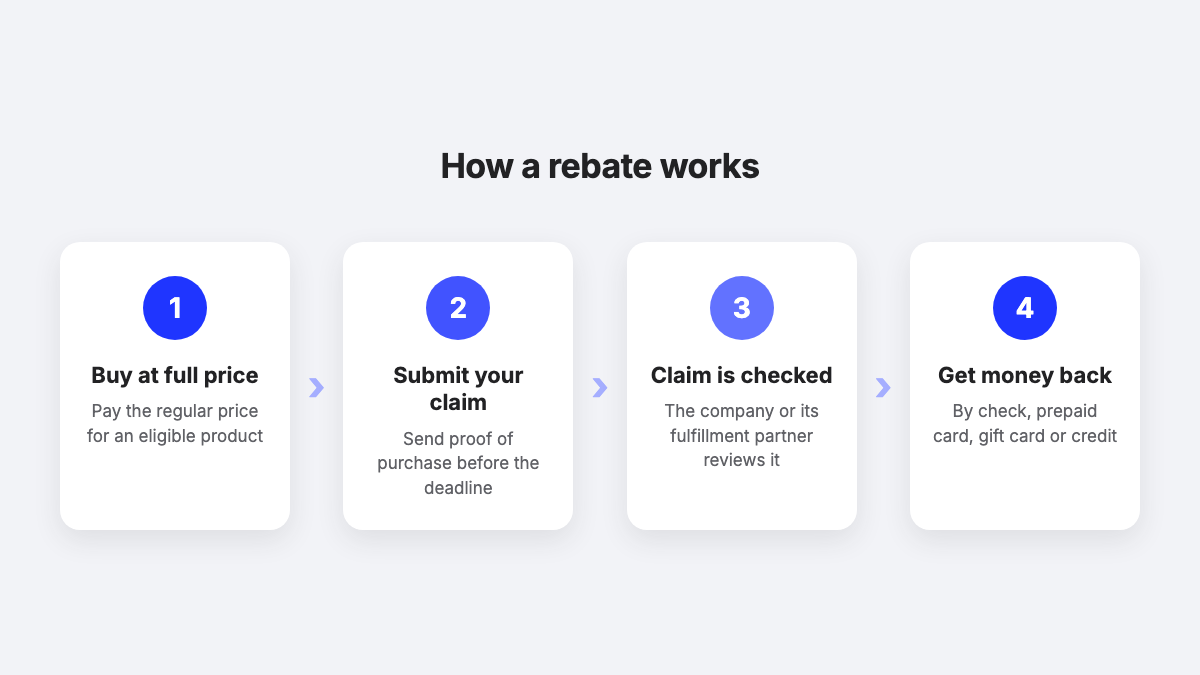
Here’s how a typical rebate works:
- Buy an eligible product at full price. The offer lists which products, stores and purchase dates qualify.
- Submit a claim. Send the form and your proof of purchase, such as the receipt and sometimes the barcode from the packaging, before the deadline.
- Wait while the claim is checked. The company, or a fulfillment company working for it, reviews your claim.
- Get paid. Depending on the offer, the money arrives as a check, a prepaid card, a digital gift card or an account credit.
Here’s what that looks like in dollars. Say Maria buys a $200 blender with a $40 rebate. She pays $200 at the register. If she claims on time and her claim is approved, she gets $40 back a few weeks later, and the blender costs her $160. If the form ends up in a drawer, it costs her $200.
Same blender. A $40 difference.
Why do companies offer rebates at all? A rebate lowers the price you effectively pay without lowering the price on the shelf, and the company can start and stop it on a set schedule. Digital claims also show the company who’s buying.
There’s a less flattering reason, too: not everyone claims, and an unclaimed rebate costs the company nothing. We’ll come back to why that’s a risky bet for businesses.
Rebate vs discount vs cash back
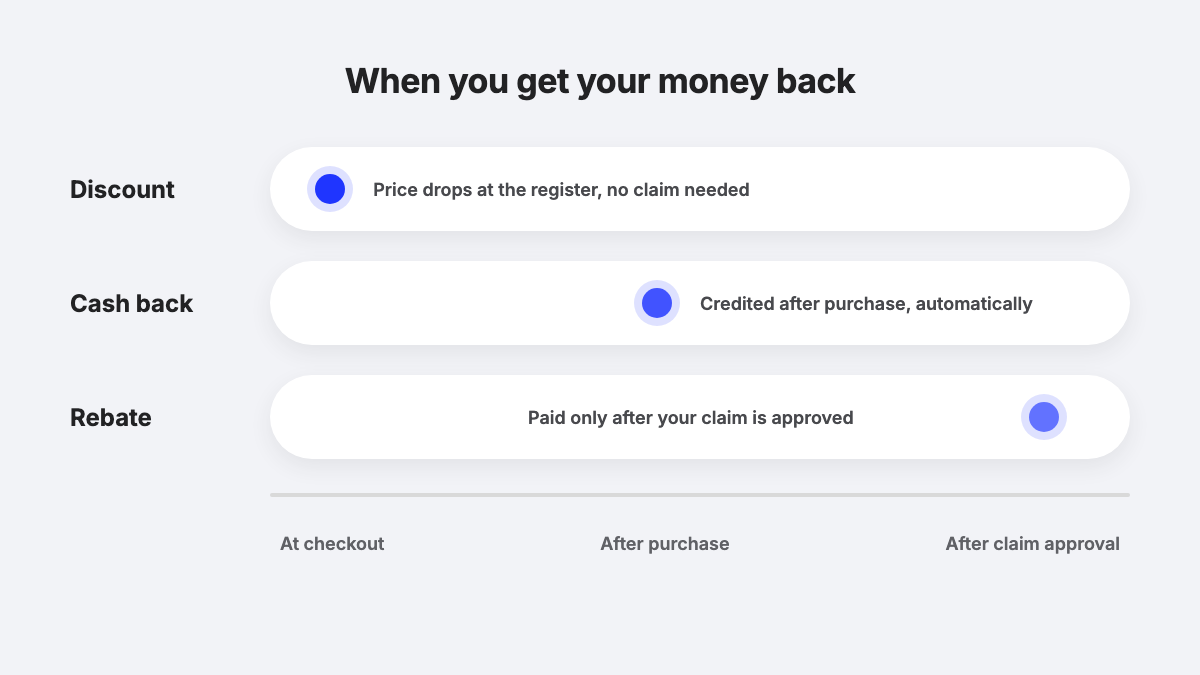
All three put money back in your pocket. The difference is when you get it and how much work it takes.
| Rebate | Discount | Cash back | |
|---|---|---|---|
| When you save | After you buy, once your claim is approved | At checkout | After you buy, automatically |
| What you do | Submit a claim with proof of purchase before the deadline | Nothing, or enter a code | Nothing once you’ve signed up |
| Offered by | Manufacturers, retailers, utilities | Retailers and brands | Card issuers, shopping apps, retailers |
| How you get the money | Check, prepaid card, digital gift card or account credit | A lower price on the spot | Statement credit, account balance or points |
| The catch | It pays out only if you claim it correctly and on time | Tied to one purchase or a short window | A small percentage of what you spend |
Back to Maria’s $200 blender:
- With a $40 discount, she pays $160 at the register, and that’s it.
- With a $40 rebate, she pays $200 and gets $40 back after her claim is approved, as long as she remembers to claim it.
- With a 2% cash-back credit card, she pays $200 and gets $4 back automatically.
So which is best? Take a discount whenever you can get one, because you get it on the spot with no effort. A rebate can be worth far more than cash back, but only if you claim it.
Types of rebates: mail-in, digital and instant
Rebates differ mainly in how much effort the claim takes. These are the three you’ll see most.
Mail-in rebates
The classic version. You fill out a paper form, attach your proof of purchase (often the original receipt and the barcode cut from the box) and mail it before the deadline. Then you wait several weeks for your money.
Mail-in rebates take the most effort, which makes them the easiest to forget.
Digital rebates
Digital rebates move the whole claim online. You fill out a form on a website or in an app, upload a photo of your receipt and track the claim’s status from there. The payout is often digital too, such as a prepaid card or a digital gift card sent by email.
No envelopes and no stamps make digital rebates far easier to claim.
Instant rebates
An instant rebate comes off the price at checkout. There’s no form and no waiting, so in practice it works just like a discount.
If you see “instant rebate” on a price tag, there’s nothing to mail. Enjoy it.
How to claim a rebate step by step
Claiming a rebate takes a few minutes. It just rewards people who are a little organized and a lot prompt.
- Read the terms before you buy. Check which products, stores and dates qualify, when the deadline is, which documents you need, how you’ll get paid and whether there’s a limit such as one rebate per household.
- Keep everything until you’re paid. Hold on to the receipt, the packaging and the form or offer code. If the offer wants your original receipt, ask the cashier for a separate receipt for that item. Yes, the empty box lives in your garage for a few weeks.
- Submit the claim the same day. In the University of Florida study, people were far more likely to redeem a rebate with a one-day deadline than with a three-week one, because extra time invites procrastination. Treat the claim like a bill that’s due tomorrow.
- Fill in every field exactly. Use the name and address on your purchase, double-check the product details and attach every document the offer asks for. Small mistakes are an easy way to get a claim rejected.
- Keep proof that you submitted. Photograph or scan the form, receipt and barcode before you send them, and save any confirmation number or email. If you mail the claim, use a trackable shipping option.
- Follow up if the money is late. Set a reminder for the date the offer promises, and contact the company or its fulfillment house if nothing arrives. In rebate cases against CompUSA in 2005 and American Telecom Services in 2009, the Federal Trade Commission ordered the companies to pay rebates within the time they promised, or within 30 days if the offer gave no time. If you can’t resolve it, report it at ReportFraud.ftc.gov or to your state attorney general.
- Use the payout promptly. Cash the check, activate the card or redeem the gift card as soon as it arrives, and check for an expiration date so your rebate doesn’t disappear a second time.
How businesses can run a rebate program
Design a rebate your customers can actually claim, and pay it quickly. Treating a rebate as a bet that people won’t follow through can cost you more than it saves.
In 2005, the FTC found that CompUSA rebates promised “within six to eight weeks” took some customers one to six months, and some never arrived at all (FTC, 2005). In 2009, it said tens of thousands of consumers who sent correct forms on time got their American Telecom Services rebate checks late, some after waiting a year or more (FTC, 2009).
Customers remember the rebate that never showed up. Here’s how to run one they’ll remember for the right reasons:
- Set one clear goal. Moving older inventory, launching a product, nudging upgrades, rewarding repeat buyers and matching a competitor’s price each call for a different offer. If you’re weighing other promotions too, see our guide to gift cards for business promotions.
- Choose how customers will claim. Instant rebates remove all friction but pay out on every sale. Digital rebates add one short claim step and tell you who’s buying. Mail-in rebates add the most friction for everyone, so start with digital if you’re building from scratch.
- Write terms anyone can follow in 30 seconds. Spell out the eligible products and dates, the deadline, the documents needed, and exactly how and when customers get paid.
- Make claiming quick. Use a mobile-friendly form, accept a photo of the receipt and confirm every claim by email the moment it arrives.
- Validate claims automatically. Match each claim against your orders and flag duplicates for review, so valid claims never sit in a queue.
- Pay fast, in a form people want. Paper checks are slow and easy to forget. A digital reward can arrive by email soon after a claim is approved.
- Promise only the timeline you can keep. If something slips, tell customers what’s happening instead of letting claims go silent.
- Measure the results. Track the redemption rate, the sales lift against a period without the rebate, the cost per redeemed rebate, the time to payout and the support tickets the program creates.
How Giftronaut helps you pay rebates
If you pay rebates as digital rewards, we handle the payout so your team can focus on the offer.
- Let customers choose their reward. A Choice Card lets each customer pick the brand and currency when they redeem, from 4,300+ brands across 225 countries.
- Pay different amounts in one order. Upload a spreadsheet to send rebates in bulk and set a different amount for each customer.
- Pay as soon as a claim is approved. Connect your claim form, spreadsheet or CRM through our Zapier integration, and a new approved claim can trigger a reward automatically. Our guide shows how to automate rebates with Zapier step by step.
- Build payouts into your own portal. Use the Giftronaut gift card API to send rewards from your own claim system. API access starts with a sandbox key from our team.
A rebate is only as good as its payout
A rebate is an IOU. Shoppers get its value only when they claim it, so send the claim the day you buy. Businesses earn customers’ trust only when they pay it, quickly and in a form people actually want.

Frequently Asked Questions
Is a rebate the same as a refund?
No. A refund returns your money when you send an item back, while a rebate pays back part of the price on an item you keep. You also have to claim a rebate yourself, with proof of purchase, before the offer’s deadline.
How long does it take to get a rebate?
It depends on the offer, so check the timeline in its terms. In orders against CompUSA in 2005 and American Telecom Services in 2009, the Federal Trade Commission required those companies to pay rebates within the time they promised, or within 30 days if the offer gave no time.
Are rebates taxable income?
Not for a typical purchase rebate. IRS Publication 525 (2025) says a cash rebate from a dealer or manufacturer of an item you buy isn’t income, but you must reduce your basis in the item by the amount of the rebate.
Is an instant rebate the same as a discount?
In practice, yes. An instant rebate comes off the price at checkout, so there’s no claim to file and nothing to mail, and you see the savings right away.
Why do companies offer rebates instead of lowering the price?
A rebate lowers the price customers effectively pay without changing the shelf price, and it can run for a set period. Some companies also count on part of their customers never claiming, a bet that can backfire when late or missing payouts lead to complaints and FTC action.
Can a business pay rebates with digital gift cards?
Yes. A rebate can be paid by check, prepaid card, digital gift card or account credit, depending on the offer. With Giftronaut, you can pay rebates as a Choice Card, and each customer picks the brand and currency when they redeem, from 4,300+ brands across 225 countries.