
Employee survey questions should cover the topics that shape how people feel about work: their role, their manager, leadership, the team, culture, growth, workload and well-being, and pay, benefits and recognition. Ask a few short questions per topic on one answer scale, add an open question where a number can’t explain why, keep the survey short enough to finish in under ten minutes, and ask only what you’re ready to act on.
At a previous job, I helped write my team’s first anonymous employee survey, and I was quietly proud of the demographic section: department, office location, years at the company. The morning it went out, a colleague from the two-person facilities team leaned into my doorway. “So when you say anonymous,” he said, “you mean anonymous for everyone except us?” I opened my mouth to defend it and closed it again. The survey was back in drafts before lunch.
Every question on an employee survey decides two things: what you’ll learn, and who will feel safe answering it. So the work isn’t finding more questions. It’s picking the right ones for the decision in front of you. Here are 50 to choose from, sorted by topic, with the answer scale each group works best on, plus the questions most banks leave out: benefits, recognition and what kind of reward people actually want.
How do you choose employee survey questions for your goal?
The right employee survey questions come from the decision the survey has to inform. Name that decision first (who to support, what to fix, which benefits to fund, how to thank people), then take only the topic groups that feed it and leave the rest for another survey.
A survey with no decision behind it tends to produce a long report and no change. A survey built backwards from one decision produces fewer charts and a clear next step. Here’s how the common goals map to the topic groups below:
| Goal | Topic groups to pull from | Decision it ends in |
|---|---|---|
| Understand why people leave, or might | Role, manager, growth, workload | Which teams or managers to support first |
| Check a new manager or a reorganization | Manager, leadership, team | What to coach, change or explain |
| Plan next year’s benefits | Benefits, workload and well-being | Which benefits to keep, cut or add |
| Decide how to recognize people | Recognition, reward preferences, manager | How often, by whom and with what reward |
The last row is the one most question banks stop short of. They ask whether people feel recognized and then leave you with a score. Take a 60-person team whose recognition score comes in low. The score alone tells you there’s a problem. Three more questions tell you what to do about it: how often people would like to hear that their work counted, whether they’d rather hear it from their manager or from peers, and what kind of reward they’d value. Put those answers together and you have a recognition plan with a frequency, an owner and a format, rather than a vague promise to “recognize more.”
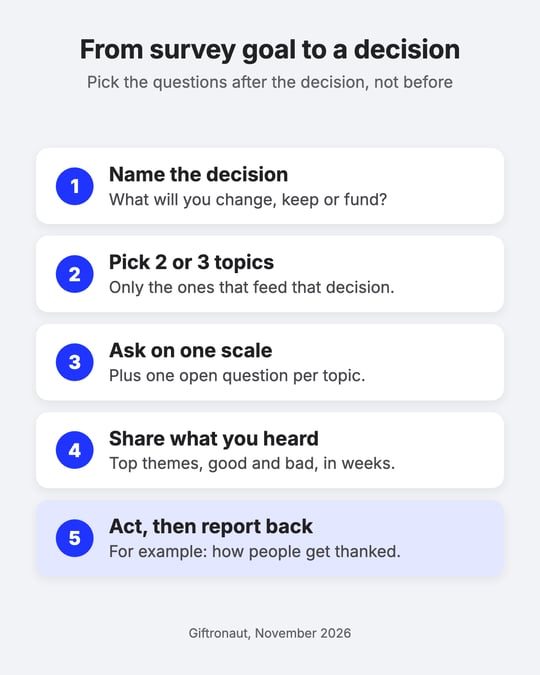
The same pattern works for every goal. If you can’t name the decision in one sentence, you’re not ready to write the questions yet.
Which question types and answer scales work best?
Rating-scale questions should carry most of an employee survey, because they let you compare topics, teams and years on the same numbers. Use one five-point agreement scale (strongly disagree, disagree, neither, agree, strongly agree) for most statements, then add a few open questions, a ranking where trade-offs matter, and multiple choice for facts such as which benefits someone has used.
These are the five question types you’ll use, and what each is good for:
| Type | Best for | Example |
|---|---|---|
| Rating scale | Attitudes you want to track over time | “My workload is manageable most weeks.” (strongly disagree to strongly agree) |
| Multiple choice | Facts and usage | “Which of these benefits have you used this year?” |
| Yes or no | Simple facts with no shades | “Do you know who to talk to about your benefits?” |
| Ranking | Priorities and trade-offs | “Rank these rewards from most to least useful to you.” |
| Open-ended | The reason behind a score | “What gets in the way of doing your best work?” |
A few habits keep the answers clean:
- One idea per question. “How satisfied are you with your manager and the feedback you get?” asks two things, so a low score can’t tell you which one failed. Split it into “My manager is easy to approach” and “I get useful feedback from my manager.”
- Statements, not leading questions. “Don’t you agree our new office is an improvement?” tells people the answer you want. “The new office helps me do my job” lets them disagree.
- The same scale all the way through. Switching between five points, seven points and stars makes results harder to compare and slows people down.
- A neutral middle option. Without it, people who genuinely don’t have a view get pushed into agreeing or disagreeing.
- Open questions in moderation. Two to four is plenty for most surveys. Each one takes longer to answer than a scale question, and someone has to read every reply.
If you track a single headline number, a 0 to 10 scale works for “How likely are you to recommend this company as a place to work?”, which is the question behind an employee Net Promoter Score (eNPS). Keep it separate from the five-point items so the two scales don’t get averaged together.

50 employee survey questions by topic
The 50 questions below are sorted into eight topic groups. Unless a group says otherwise, each one is a statement for the five-point agreement scale (strongly disagree to strongly agree), so you can compare one topic with another; the last group is open-ended, and two questions use a different scale where agreement wouldn’t make sense. Pick two or three groups for your goal rather than sending all 50.
1. Role and day-to-day work
- I have a clear picture of what good work looks like in my role.
- The tasks I spend most of my week on are a good use of my skills.
- I have the tools and resources I need to do my job well.
- My work feels meaningful to me.
- My role fits where I want my career to go.
- Overall, I’m satisfied with my job.
2. Your manager
Report these by team only when the team is big enough to stay anonymous (see the anonymity section).
- My manager tells me clearly what’s expected of me.
- I get useful feedback from my manager at least once a month.
- My manager is easy to approach about problems at work.
- My manager supports my professional development.
- My manager notices good work and says so.
- My manager treats everyone on the team fairly.
- I could raise a concern with my manager without worrying about the consequences.
3. Leadership and management
Use this group to see how people rate management above their own manager: how senior leaders decide, explain and listen.
- I trust the decisions senior leadership makes.
- Leadership explains the reasons behind major decisions.
- I understand the company’s main goals for this year.
- I can see how my work contributes to those goals.
- Leadership listens to employee concerns and acts on them.
- I hear about changes that affect my work before they happen.
4. Team and collaboration
- My team works well together to solve problems.
- I can count on my colleagues for help when I need it.
- Information I need from other teams reaches me in time.
- My team handles disagreements constructively.
- I’m comfortable sharing ideas in team meetings.
- New team members get the help they need to get up to speed.
5. Culture and belonging
The last question uses a 0 to 10 scale instead.
- The company’s values show up in how decisions get made.
- I feel I belong here.
- People here are treated with respect, whatever their background.
- People with different views get heard in meetings.
- I can be myself at work.
- How likely are you to recommend this company as a place to work? (0 to 10)
6. Growth and development
- I’ve learned something new in my role in the past six months.
- I can see a path to grow my career here.
- I get the training I need to do my job well.
- Promotions here go to the people who’ve earned them.
- I’ve had a useful conversation about my development in the past six months.
- I see myself still working here in two years.
7. Workload and well-being
The last question asks how often instead (never, rarely, sometimes, often, always).
- My workload is manageable most weeks.
- I can switch off from work outside my working hours.
- I can take time off when I need it without falling behind.
- Deadlines on my team are realistic.
- The company takes employee well-being seriously.
- In the past month, how often have you felt burned out by work?
8. Open-ended questions
Answer format: free text. Pick two to four of these for any one survey.
- What’s one thing we should start doing to make this a better place to work?
- What’s one thing we should stop doing?
- What gets in the way of doing your best work?
- If you could change one thing about your role, what would it be?
- What would make you more likely to stay here for the next two years?
- When did you last feel your work was recognized, and what made it count?
- Is there anything else you’d like leadership to know?
What should employee survey questions about benefits measure?
Benefits questions should measure three things separately: whether employees know what they have, whether they use it, and whether it’s worth something to them. Mixing the three hides the fix, because a benefit nobody knows about needs better communication, while a benefit people know about and still skip may need replacing.
Use these six questions, each on the scale shown:
- I understand which benefits I’m eligible for. (agreement scale)
- How easy is it to find information about your benefits? (very easy to very hard)
- Which of these benefits have you used in the past 12 months? (multiple choice, select all that apply)
- Our benefits meet my needs. (agreement scale)
- Rank these benefits from most to least valuable to you. (ranking)
- If we could add one benefit next year, what should it be? (open-ended)
Run a benefits survey a few months before your renewal or open enrollment decisions, so the answers can still change something. Benefits answers often touch on health, family and money, so the anonymity rules below matter most here.
The ranking question earns its place. When everything gets rated “important” on a scale, a ranking forces the trade-off your budget will force anyway, and it tells you which benefit to protect if something has to give.
Which questions belong in other employee surveys?
Satisfaction, engagement, pulse, feedback and recognition surveys each have a narrower job than a full employee survey, so each uses a smaller, sharper set of questions. Here’s what each one is for, with three sample questions to start from.
Employee satisfaction survey questions
A satisfaction survey measures how content people are with the parts of the job they experience every day: pay, manager, workload and growth.
- I’m satisfied with my pay for the work I do.
- I’m satisfied with the support I get from my manager.
- I’m satisfied with my opportunities to grow here.
Employee engagement survey questions
An engagement survey measures commitment, motivation and intent to stay, and usually runs once or twice a year.
- I’m proud to tell people where I work.
- I’m motivated to go beyond what my role requires.
- How likely are you to recommend this company as a place to work? (0 to 10)
Employee pulse survey questions
A pulse survey is a short check-in, often three to ten questions, sent weekly, monthly or quarterly between bigger surveys.
- My workload was manageable over the past two weeks.
- I had what I needed from my manager this month.
- What’s one thing that would have made this week easier?
Employee feedback survey questions
A feedback survey collects open input on one project, process or manager, usually right after it ends.
- What worked well on this project?
- What would you do differently next time?
- What’s one thing your manager could do to help you more?
Employee recognition survey questions
A recognition survey checks whether people feel their work is noticed and what kind of thanks they’d value. Three to start with:
- I’ve been recognized for good work in the past month.
- Recognition here goes to the people who’ve earned it.
- I’d rather be recognized in front of the team. (agreement scale)
When the talk turns to what the reward should be, it often comes down to gift cards versus branded merchandise, and we’ve compared how gift cards and swag work for employee recognition.
Which reward-preference questions should an employee survey ask?
Reward-preference questions ask what kind of thanks employees would value, how often they’d like it and who it should come from. A recognition score tells you whether there’s a problem; these three answers turn it into a decision with a format, a frequency and an owner, the last row of the goal table above.
- Which kind of reward would you value most? (time off, a gift card you choose, company merchandise, an experience, a written note)
- How often would you like to hear that your work made a difference? (weekly, monthly, quarterly, at milestones only)
- Who would you most like to hear it from? (your manager, your peers, senior leadership)
Add them to your main survey next to the recognition statements, or send them as a short add-on when you’re about to plan a recognition program. If you’ve already sent rewards and want to know whether they landed, a separate post-reward survey on delivery and product choice asks the follow-up questions.
How long should an employee survey be, and how often should you run it?
An annual employee survey works best at about 15 to 20 questions, two to four of them open, which keeps it near the 7 to 8 minutes where people start dropping out. A pulse survey stays at three to ten questions. Run the full survey once or twice a year, and only send the next one after you’ve reported back on the last.
Length matters more than it looks. In SurveyMonkey’s analysis of a random sample of about 100,000 surveys of 1 to 30 questions, respondents took about 75 seconds on the first question and about 5 minutes for a 10-question survey. Time per question then kept falling, to about 19 seconds per question by questions 26 to 30, and abandon rates rose for surveys that took more than 7 to 8 minutes. Past a certain length, people also answer each question with less care.
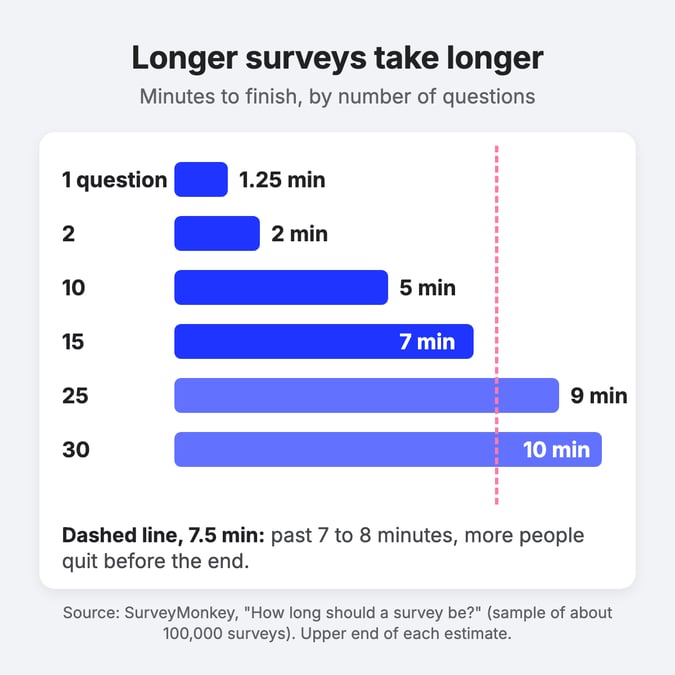
That’s why sending all 50 questions in this bank at once is a bad idea. SurveyMonkey’s figures stop at 30 questions, and 30 already lands at 9 to 10 minutes, past the point where abandon rates rose.
There’s a cost on your side too. Picture a 200-person company sending a 25-question survey that takes 9 minutes. That’s 1,800 minutes, or 30 hours of combined working time, which is a fair price for answers you’ll act on and an expensive one for answers nobody reads.
On frequency, the honest limit is your ability to follow up. Surveying every quarter with no visible change teaches people that answering doesn’t matter. Surveying once a year and acting on the results teaches the opposite.
Response rates follow the same logic. Short surveys, a clear reason, reminders and visible follow-up are the levers to pull first, and we cover the tactics in how to boost survey response rates. Paying employees to complete an internal survey is a weak fit: under IRS Publication 15-B, a gift card given to an employee is taxable wages however small, and rewarding completion means tracking who finished, which works against anonymity.
How do you keep an employee survey anonymous?
An employee survey is anonymous only when no answer, and no combination of answers, can point to one person. That depends on three things: the survey tool’s settings, the demographic questions you add, and the smallest group you’ll report results for.
Start by being exact about what you promise. Anonymous means nobody, including HR, can link an answer to a name. Confidential means someone can, but promises not to share it. Both are legitimate. Calling a confidential survey anonymous is the fastest way to lose people’s trust, so say which one yours is.
Then check these before the survey goes out:
- Ask only the demographics you’ll use. Every extra question (team, location, tenure, age) shrinks the group each person sits in. If you won’t break results down by office, don’t ask for it.
- Use broad bands. “Less than 2 years, 2 to 5 years, more than 5 years” protects people better than exact start dates.
- Set a minimum group size for reports. Decide in advance that no team, office or band gets its own results below a set number of responses, and tell employees what that number is. If your survey tool can hide small groups automatically, switch that on.
- Merge small teams. A two-person team folds into a larger group for reporting, so its answers still count without pointing at anyone.
- Warn about open comments. Ask people not to include names or details only they would know, and limit who reads the raw comments.
Anonymity is also why the questions about your manager need extra care. People rate a manager honestly only when they’re sure the manager can’t work out who said what.
What should you do after an employee survey closes?
After an employee survey closes, thank people, share what you heard within a few weeks, name the two or three things you’ll act on, and report back on progress before the next survey goes out. That follow-up is what makes people answer honestly next time.
It’s also where many organizations fall short, at least in their employees’ eyes. In a May 2023 opt-in survey of 1,068 employees by Quantum Workplace, 65% said their organization doesn’t take effective action on employee survey results. A survey that disappears into a slide deck trains people to skip the next one.
A simple way to close the loop:
- Within a week: thank everyone and share the response rate.
- Within a few weeks: share the main themes, including the uncomfortable ones. Leaving out the bad news is noticed.
- Pick two or three actions, each with an owner and a date. A longer list is harder to deliver and harder to report on.
- Before the next survey: report what changed, in a short “you said, we did” note.
When the survey included recognition and reward-preference questions, the action can be concrete. If people said they’d like to hear more often that their work counted, mostly from their manager, and that they’d rather choose their own reward, you have the outline of a recognition program: managers recognize good work monthly, and the reward is something each person picks.
That’s where Giftronaut fits. Our catalog covers 4,300+ brands in 225 countries, and a Choice Card lets each employee pick the brand when they redeem, from the catalog for their country. Rewards go out by email, SMS (text message, for US and Canadian mobile numbers) or a reward link. Because gift cards given to employees count as taxable wages, plan them with your payroll team from the start.
To show what the program did a few months later, our employee recognition program report post covers what to measure, and the recognition questions from this survey give you the before number to compare against.
Start with the questions you’re ready to act on
These days, before any survey goes out, I read it once as the person in the smallest team, with every demographic answer filled in. Any question that would point straight at them gets merged or cut. The facilities team got its own line in the comments box instead: “Anything we’ve missed?” They used it.
Your next step is small. Write down the one decision this survey has to inform, take two or three topic groups from the 50 questions above, add two open questions, and read the draft as your smallest team would. Then put the date you’ll share results in the calendar before you send it.

Frequently Asked Questions
What are the best employee survey questions to ask?
The best employee survey questions are the ones tied to a decision you’ll act on. Cover the role, manager, leadership, team, culture, growth, workload and benefits, using one agreement scale. Add two to four open questions so you learn why scores are low.
What are the five types of survey questions?
The five common types are rating scale, multiple choice, yes or no, ranking and open-ended. Rating scales suit attitudes you track over time. Open-ended questions explain the reasons behind a score.
Should employee surveys be anonymous?
Most employee surveys should be anonymous, or at least confidential, so people answer honestly. Tell employees which one yours is. Keep demographic questions broad and never report results for groups too small to hide individuals.
How often should you survey employees?
Run a full employee survey once or twice a year and short pulse surveys in between, if you can act on them. Never send a new survey before reporting back on the last one.
Is 50 questions too many for one employee survey?
Yes, 50 questions is too many for one survey. SurveyMonkey’s data shows a 25-question survey taking 7 to 9 minutes, with more people quitting after 7 to 8 minutes. Pick 15 to 20 questions for your goal.