
Employee appreciation gift cards work best when the employee picks the brand and the amount fits the moment: a multi-brand card for most occasions, a single brand only when you know the person uses it. A workable starting point is $10 to $25 for a quick thank-you, $25 to $50 for a project win and $50 to $100 for a milestone, and in the U.S. every one of them counts as taxable wages.
At a previous job, I saved every thank-you for December. My theory was that one bigger card at the end of the year would mean more than a few small ones. In April, a colleague who had spent a weekend rescuing a client launch asked me, very politely, “So do I hear about this in December?” She did. By then the card said “thanks for a great year,” and neither of us could remember which weekend it had been.
That’s the quiet problem with employee appreciation gift cards. Teams spend a lot of energy on which card and how much, and very little on when. Yet the timing is the part people remember, long after they’ve forgotten the amount.
Which employee appreciation gift cards work best?
The employee appreciation gift cards that work best are the ones each person would have picked for themselves. For a team, that usually means a card where each employee chooses the brand after it arrives. A single-brand card works when you know the person well enough to be sure they’ll use it.
Our own sending data points the same way. Rewards where recipients choose their own brand account for 82% of Giftronaut recipients and 82% of total order value (Giftronaut data, September 2026). When people do choose, the brands they pick most often are Amazon.com, the Visa Reward Virtual Account, Walmart, Starbucks and Target, in that order (Giftronaut data, September 2026). Everyday, flexible brands win, which tells you something about what an appreciation card is for: it covers something the person was going to buy anyway, and it feels like a treat because someone else paid.
Here’s how the main types compare when the goal is appreciation rather than a holiday gift:
| Card type | When it fits | Watch out for |
|---|---|---|
| Multi-brand card (recipient chooses) | Mixed teams, people you don’t know well, staff in several countries | Write a real message, or it can feel like a voucher |
| Everyday retail or online shopping | Most U.S. teams, any occasion | Choose the country version that matches where the person lives |
| Coffee or lunch | Quick thank-yous, peer-to-peer moments | Too small for a milestone |
| Food delivery | Long weeks, late launches, parents of young kids | Coverage varies by city |
| Wellness, fitness or spa | After a demanding stretch | Only if the person would actually book it |
| Streaming or entertainment | Light, fun thank-yous | A card for a service someone doesn’t use goes unspent |
| Travel or experiences | Big milestones and long service | A small amount won’t cover much, so save these for larger awards |
A few patterns hold across all of these.
Choice beats a clever pick for groups. A card for one store can be perfect for one person and useless to the next. When you’re thanking a whole team, letting each person choose removes the guesswork, and nobody has to pretend they love a brand they never use.
A single brand still has its place. If a teammate mentions the same coffee shop every morning, a card for that shop says you were paying attention. That’s a stronger thank-you than a generic card, as long as you’re right about the habit.
Country matters more than people expect. Gift cards are issued for one country and can’t be redeemed in another, even when the brand is the same, so an Amazon.com card won’t work on Amazon.co.uk. That alone is a reason to let anyone outside your home country choose their own card.
If you want a longer list of individual cards to compare, our guide to the best gift cards for employees ranks them one by one. For appreciation, the bigger decisions are how much to send and when.
How much should an employee appreciation gift card be?
An employee appreciation gift card should be sized to the moment it thanks, from about $10 to $25 for a quick thank-you to $50 to $100 for a real milestone. Those are starting points, not rules or survey results. What matters more is that you plan them inside a per-person budget for the year, so the small moments don’t get skipped to pay for the big ones.
For a budget anchor, the best recent number comes from a Milliman pulse survey of employers published in February 2023. The median recognition budget was $100 per employee per year, and the average was $139.71. Those figures include the cost of running the program, not just the rewards, so the money that actually reaches employees is a little lower.
Here’s how the starting points line up by occasion:
| Occasion | Starting range per person | Why this size |
|---|---|---|
| Quick thank-you (covered a shift, fixed a problem fast) | $10 to $25 | About the price of a coffee or lunch, so the note carries the meaning |
| Project win or goal reached | $25 to $50 | Big enough to notice without turning into a bonus |
| Employee Appreciation Day, whole team | $15 to $25 | Small per person because it goes to everyone at once |
| Work anniversary or other milestone | $50 to $100 | Grows with the milestone, such as five or ten years |
| Above-and-beyond effort (a weekend rescue) | $50 to $100 | Rare by design, so it stays meaningful |
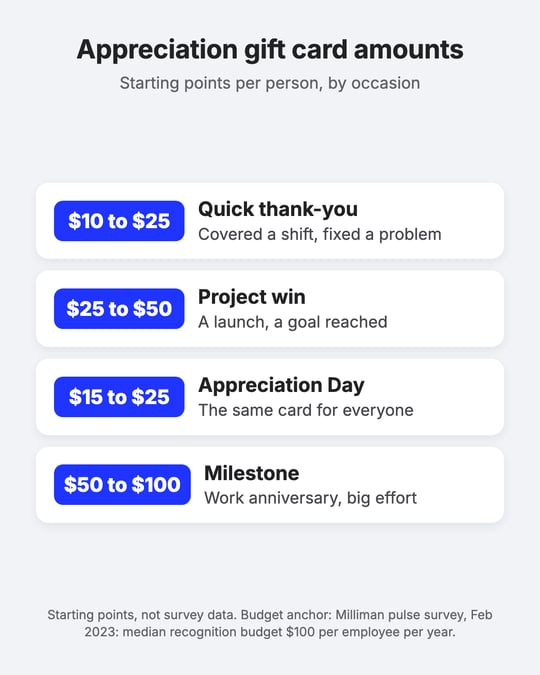
The numbers mean more once you run them for a real team. Take a 40-person team with a $100 annual budget per person, about the Milliman median. That’s $4,000 for the year. One employee’s year might look like a $20 card on Employee Appreciation Day, a $40 card for a project win and two $20 thank-yous, which comes to exactly $100. Someone with a five-year anniversary that year will go over, and that’s fine, because plenty of others won’t have one.
A few rules keep the amounts fair without a spreadsheet war:
- Set amounts per person, not as a total. A total for “the team” breaks the moment someone joins. A per-person amount for each occasion keeps working as headcount changes.
- Apply the same amount to the same occasion. If one manager gives $25 for a project win and another gives $100, people notice. Agree on the ranges once and write them down.
- Tie tiers to the moment, not the job title. A larger card for a larger contribution is easy to explain. A larger card because someone is more senior is harder.
- Don’t let a small budget stop you. A $15 card with a note that names exactly what someone did often lands better than a bigger card with “thanks for all you do.” The amount sets the tone. The note does the thanking.
One practical detail: every gift card product has its own minimum and maximum value, so check that your amount is allowed for the card you pick. On Giftronaut, about three quarters of the products issued in U.S. dollars start at $5, so even the smallest thank-you amount usually works (Giftronaut data, September 2026).
If you’re building the budget for a whole recognition program rather than individual moments, our guide on how to choose employee recognition gift cards for your program covers the program design side.
When should you give employees a gift card?
An employee gift card lands hardest close to the moment it thanks, while the person and everyone around them still remember what happened. A card that arrives the same week as the win says “we saw that.” The same card months later says “it was your turn.”
Appreciation moments fall into two groups. Some you can see coming, so you can plan them. Others happen as the work gets done, so you need a way to act quickly.
Moments you can plan:
- Work anniversaries and service milestones. The date is already in your HR records, which makes these the easiest to get right and the most awkward to miss. Our guide to work anniversary gifts has ideas by milestone year, and you can automate birthday and work anniversary gift cards so they go out on the day.
- Employee Appreciation Day. A whole-team thank-you with a fixed date. Our list of Employee Appreciation Day gifts covers ideas for the day itself.
- Onboarding milestones. The end of a first month or a finished probation period is a natural point to say the new person has made a difference already.
- The year-end gift. Plenty of companies still do one, and it can sit alongside everything here. Our guide to Christmas gift cards for employees covers that season.
Moments that happen as the work does:
- Project launches and wins. A shipped feature, a closed deal, a passed audit.
- Someone stepping in. Covering a shift, taking a customer call nobody wanted, staying late to unblock a teammate.
- Peer nominations. When a teammate puts someone forward, a small card turns the nomination into something the person can see.
- After a hard stretch. A month of overtime, a system migration or a busy season. A card here is a thank-you for stamina as much as results.
The planned moments mostly take care of themselves once they’re on a calendar. The unplanned ones are where appreciation gets lost, usually because nobody owns them. Give managers a small amount they can send without approval for quick thank-yous, and a clear person to ask for anything larger. Speed matters here, and so does follow-through on the other side: in Giftronaut data from 45,162 redeemed rewards, 51.6% were redeemed within one day of being sent (Giftronaut data, September 2026). People open a thank-you quickly when it arrives while the moment is still fresh.
Staff appreciation gift cards for frontline and hourly teams
Staff appreciation gift cards need a little more planning for frontline, hourly and part-time teams, because those employees often don’t sit at a desk or check a work inbox. The card itself is the same. What changes is how it reaches people, and who gets included.
Think of a school’s support staff, a clinic’s front desk, a warehouse shift or a retail floor. The appreciation is just as earned, but a reward email sent to a company address nobody opens is a thank-you that never lands. Three choices make the difference:
- Pick a delivery channel people actually check. Email works for office teams. For staff who live on their phones, text message delivery is often better. Giftronaut sends Choice Cards by text to US and Canadian mobile numbers at no extra cost, so for staff elsewhere, use email or a reward link instead.
- Use reward links when you don’t have contact details. A reward link can be shared through your own channels, such as a team chat or an internal messaging app, and doesn’t need recipient details when you place the order. On Giftronaut, the reward link download feature has to be turned on for your account first.
- Include everyone who did the work. Part-time staff, contractors on the floor and the night shift are easy to leave off a list built from an email directory. Decide up front who’s in, and say so in the message. (Contractors aren’t employees for tax purposes, so check with payroll how their rewards are handled.)
For whole-staff moments, an equal amount for everyone is usually the cleanest choice. It’s easy to explain, and nobody has to wonder why their card was smaller. Save different amounts for individual moments, where the reason is obvious.
How to personalize an appreciation gift card
Personalizing an appreciation gift card mostly means writing a message that names what the person did. Design and branding help, but a specific sentence is what people remember. Message wording deserves a guide of its own, so here’s the short version: one specific action, one line on why it mattered, and the person’s name.
Beyond the message, a few touches make the card feel like it came from your company rather than a store:
- Use the person’s name. Personalization tokens can insert each recipient’s first or last name into the subject line and message, so a bulk send still reads like a note to one person.
- Brand the email. A brand template adds your logo, colors and sender name, so the reward arrives from your People team and not from a service employees don’t recognize. With White Label turned on, your branding carries through to the pages where employees redeem.
- Match the design to the moment. A Choice Card can use one of the ready-made designs, a design made with AI or an image you upload, so a launch thank-you doesn’t look like a birthday card.
- Attach something extra. A one-page note from a leader, a team photo or a certificate can go along as an attachment.
- Tailor it by team. A sales team that just closed its quarter and an engineering team that kept the systems running deserve different messages, even if the cards are the same size.
One more habit worth stealing: send the test email to yourself before the real one goes out. A wrong name or a merge field that didn’t fill in is a small error that reads as a big one.
What works for remote and international teams?
Appreciation gift cards for remote and international teams work best as digital cards that each person can redeem in their own country and currency. Physical cards and mailed gifts run into shipping times, customs and wrong addresses. A digital card arrives the same day wherever the person lives.
Country is the detail that trips teams up. Gift cards are issued for one country, so a card bought for your head office can be useless to a teammate abroad. On Giftronaut, about 98% of products are tied to exactly one country (Giftronaut data, September 2026). The fix is to let each recipient choose:
- Recipient choice avoids guessing. With a Choice Card, the recipient selects their country and currency when they redeem and picks from the brands available there. You don’t need to know where someone lives to send it.
- Send the whole team in one order. Upload a spreadsheet of recipients, give each person their own amount, and deliver by email or reward link, or by text to US and Canadian mobile numbers. Everyone still picks their own card.
- Coverage is broad, but not equally deep. Giftronaut reaches 225 countries, with local gift cards in 71 of them. Where there’s no local catalog, a global option such as the Global Visa Reward Card, usable in 223 countries, covers the gap.
- The message can match the person’s language. Reward emails can be translated into any of 15 languages, so a thank-you to the team in Manila reads as naturally as one to the team in Chicago.
- Time the send for the recipient. Smart Orders let you set a time zone and send time, so a thank-you doesn’t land at 3 a.m. Group recipients by region if your team spans several time zones.
- Plan for company email filters. Corporate security filters sometimes hold reward emails. Ask the recipient’s IT team to allowlist no-reply@giftronaut.com and the giftronaut.com domain before a large send.
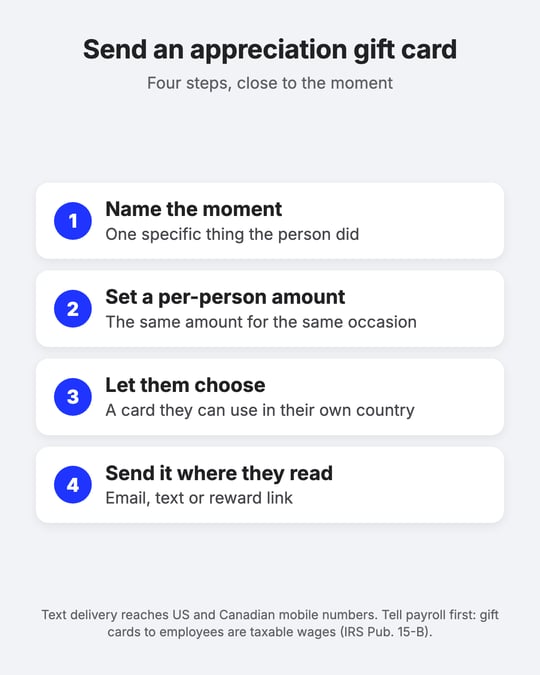
For remote employees, the card itself can carry less of the weight than you’d expect. What remote staff miss most is the moment around it: the team noticing out loud. Pair the card with a mention in a team call or channel, and it stops being a transaction that arrived in an inbox.
Are employee appreciation gift cards taxable?
Employee appreciation gift cards are taxable in the U.S. at any amount: gift cards given to employees count as wages and go through payroll. IRS Publication 15-B says cash and cash equivalents, including gift cards and gift certificates, “no matter how little, are never excludable as a de minimis benefit.”
This catches teams out because the same publication lists holiday or birthday gifts, other than cash, with a low fair market value as de minimis benefits that can be tax-free. A $10 gift card is not one of them. The amount doesn’t change the rule; only the form of the gift does.
The same goes for long-service awards. Publication 15-B allows a tax exclusion for certain length-of-service and safety awards, but only for tangible personal property. It states that the exclusion “doesn’t apply to awards of cash, cash equivalents, gift cards, gift coupons, or gift certificates.” A ten-year anniversary gift card is taxable like any other.
What this means in practice:
- Tell payroll before the order goes out, not after. They need each employee’s name and amount to report it as wages.
- Decide whether to cover the tax. If you want the employee to keep the full face value, ask payroll about grossing up the amount so withholding doesn’t come out of the card.
- Keep employee and non-employee rules apart. W-9 and 1099 forms are for recipients who aren’t employees, such as contractors. They’re not how employee gift cards are handled.
Our gift card taxation hub covers how gift cards are treated for other kinds of recipients. For your own program, check with your payroll team or tax adviser.
Mistakes that make an appreciation gift card fall flat
Most appreciation gift cards that fall flat do so for the same handful of reasons, and none of them is the amount.
- Sending everyone the same single brand. It feels fair, but a card for a store someone never visits is a thank-you they can’t use. Let people choose, or be sure of the brand.
- Arriving long after the moment. The longer the gap, the more the card reads like routine. Send it within days, not months.
- Skipping the message. A card with no note feels like an expense. A card with one specific sentence feels like recognition.
- Forgetting payroll. A surprise on someone’s pay stub undoes some of the goodwill. Tell payroll first.
- Leaving people off the list. Night shifts, part-timers and remote staff are the easiest to miss and the quickest to notice.
- Making the amount the headline. “Here’s $50” puts the focus on the money. “Thanks for the weekend you gave the launch” puts it on the person.
How Giftronaut handles employee appreciation gift cards
Giftronaut lets HR teams and managers send appreciation gift cards one at a time or to a whole team, with each person choosing the reward they want. Here’s how that works for each kind of appreciation moment:
- Let each employee choose. The Choice Card lets recipients pick from 4,300+ brands in 225 countries, in their own currency. You can also limit the brands shown, or send a single-brand Branded Card when you know what someone wants.
- Send different amounts in one order. Upload a spreadsheet of recipients and assign a different amount to each person, so a project win and a quick thank-you can go out together.
- Put dated moments on autopilot. Smart Orders send rewards on key dates such as birthdays, work anniversaries and onboarding milestones once the order is set live. Your balance is deducted 24 hours before each send, so keep the account funded ahead of the date.
- Deliver where people read. Rewards go by email, SMS (text message) or reward link, sent right away or scheduled. Text delivery reaches US and Canadian mobile numbers.
- Brand every send. Brand templates add your logo, colors and sender name, and White Label carries your branding through to the redemption pages.
- See where each order stands. Order Management lists every order with its real-time status.
- Recover unused value if you choose. The Refund Option returns 50%, 40% or 30% of unredeemed value for a 30-, 60- or 90-day window. It must be selected when you place the order and covers only fully unredeemed rewards; the default 180-day window has no refund.
On cost, you pay face value for the rewards you send, with no subscriptions, per-seat fees or setup costs. ACH and wire funding are free, and credit card deposits carry a 3% processing fee. Our employee rewards page shows how teams use it for recognition, milestones and incentives, and our guide to corporate gift cards covers choosing, funding and sending them more broadly.
Start with the next win, not the next holiday
These days, I keep a running note with a date and the one thing someone did, and the card goes out the same week. December still happens. It just doesn’t have to remember the whole year on its own.
You don’t need a full program to start. Pick one moment that happens on your team this month, such as a project wrap-up or someone covering for a colleague. Set a per-person amount for that kind of moment, tell payroll, and write one sentence about what the person actually did. Then send it while everyone still remembers why.

Frequently Asked Questions
Is a $25 gift card enough to thank an employee?
Yes, for a quick thank-you or a project win. Save $50 to $100 for milestones, and plan the year inside a per-person budget; a 2023 Milliman survey found a median of $100.
When are the best times to give gifts to employees?
Give them close to the moment they thank. Good times include work anniversaries, project wins, Employee Appreciation Day, onboarding milestones and the end of a hard stretch, not only the year-end holidays.
What gift cards work for remote employees in other countries?
A multi-brand card works best, because gift cards are issued for one country. With a Giftronaut Choice Card, each employee picks their country and currency at redemption and chooses from local brands.
Do employees pay tax on a small gift card from work?
Yes, in the U.S. IRS Publication 15-B treats gift cards given to employees as taxable wages at any amount, never as a de minimis benefit. Tell payroll before you send them.
Can I send different amounts to different employees in one order?
Yes. On Giftronaut, you can upload a spreadsheet of recipients and assign a different reward amount to each person in the same order.
Can employee appreciation gift cards be sent by text message?
Yes, for US and Canadian mobile numbers. Giftronaut sends Choice Cards by text to those numbers at no extra cost; for other countries, send by email or reward link.
Is a gift card a good way to show employee appreciation?
Yes, when it comes with a specific message and arrives close to the moment. The card covers something they’d buy anyway, and the note tells them exactly what was noticed.