Is it safe to buy digital gift cards? Yes, when you buy from the brand itself or a seller you can verify, and no when the price looks too good to be true or a stranger insists you pay in gift cards.
A digital gift card is a code, and a code works a lot like a house key: it opens the door for whoever is holding it. The card isn’t the weak spot. What matters is who sold you the key, and who else gets a look at it on the way to the person you meant to give it to.
Most of the advice below comes back to those two questions. Let’s start with how digital cards stack up against the physical kind.
Are digital gift cards safer than physical gift cards?
In some ways yes and in others no. The risks change rather than disappear, so it helps to see where each type can go wrong.
| Where it can go wrong | Physical card | Digital card |
|---|---|---|
| Tampered with before you buy | Possible. The FTC warns that scammers sometimes tamper with gift cards in store displays | No store rack to tamper with |
| Lost or intercepted after you buy | Can be lost in a wallet or the mail | Can be seen by anyone who gets into the inbox or message it was sent to |
| Sent to the wrong person | The wrong address on an envelope | A typo in an email address |
| Fake or stolen card | Possible from any unverified seller | Possible from any unverified seller |
The rack problem is worth a closer look. In a December 2024 consumer alert, the FTC explains that with the card numbers from a tampered card, a scammer can get any money you put on it, even without holding the card.
A digital card skips the rack and the post office. It adds phishing messages and typos. For the full comparison, see our guide to digital versus physical gift cards.
What are the real risks when you buy digital gift cards online?
There are five worth knowing.
Fake or already-used cards from discount sellers
Some sites sell digital cards well below face value. The FTC’s advice is to avoid buying gift cards from online auction sites (page dated July 2023) because the cards may be fake or stolen.
Say a $100 card is listed for $60. Someone is absorbing that $40, and it usually isn’t the seller. For a closer look at one marketplace, here is how eBay gift card scams work and how to avoid them.
Phishing messages that look like a delivery
A text saying “your gift card is ready, claim it here” is the classic bait. Don’t click it, and don’t reply to it either. Check with the person who supposedly sent the card, using a number or address you already have.
For example, Giftronaut reward emails come from “Team Giftronaut” at no-reply@giftronaut.com, and our Help Center tells recipients to verify with their sender before clicking anything that looks suspicious.
Bots that guess card codes
Automated code guessing is a recognized threat. OWASP, which catalogs web security risks, lists brute-forcing gift cards, vouchers and coupons as one of its automated threats.
You can’t stop that as a buyer, but you can choose a seller that handles it. When a Giftronaut recipient clicks the redemption link for a prepaid card, the card number and PIN are generated at that moment, so no one could have used the card before then.
Someone telling you to pay in gift cards
This one flips the problem around. The danger isn’t buying a card, it’s being asked to pay with one. The FTC says it plainly: no real business or government agency will ever tell you to buy a gift card to pay them, and if someone does, it’s a scam.
A code sent to the wrong person
One mistyped letter in an email address can send a card to a stranger. We cover the fix further down, because it depends on who sold you the card.
How can you tell a digital gift card seller is legit?
Run through these before you enter any payment details:
- Start at the brand. Go to the brand’s own site or a retailer you already know. If you land on an unfamiliar site from an ad or a message, stop there.
- Do the discount math. A small promotion is normal. A card at 40% off isn’t a promotion, it’s a question you should ask before paying.
- Look for a company behind the site. A real seller names its company and lists contact details and policies. For platforms, independent reviews help, such as Giftronaut’s G2 reviews.
- Treat the padlock as the minimum. The “https” padlock tells you the connection is encrypted. It doesn’t tell you who is on the other end, and scam sites can have one too.
- Hand over only what’s needed. A gift card purchase shouldn’t ask for your Social Security number or date of birth.
- Protect the code afterward. Redeem it or save it somewhere safe soon after it arrives, and don’t post it or pass it along.
What should you do if a digital gift card goes to the wrong person?
Act fast and contact the seller, because what you can do depends entirely on their rules.
Here’s how it works on Giftronaut. A recipient can’t change the email address their reward was sent to, but the original sender can update the address and resend it. According to our Help Center, you do it from Order Management, then Order History.
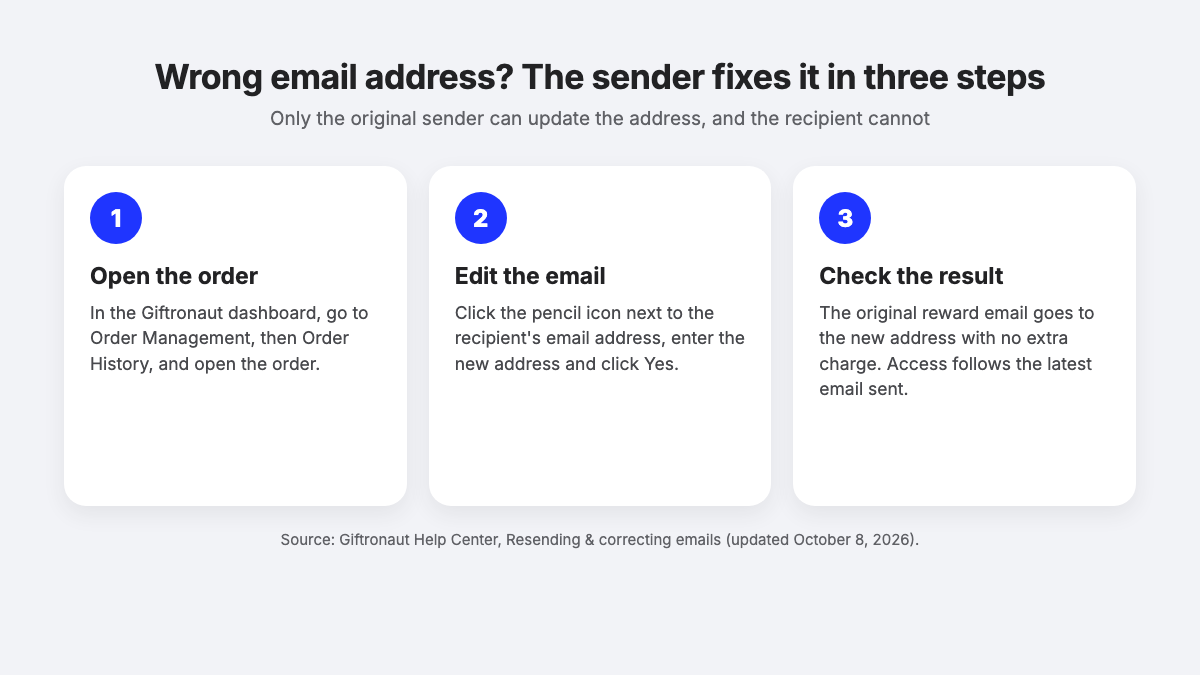
Resending doesn’t reduce the balance or add a charge, though several resends in a short time can trigger spam filters. The original link stays valid, but access follows the latest email you send.
Now the honest catch. Once a reward has been redeemed, even partly, it can’t be reclaimed through the Refund Option, and a fulfilled order can’t be canceled, returned, exchanged or refunded. So the fix that always works is the boring one: check the address before you send.
How does Giftronaut keep digital gift cards safe for business senders?
Giftronaut is a digital gift card platform for businesses, powered by Wincube Inc, which has run B2B online gifting since 2011 (Giftronaut About Us). Here is what that means for the safety questions above:
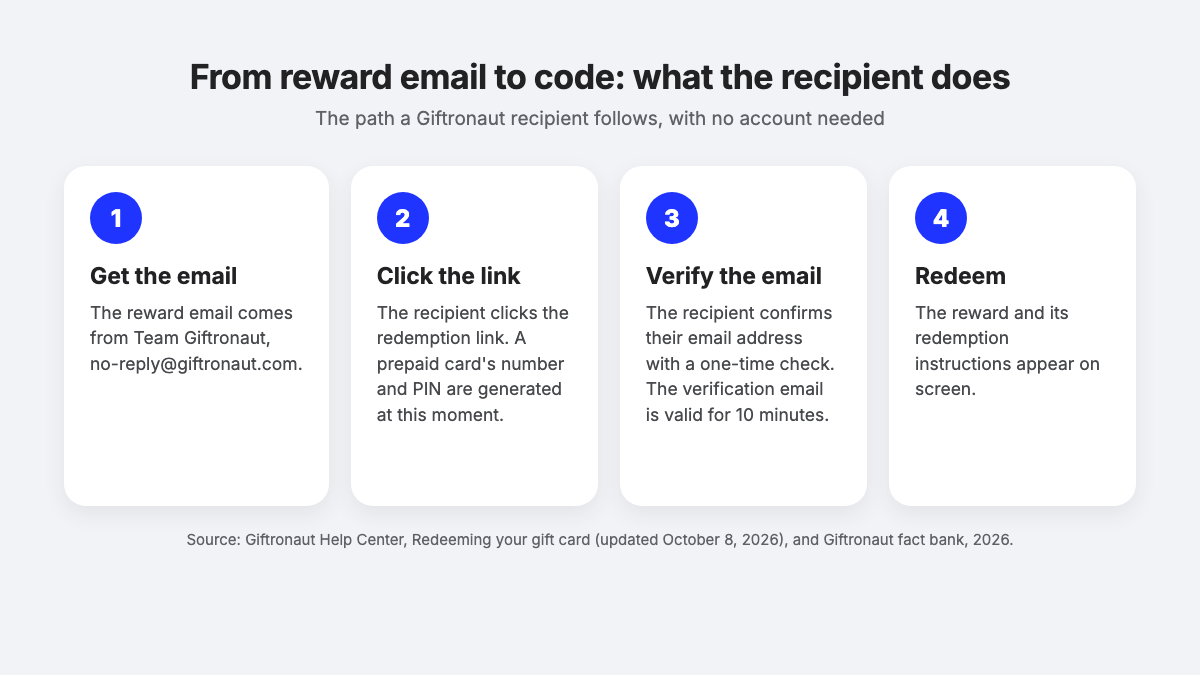
- Recipients verify before they redeem. The reward email comes from Team Giftronaut. The recipient clicks the redemption link, confirms their email address through a one-time verification step and only then reaches the redemption page. The verification email is valid for 10 minutes, and a new one can be requested. Recipients don’t need an account.
- Prepaid card details appear when they’re needed. The number and PIN are generated when the recipient clicks the redemption link, not when the order is placed.
- Senders can fix a wrong address. We walk through it in our Help Center guide to resending and correcting emails.
- New business accounts are checked. The first pre-fund deposit for a new business account is held while we verify the business, and most reviews finish within one business day.
- Sanctioned countries are blocked. Access is blocked from 12 countries covered by US sanctions.
Here is the recipient’s path from email to code. Our guide to how digital gift cards are delivered covers delivery in more detail.
With a Choice Card, recipients pick their own reward from 4,300+ brands in 225 countries, including Amazon, Visa, Starbucks and Target. Gift cards are country-specific, so a card can’t be redeemed in a country other than the one it was issued for. If you send rewards to employees, our best practices for secure employee gift card delivery go further.
Safe gift card buying comes down to who holds the code
Back to the house key. You wouldn’t hand a copy to a stranger who offered a bargain, and you wouldn’t leave one where anyone could pick it up. Digital gift cards ask for the same habits.
Before your next purchase, check the seller first, then the price, then the recipient’s address. That takes about a minute and covers nearly every risk in this guide.

Frequently Asked Questions
Is it safe to buy digital gift cards online?
Yes, when you buy from the brand, a retailer you know or a platform you can verify. The risks come from discount resale sites, phishing messages, typos in the recipient’s email address and anyone who asks you to pay in gift cards.
Is it safe to buy digital gift cards from discount websites?
It’s the riskiest place to buy them. The FTC advises against buying gift cards from online auction sites because the cards may be fake or stolen, and a steep discount is a reason to check the seller more carefully, not a reason to hurry.
Are digital gift cards safer than physical gift cards?
Neither is safer in every case. Digital cards avoid tampering on a store rack and loss in the mail, but they add phishing messages and the chance of a mistyped email address, so the safer card is the one bought from a seller you can verify.
How can I tell if a digital gift card website is legit?
Look for a named company with contact details and policy pages, check independent reviews and compare the price with the card’s face value. A padlock in the address bar only means the connection is encrypted, so it isn’t proof the seller is honest.
Is it safe to buy and send digital gift cards by email?
Yes, if you double-check the address before you send. On Giftronaut, the recipient also confirms their email address through a one-time verification step before reaching the redemption page.
What happens if I send a digital gift card to the wrong person?
On Giftronaut, only the original sender can update the email address and resend the reward, and resending doesn’t reduce the balance or add a charge. A reward that was already redeemed can’t be reclaimed through the Refund Option, so check the address before you send.
Is Giftronaut legit?
Yes. Giftronaut is powered by Wincube Inc, which has run B2B online gifting since 2011, and recipients rate their redemption experience 4.87 out of 5 on average across 2,906 ratings (Giftronaut data, September 2026). You can also read independent reviews on G2.