
Employee recognition awards are named honors a company gives for a specific contribution, such as strong performance, living the company’s values, a service milestone, a new idea or great teamwork, usually with a reward attached. To run them fairly, pick a few categories with written criteria, set three tiers (spot, quarterly and annual) with a known reward at each, and let a few people from different teams choose winners from nominations that describe what the person actually did.
At a previous job, I sat on the panel that picked the quarterly “above and beyond” award. The panel read eleven nominations over sandwiches and chose the one that made the whole table nod: three warm paragraphs from a manager who wrote beautifully. The runner-up’s nomination was two lines long. Her manager stopped by my desk the next morning. “She fixed the billing outage. I just can’t write.” He was right on both counts.
That’s the quiet risk in most award programs. The prize goes to the most polished story instead of the strongest work, and the rest of the team notices.
The fix is mostly structure. You need good award ideas, and there are 50 below, sorted by category and by role. Then you need the parts that decide who wins: tiers with a reward at each level, a nomination process that rewards the work, and a way to get the reward to every winner, including the ones who work three time zones away.
What Are Employee Recognition Awards?
Employee recognition awards are named honors, such as “Customer Champion” or a five-year service award, that a company gives an employee for a specific contribution. Most come with something to keep: a gift card, a certificate, a plaque or extra time off. Unlike an everyday thank-you, an award has criteria, a schedule and a decision behind it, so the whole team will judge it by whether it was fair.
Every working award has five parts:
- A name people remember.
- Criteria written before anyone is nominated.
- A schedule: any week, every quarter or once a year.
- A reward that’s the same for every winner at that level.
- A decider: a named person or panel.
If one of the five is missing, people fill the gap with guesses, and the guesses are rarely generous.
Do recognition awards actually help retention?
Recognition that employees feel is linked to lower turnover. Gallup and Workhuman tracked nearly 3,500 employees from 2022 to 2024 and found that well-recognized employees were 45% less likely to have turned over after two years (Gallup, September 2024). The same research found that just 22% of employees say they get the right amount of recognition for the work they do.
Read those two numbers together. Most people feel under-recognized, and the ones who feel well recognized are much more likely to still be around in two years. That’s a correlation across many companies, not a promise for yours. It does suggest that what counts is recognition people actually notice and believe, which is what a fair award program is built to deliver.
What Are the Main Categories of Employee Recognition Awards?
Most employee recognition awards fall into five categories: performance, values and behavior, service milestones, innovation, and teamwork. Picking two or three categories, rather than all five at once, keeps each award rare enough to mean something. Below are 25 award ideas, five per category, each with the kind of evidence that should earn it.
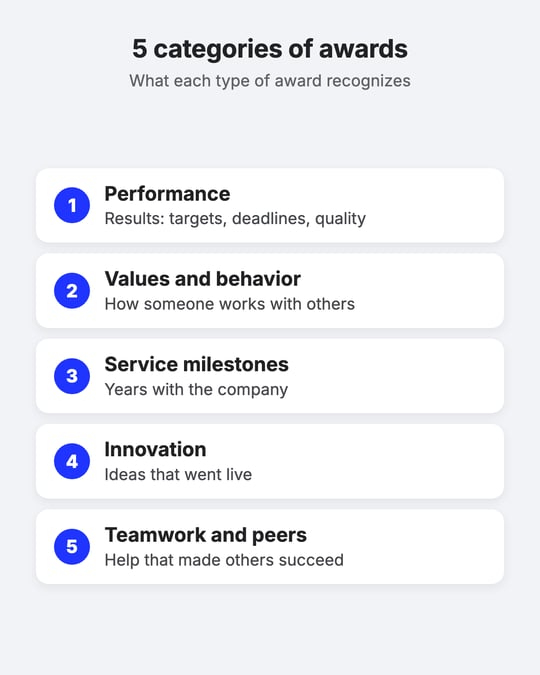
Performance awards
Performance awards recognize results someone can point to: a target beaten, a deadline met, a number moved. They’re the easiest to judge fairly because the evidence usually already exists in a report.
- High Achiever Award: beat a stated target two quarters in a row, whether that’s a quota, a backlog or a delivery date.
- Quality Performer Award: produced work that needed the fewest corrections in the period, judged from your own quality checks.
- Turnaround Award: took a struggling account, project or metric and brought it back on track.
- Rookie of the Quarter: the newer hire whose results ramped up fastest in their first year.
- Clutch Player Award: delivered under an unusual deadline without cutting corners.
Employee of the Month is the classic performance award, and it has its own rhythm and pitfalls. Our guide to employee of the month ideas that aren’t boring covers how to run one.
Values and behavior awards
Values awards recognize how someone works, not only what they deliver. They make a company’s values visible in a way a poster in the kitchen never will, but only if every award names the moment that earned it.
- Integrity Award: raised a problem early when staying quiet would have been easier.
- Above and Beyond Award: stepped well outside their role to help a customer or colleague.
- Culture Champion: made one company value concrete, for example by fixing how new hires are welcomed.
- Employee Advocate Award: improved something about colleagues’ day-to-day working life.
- Customer Hero Award: turned an unhappy customer into a loyal one.
Service milestone awards
Service awards recognize time with the company, usually at set anniversaries such as one, five, ten and twenty years. They’re predictable, which is their strength: nobody has to be nominated, so nobody gets missed.
- Years of Service Award: given at each milestone anniversary you choose.
- First-Year Award: marks the end of a new hire’s first year, often the year people decide whether to stay.
- Legacy Award: long tenure plus something they built that the company still uses.
- Institutional Memory Award: for the person everyone asks how things actually work.
- Mentor Milestone Award: for long-serving staff who have trained a run of new colleagues.
For tenure reward ideas beyond the plaque, see our post on digital service award gift cards.
Innovation awards
Innovation awards recognize ideas that changed how the company works, not ideas that sounded clever in a meeting. The fairest version only counts an idea once it’s live.
- Best Idea Shipped: an idea that went from suggestion to a working change within the period.
- Process Fixer Award: removed a step, a meeting or a manual task from a team’s week.
- Disruptor Award: challenged an accepted way of working and turned out to be right.
- Design Excellence Award: created a design that made something easier to use.
- Fail-Forward Award: ran an experiment that didn’t work and wrote it up so others could learn from it.
Teamwork and peer awards
Teamwork awards recognize what one person makes possible for others. Many of them work best when peers nominate, because colleagues see help that managers miss.
- Best Team Player: consistently picked up work so the team could hit a shared goal.
- Bridge Builder Award: got two teams that rarely talk to work together.
- Peer’s Choice Award: chosen by a vote among colleagues, with a one-line reason for each vote.
- Unsung Hero Award: for behind-the-scenes work that kept something running.
- Onboarding Buddy Award: helped a new colleague get productive quickly.

Employee Recognition Award Ideas by Role
Role-based employee recognition award ideas work because each team already tracks its own wins, so the criteria are easy to write and hard to argue with. Use them alongside the five categories, or instead of them if your company is organized mainly by function. Here are 25 more, five for each of five common roles.
Sales teams
- Quota Crusher: exceeded quota for the quarter.
- Deal Closer of the Quarter: closed the most important or difficult deal.
- Top Lead Generator: sourced the most qualified opportunities.
- Negotiation Master: protected price or terms on a hard negotiation.
- Sales Mentor: coached a newer rep to their first closed deal.
Marketing teams
- Campaign of the Quarter: ran the campaign that beat its goal by the widest margin.
- Brand Builder: improved how the company is seen, in press, events or social.
- Content Creator Award: produced the piece customers and sales used most.
- Search Wizard: grew organic traffic or rankings for an important page.
- Experiment of the Quarter: ran the most useful test, whatever its result.
Customer service teams
- Customer Champion: earned the most specific praise from customers.
- Fast Fixer: resolved urgent issues quickly without reopening them.
- Top Troubleshooter: took on the most complex cases.
- Client Care Award: kept a long-term customer relationship healthy.
- Satisfaction Specialist: held a consistently high customer satisfaction score.
Remote workers
- Virtual MVP: kept a distributed project moving across locations.
- Async Ace: wrote updates so clear that meetings got cancelled.
- Time Zone Bridge: made handoffs between regions work.
- Remote Problem Solver: fixed a technical or logistical block without waiting for help.
- Meeting Master: ran remote meetings that ended early with decisions made.
In-office workers
- Office Dynamo: kept morale up and was always willing to help.
- On-the-Spot Problem Solver: fixed a workplace snag before it became a ticket.
- Collaboration Guru: pulled people together across desks and teams.
- In-Office Mentor: coached colleagues day to day.
- Community Builder: made the office a place people wanted to be.
Remote awards come with one practical wrinkle: the winner isn’t in the room when you announce it, and the reward has to reach wherever they live. The product section below covers that step.
How Should You Set Award Tiers and Reward Amounts?
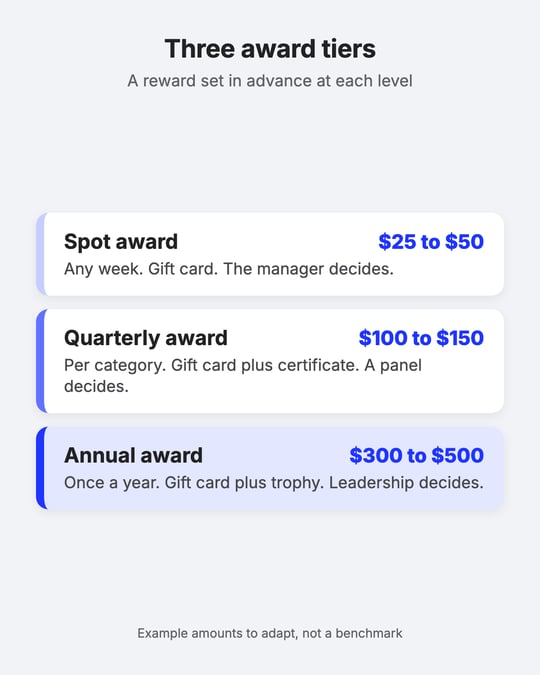
A three-tier structure covers most employee recognition awards: spot awards for single moments, quarterly awards for each category and one annual award for sustained impact. Each tier needs a reward amount set before the first nomination, so every winner at that tier gets the same thing and nobody negotiates afterward.
| Tier | Example reward | Who decides |
|---|---|---|
| Spot award, any week | $25 to $50 gift card | The employee’s manager, within a monthly budget |
| Quarterly award, per category | $100 to $150 gift card plus a certificate | A small panel, from nominations |
| Annual award | $300 to $500 gift card plus a trophy or plaque | Leadership, from the year’s quarterly winners |
These amounts are a starting point to adapt to your budget, not a benchmark. What matters more than the exact figure is that the gap between tiers is visible, so a quarterly win feels bigger than a spot award and the annual award feels like the top of the ladder.
Take a 120-person company with three quarterly categories. Eight spot awards a month at $50 come to $4,800 a year. Three quarterly winners at $150, four times a year, add $1,800. Two annual winners at $500 add $1,000. The total is $7,600, or about $63 per employee per year, before any trophies.
Spot awards end up carrying most of the budget. That’s intentional: they’re the tier people see most often, and they catch good work in the week it happens. If you want to go further with them, our spot bonus guide covers how spot rewards work.
One tax point applies at every tier: the IRS treats gift cards given to employees as taxable wages however small (IRS Publication 15-B), so loop in payroll and see our gift card tax guide for the rules.
How Do You Choose Award Winners Fairly?
Fair award winners come from three things set before nominations open: written criteria for each category, a nomination form that asks for a specific example, and more than one person deciding. When any of the three is missing, the award drifts toward whoever is most visible or whoever has the most persuasive manager.
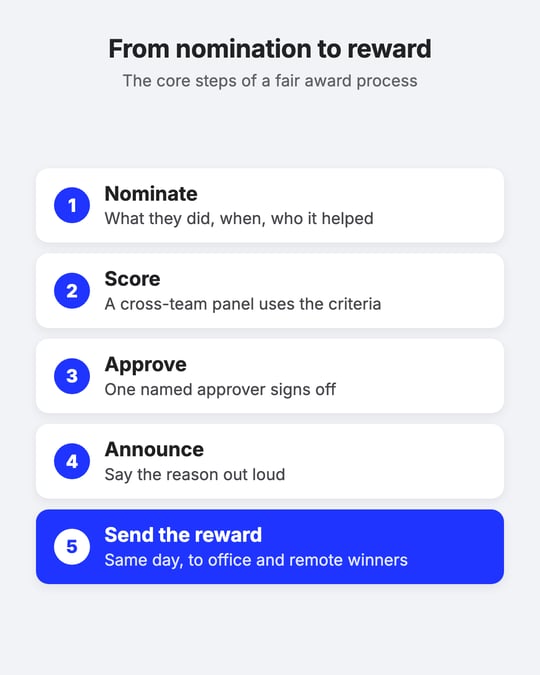
Here’s a process that holds up from nomination to reward:
- Write one sentence of criteria per award. “Raised a problem early when staying quiet was easier” is a criterion. “Shows integrity” is a mood.
- Open nominations to peers and managers. Ask three short questions: what did the person do, when, and who did it help? Cap the answers at a few sentences, so a fluent writer can’t outweigh a strong example.
- Check eligibility. Decide up front whether someone can win the same award twice in a year, and whether part-time and contract staff can be nominated.
- Score with a small panel. Three to five people from different teams score each nomination against the criteria on a simple 1 to 5 scale. A nominee’s own manager steps out of that nominee’s score.
- Get one approval. A named approver confirms the winners and the reward budget, so nothing changes after the announcement.
- Announce the reason, then send the reward. Name the specific contribution in the announcement, and send the reward the same day.
The difference between a weak and a strong nomination is easy to see side by side:
- Weak: “Dana always goes above and beyond. She’s a great team player.”
- Strong: “In March, Dana rebuilt the returns checklist after two shipments went to the wrong warehouse. The warehouse team now uses her checklist for every return.”
The strong version gives the panel something to score, and it gives the announcement its best line.
At the end of each year, look at the winners as a group. If the same team keeps winning, if one manager’s people dominate the spot awards, or if remote and part-time staff never appear, the criteria or the nomination process need work, not the winners. When managers do most of the nominating, our guide to briefing managers on fair recognition nominations gives them a shared standard.
How Giftronaut Handles the Reward Step, Including Remote Winners
Giftronaut handles the last step of an award program: getting the reward to each approved winner, wherever they work. Your nominations, scoring and approval stay in your own process, and Giftronaut takes over from the approved list.
Here’s how each tier maps to it:
- Who can send: a Super Admin invites team members and sets their permissions, such as placing orders, funding the account and viewing team order history (Help Center). HR can fund the account while managers place spot-award orders.
- Spot awards: a one-time order goes out right away or on a date you choose (Help Center).
- Quarterly and annual awards: schedule the order for announcement day, add the winner’s name with a personalization token, and attach the award certificate to the reward email as a PDF, JPEG, JPG or PNG of up to 5 MB.
- Service awards: Smart Orders send rewards automatically on dates such as work anniversaries once the order is live (Help Center).
- Remote winners: a Choice Card lets the winner choose a brand in their local currency when they redeem, from 4,300+ brands across 225 countries. Gift cards are country-specific, so a Branded Card bought for one country can’t be redeemed in another; with a Choice Card, the winner selects their country at redemption.
- Delivery: rewards go by email, SMS (text message) to US and Canadian mobile numbers, or as a reward link you can share in your own channel. You can translate the message into up to five languages per order.
- The fairness check: download your order history filtered by date range, order creator, status or country (Help Center) to see which managers sent spot awards and where they went.
There are no fees, contracts or subscriptions: you pay for the rewards you send. If you’d like to see how recipients pick their brand, our post on Choice gift cards walks through it.
Best Practices for Running Employee Recognition Awards
Award programs that last share a few habits: they stay small, they say exactly why someone won, and they get a yearly review. None of these needs a big budget.
- Establish clear criteria. Publish each award’s criteria with the call for nominations, so people know what earns it before they’re judged on it.
- Offer a tangible reward. The recognition matters most, but a reward makes it memorable. Letting the winner choose the reward avoids the plaque-and-mug drawer.
- Personalize the reason. Name the project, the customer or the moment. A short award letter does the same job in writing; our employee recognition letter examples include templates.
- Celebrate publicly, and include remote staff. Announce winners where everyone will see it: an all-hands meeting, the company newsletter or the team channel. Read the reason out loud, and make sure remote winners are on the call.
- Review every year. Check which teams won, which categories drew no nominations and whether the reward amounts still feel right.
Awards are one format among several. For other ways to use rewards in a recognition program, see these employee recognition and rewards program examples. And if you’re a small company running this without an HR team, our guide to meaningful employee recognition with gift cards scales it down.
Your First Round of Employee Recognition Awards
These days, any nomination form I help with asks for three short answers, what the person did, when, and who it helped, and nothing longer than a few sentences. The fluent writers hate it. The people who fix billing outages do much better.
You don’t need all 50 ideas to start. Pick one quarterly award in one category, write its criteria in a sentence, set the reward and the panel, and run a single round. After that round, check who was nominated and who wasn’t, then add a second category or a spot-award budget.

Frequently Asked Questions
What are employee recognition awards?
Employee recognition awards are named honors for a specific contribution, such as performance, values, service, innovation or teamwork. Most come with a reward, like a gift card, certificate or extra time off.
What are the key types of recognition awards?
The key types are performance, values and behavior, service milestone, innovation and teamwork awards. Many companies also create awards by role, such as sales, marketing or customer service.
How much should an employee recognition award be worth?
Set one reward amount per tier before nominations open, so every winner at that tier gets the same thing. One example plan is $25 to $50 for spot awards, $100 to $150 for quarterly awards and $300 to $500 for an annual award, adjusted to your budget.
How often should companies give employee awards?
Use three rhythms: spot awards any week, category awards each quarter and one annual award. Quarterly awards are frequent enough to matter and rare enough to feel earned.
How do you choose award winners fairly?
Publish written criteria before nominations open, and ask each nomination for one specific example. Then let a small cross-team panel score them, with each nominee’s own manager stepping out.
Can remote employees receive recognition awards?
Yes. Send the reward digitally by email, text or reward link, and announce the win where remote staff will see it. A reward that lets winners choose a local brand works across countries.
What is the difference between recognition and rewards?
Recognition is the acknowledgment: saying what someone did and why it mattered. A reward is the thing that comes with it. Awards combine both, so the stated reason matters as much as the prize.