
Safety incentive programs recognize workers for actions that support workplace safety, such as reporting hazards or improving a procedure. Design the rewards so that reporting an injury or illness never becomes something workers feel pressured to avoid.
Whenever someone shows me a rewards program, I ask one question before I look at the rewards: what happens to the person who raises their hand? If the honest answer is “nothing,” or “the team loses its streak,” I stop reading the criteria.
Picture two teams looking at the same board. One sees a reward for raising a hazard. The other sees a prize that disappears when somebody reports an injury. Those are hypothetical designs, but they send very different messages. Judge a program by what a worker feels comfortable reporting, not by how tidy the board looks at the end of the month.
What are safety incentive programs?
Safety incentive programs attach recognition or a reward to defined safety-related activities or outcomes. A useful design supports the wider safety and health program. It doesn’t replace hazard control, training, reporting duties, or the employer’s responsibility to provide a safe workplace.
OSHA’s worker participation guidance, checked in October 2026, describes workers taking part in establishing, operating, evaluating, and improving the safety program. It emphasizes participation across roles and protection from retaliation for reporting concerns.
That gives the program a practical starting point. Ask workers which hazards are difficult to raise, what happens after a report, and whether they receive feedback. A reward for reporting has little meaning if nobody responds to the concern.
Keep three decisions separate:
- Safety decision: what needs to change to control the risk.
- Recognition decision: which contribution meets the published recognition criteria.
- Delivery decision: how the approved recipient receives the reward.
A manager shouldn’t wait for a reward nomination to address a hazard. The safety response follows the organization’s established process whether or not recognition is offered.
Safety reward ideas
Good safety rewards recognize specific contributions that workers can make without hiding an injury or competing to make the injury count look better. Examples include reporting a useful hazard, helping improve a procedure, or sharing a practical safety lesson. Have the safety team define how each contribution is assessed.
| Activity to recognize | Evidence to review | A design check |
|---|---|---|
| Reporting a hazard or near miss | The concern and its route to the responsible owner | Don’t make a reward depend on an injury going unreported |
| Suggesting a safer work procedure | The suggestion and the safety team’s assessment | Give all shifts a way to contribute |
| Helping test an approved improvement | Participation and feedback from the trial | Don’t reward taking an avoidable risk to demonstrate a problem |
| Sharing a useful safety lesson | The lesson and the audience it reached | Keep personal injury details private |
| Supporting a worker-led safety review | The worker’s contribution and follow-up | Make participation possible during normal work arrangements |
These are practical program examples. OSHA’s worker-participation guidance specifically supports recognizing positive activities such as reporting hazardous conditions and suggesting safer procedures.
The recognition can be a personal thank-you, a team acknowledgment, or a modest reward that fits company policy. Ask the recipient how they prefer to be recognized. Not everyone wants to describe a sensitive event in front of the whole team.
Avoid paying simply for the largest number of reports. That measure can favor people with more reporting opportunities and distract from whether concerns receive useful action. Define the contribution you want to recognize, then review the quality and follow-up consistently.
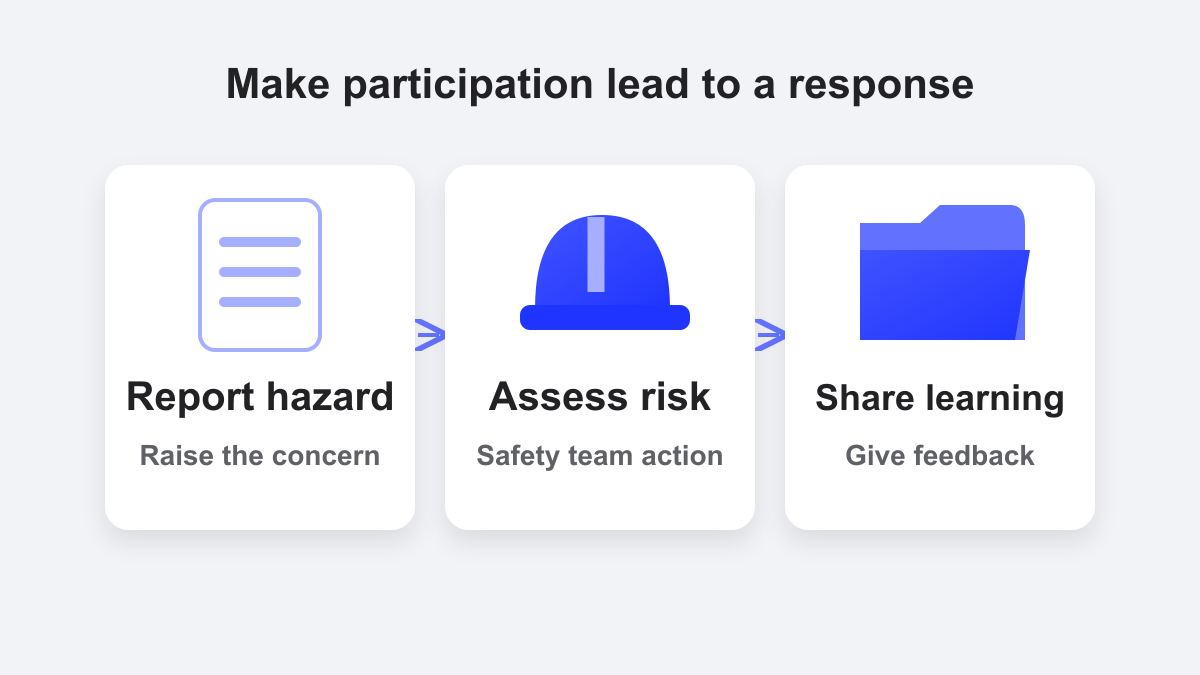
The important sequence is raising the concern, getting it assessed, and sharing the appropriate learning. Recognition supports participation; it isn’t permission to postpone risk control.

Do safety incentives discourage reporting? What to avoid
Safety incentives can discourage reporting when workers believe that reporting an injury will cost them or their coworkers a reward. Review that pressure as part of the design, including how managers explain the program. A written instruction to report doesn’t settle the issue if the surrounding incentives send a different message.
In the US, OSHA’s October 11, 2018 clarification says workplace safety incentive programs aren’t prohibited under 29 CFR 1904.35(b)(1)(iv), the rule against discriminating against an employee for reporting a work-related injury or illness.
The clarification describes two types. A participation-based program rewards reporting near-misses or hazards and involvement in the safety and health management system, and positive action under it is always permissible. A rate-based program focuses on reducing reported injuries and illnesses, typically with a prize or bonus at the end of an injury-free month or by evaluating managers on their work unit’s lack of injuries. That type is also permissible, as long as it isn’t implemented in a way that discourages reporting. OSHA points to adequate precautions that make sure employees feel free to report an injury or illness.
OSHA also says that consistently enforcing legitimate work rules, whether or not an injury or illness is reported, shows an employer is serious about a culture of safety and not just the appearance of lower injury rates.
Don’t turn that guidance into either of these claims: “All injury-free bonuses are illegal” or “Any injury-free bonus is fine if we add a disclaimer.” The implementation and its effect on reporting matter. Have the safety and legal teams review the actual design under the rules that apply to the workplace.
What warning signs should the team investigate?
Look for evidence that workers hesitate to report or receive pressure after doing so. Review reports, worker feedback, and the follow-up process together. A change in reported incidents needs investigation rather than an automatic celebration or punishment.
- Workers ask whether reporting will make the whole team lose a prize.
- A supervisor pressures someone to wait before recording a concern.
- One shift receives recognition opportunities that another can’t access.
- Reports are collected but the responsible owner never gives feedback.
- The program celebrates a low count without checking whether reporting remains usable.
Don’t use these examples to diagnose an individual worker’s motives. Use them to improve the reporting process and the program’s rules.
How to design a fair program
A fair safety incentive program has written criteria that workers can understand and apply consistently across roles. Involve workers in the design, give them a way to question decisions, and review the program after a defined pilot period. Fairness needs attention to access as well as the reward amount.
OSHA’s participation guidance calls for workers at all levels to have opportunities to contribute, with attention to language, education, and available time. It also recommends feedback so workers know their concerns are being heard and addressed.
For a hypothetical pilot, select one contribution to recognize, such as a useful suggestion for a safer procedure. The safety team reviews the suggestion through its normal process. A separate recognition decision then follows the written criteria, without making a reward a condition for responding to the concern.
A short program record should identify:
- The action eligible for recognition and the reason it supports the safety program.
- The evidence needed, without unnecessary health or personal details.
- The person responsible for the safety review and the person approving recognition.
- The participation routes available to each shift, location, and relevant worker group.
- The reward type, budget, and applicable company policy.
- The process for asking questions, correcting an error, or challenging inconsistent treatment.
- The date for reviewing participation, feedback, and unintended effects.
Check the design with people who will use it. A portal-only process may exclude workers who don’t have convenient access during their shift. A meeting held at one location may be hard for another team to attend. Resolve those access issues before comparing participation counts.
How should you evaluate the pilot?
Look at participation, response time, completed follow-up, and worker feedback alongside incident reporting. No single count tells the whole story. More reported concerns can reflect a more usable reporting route, a change in hazards, or both.
Use the same definitions and time periods when comparing results. Record any changes in staffing, work volume, or reporting methods that affect interpretation. If the team can’t explain why a number moved, investigate before describing the program as a success.
How to deliver safety rewards
Approve the safety contribution and recipient first, then choose a delivery method that works for the person’s location and contact details. Keep safety records separate from the reward message. The recipient doesn’t need private incident details included in an email to receive recognition.
As checked in October 2026, Giftronaut’s How It Works page describes email, text-message, and reward-link delivery. The Choice Card page confirms text delivery to US and Canadian mobile numbers. Check those limits before choosing SMS for a distributed workforce.
Choice Card recipients select from the rewards available to them. Giftronaut offers 4,300+ brands in 225 countries, with availability depending on where the recipient is. Your organization still decides who qualifies and what each reward is worth.
Tell payroll before the first reward goes out. In the US, IRS Publication 15-B (2026) says the exclusion for safety achievement awards doesn’t apply to cash, cash equivalents, gift cards, gift coupons or gift certificates, and that cash equivalents, no matter how little, are never excludable as a de minimis benefit. For employees, that makes a gift card taxable wages and it goes through payroll. Contractors and other non-employees follow different rules, which our guide to gift card taxes by recipient walks through.
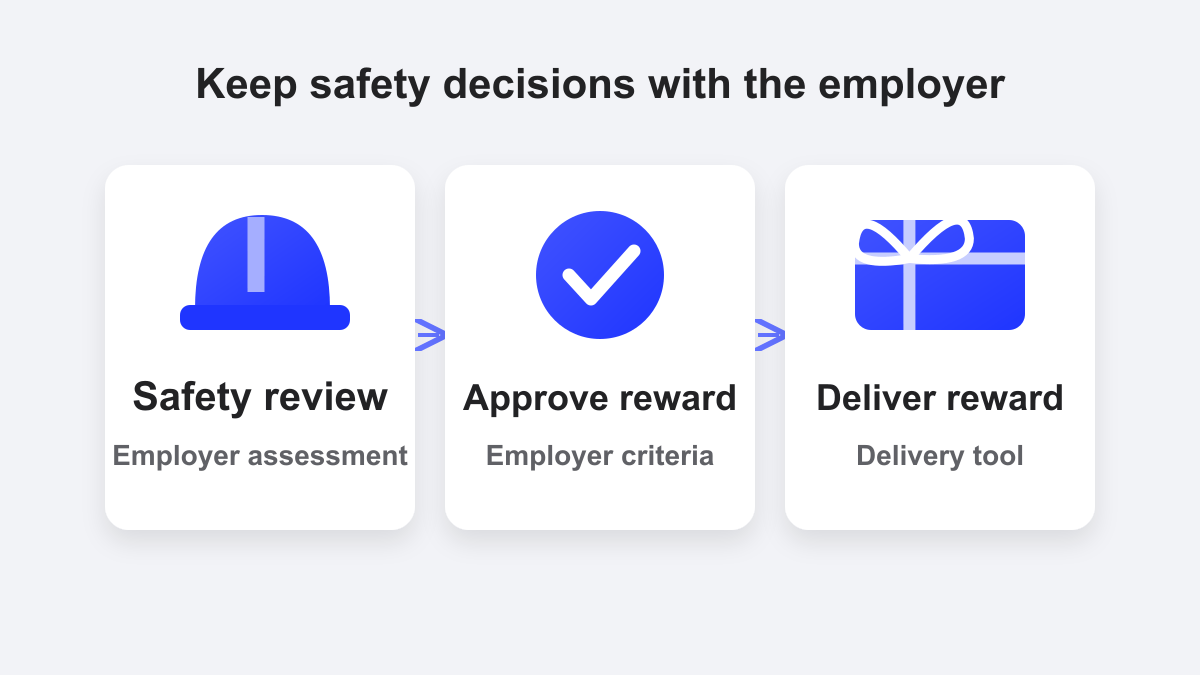
The employer owns safety assessment and recognition approval. Reward delivery follows that decision; it doesn’t certify safe behavior or evaluate an incident.
For broader recognition approaches, our recognition at work ideas include ways to acknowledge a specific contribution. Use the message to describe the useful action, without suggesting that receiving a reward proves the workplace is risk-free.
Reward participation without making silence valuable
Choose contributions that make the safety program more usable: raising concerns, improving procedures, and sharing appropriate learning. Check whether workers can participate fairly and whether reports lead to a response.
The reward should be easy to explain. The reporting route should be easier to use. Keep that order when deciding what to change after the pilot.

Frequently Asked Questions
Are safety incentive programs prohibited by OSHA?
No. In the US, OSHA’s October 2018 clarification says safety incentive programs aren’t prohibited. A program must not be implemented in a way that discourages injury or illness reporting, so have the actual design reviewed rather than relying on its label.
What is the difference between participation-based and rate-based incentive programs?
A participation-based program rewards actions such as reporting near-misses or hazards. A rate-based program rewards a lower number of reported injuries, for example with a prize for an injury-free month. OSHA permits both, but a rate-based program must not be implemented in a way that discourages reporting.
Which safety incentive programs encourage workers to report hazards?
Participation-based designs recognize actions such as reporting hazards or suggesting safer procedures. OSHA identifies these as positive safety activities. The organization must also provide a usable reporting route and respond to the concerns raised.
Can safety incentive programs reward an injury-free period?
Yes, with limits. OSHA says a rate-based program, such as a prize for an injury-free month, is permissible if it isn’t implemented in a way that discourages reporting. The safety and legal teams still need to review the actual design and its effect on reporting.
Does a fall in reported injuries prove a safety incentive program worked?
No, the count alone doesn’t show whether hazards declined or reporting changed. Review participation, reporting access, work conditions, and follow-up alongside the number. Investigate the reason for the change before attributing it to the reward program.
Does Giftronaut decide who qualifies for a safety reward?
No. Your organization makes the safety and recognition decisions, and Giftronaut delivers the approved reward by the method you select. Keep incident assessment and eligibility approval with the responsible team.