Referral program examples from Dropbox, Google Workspace and Wise differ in what they pay (storage space, cash or a partner commission), but each one states what qualifies, what it pays and where it stops. Those three parts are what’s worth borrowing.
A friend once sent me a referral link for a meal-kit service and promised a credit for me and another for them. I signed up, the box showed up, and my credit never did. My friend’s didn’t either. My friend and I traded screenshots for a week before the line in the terms that explained it turned up. Neither had read that far.
If you’re about to build a referral program, design for that week of screenshots. The well-known programs spell out what counts, what it pays and where it stops, so start with how they do it.
What do real referral program examples look like?
Real referral program examples reward both sides of an invitation, in different ways. Dropbox gives both people storage space, Google Workspace pays the referrer cash and gives the new user a first-year saving, and Wise pays partners a commission and gives guests a discount. The table uses each program’s own official page, checked in October 2026, and those pages list earning rules with no results data.
| Example | How a referral qualifies and what it pays | Limit or catch |
|---|---|---|
| Dropbox | Both people get bonus space once the friend accepts the invitation, installs the Dropbox app, logs in from it and verifies their email. Basic referrers earn 500 MB per friend; Plus, Family and Professional referrers earn 1 GB. | Referral space is capped at 16 GB on Basic and 32 GB on the paid plans. Creating an account alone doesn’t qualify. |
| Google Workspace | The referrer earns a one-time cash reward for each eligible new user. The US rates are $8 per user on Business Starter, $15 on Business Standard and $23 on Business Plus. | Rewards cover up to 100 users per referred account and 200 new users a year, and only in the countries Google lists. |
| Wise partner invite program | Partners who promote Wise commercially earn a commission for each new user. Invited guests get a discount to try Wise, such as a free transfer, depending on their region. | Some activity doesn’t qualify, such as same-currency transfers and gambling, and a reward expires if it isn’t claimed within a year. |
Notice that all three give the new person something too. Dropbox gives the friend bonus space, Google hands out promotion codes for first-year savings, and Wise offers guests a discount. If you want an invite to feel less like asking a favor, give the new person a reason to say yes.
Look at the unit being paid, too. Google Workspace pays per eligible user: a referred account with 10 Business Plus users earns the referrer $230 at the US rate, because 10 × $23 is $230. Pay per company instead and the same account is one reward. Whichever you choose, write the unit into your offer so finance, sales and the referrer count the same thing.
Wise shows why the program’s context matters. Anyone who promotes Wise on a commercial platform is assigned to its partner invite program, and what a guest receives depends on their region. Check which program applies before you quote anyone a reward.

How does a B2B referral program decide when to pay?
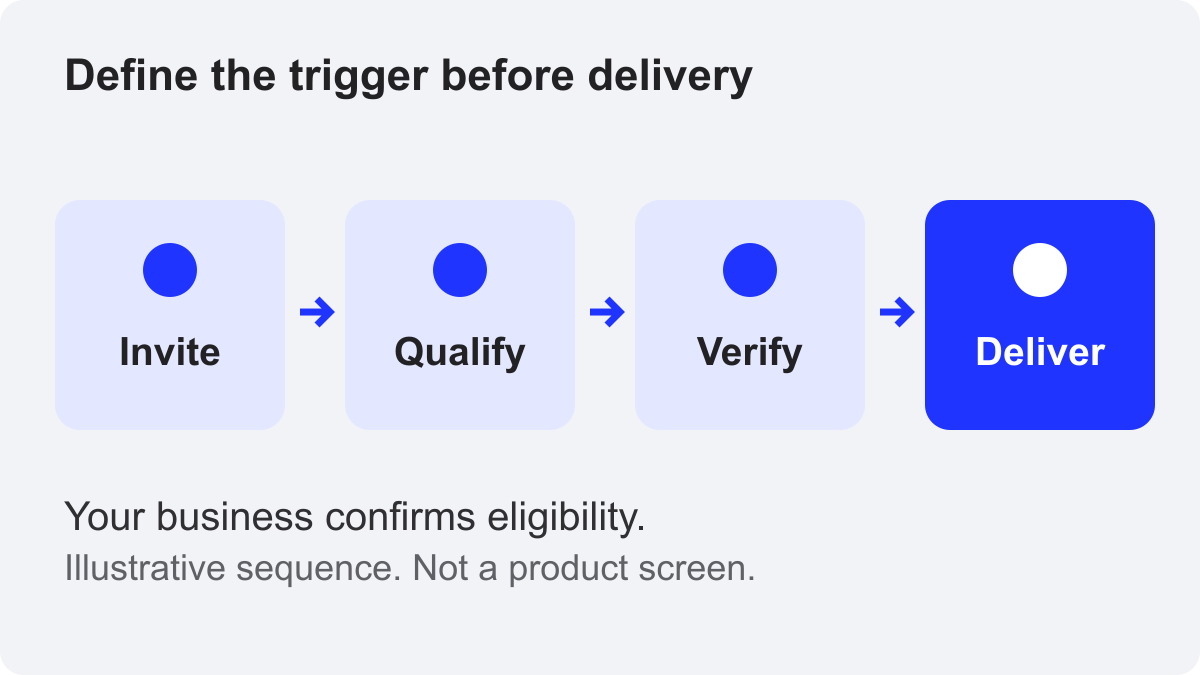
A B2B referral program decides when to pay by choosing a milestone: an introduction, an accepted lead or a paying account. Each costs a different amount and takes a different amount of time to confirm, so pick the one your sales process can actually verify before you set a reward.
Google Workspace’s reward follows eligible new users, so it tracks a real account. Paying at the introduction is faster, but you’ll spend more time filtering out contacts you already know.
Picture a software company that rewards an existing customer once a referred business pays its first invoice. The referral form records who made the introduction and which business they named. A sales owner checks that the opportunity wasn’t already active, finance confirms the paid invoice against the published terms, and only then does the program owner approve the reward. That’s a suggested design; none of the programs above is described that way.
Decide up front what happens when two people refer the same account. Crediting the first recorded introduction is one clear rule, and whichever you pick belongs in the terms before a dispute starts. Changing attribution after someone has acted on the offer is the quickest way to lose them.
If your referrers are partners rather than customers, our guide to building a partner referral program covers that setup.
Which reward should a referral program offer: cash, credit or gift cards?
The right referral reward is the one your referrers can actually use, once you’ve priced what it costs to deliver. Credit works when more of your product has real value to them, cash works when your agreement and payment setup allow it, and a gift card works when you know what they want or let them choose. A bigger amount isn’t automatically a better offer.
| Reward | Works when | Check first |
|---|---|---|
| Product or account credit | Existing customers value more of your service | Where the credit can be used, who’s eligible and what happens to an unused balance |
| Cash | A direct payment fits your agreement | Who can be paid, which recipient details you need, processing costs and approval controls |
| A specific gift card | You know the recipient’s country and preference | Whether the brand is available in their country, the currency and the card’s own terms |
| A reward they choose (Choice Card) | Recipients have different tastes or live in different countries | Which rewards are available in their country |
Some programs raise the reward as someone refers more people. For a first pilot, a flat reward is easier to budget and to explain.
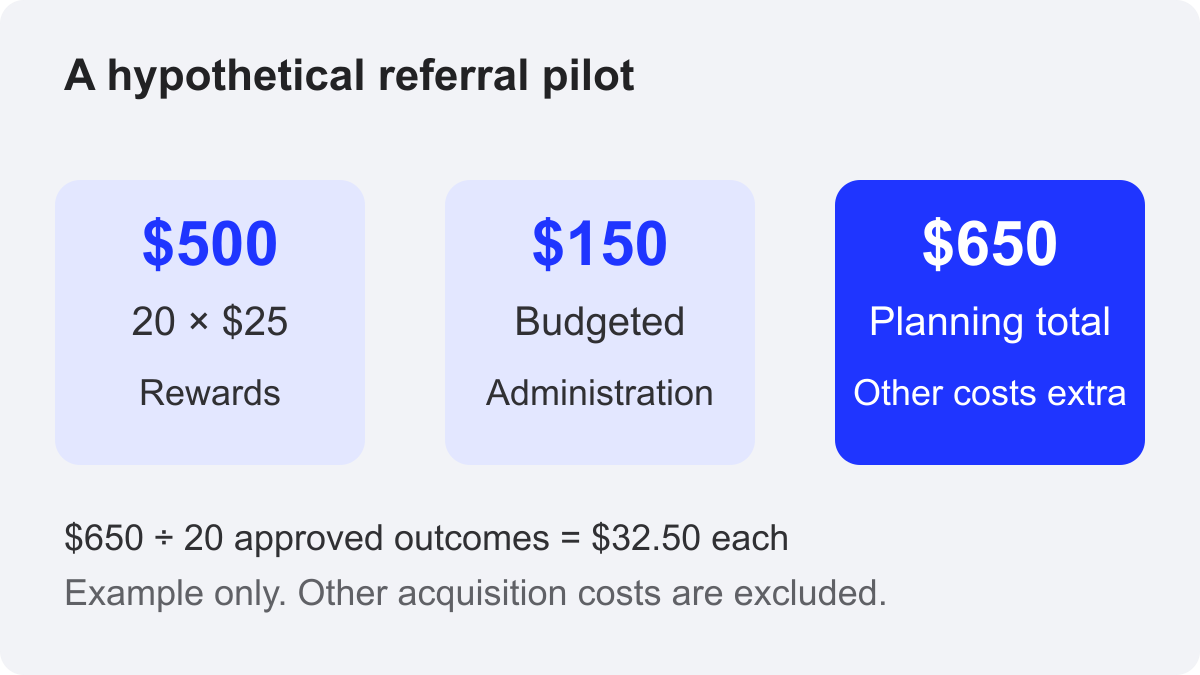
Price a pilot before you open the offer to everyone. Suppose 20 approved referrals each earn a $25 reward: 20 × $25 = $500. Add $150 for administration and the planning total is $650, or $32.50 per qualified referral. Funding costs come on top: if you fund Giftronaut rewards by credit card, a 3% processing fee applies, while ACH and wire deposits carry no fee. Sales effort and other acquisition costs aren’t in this example.
Sounds like a lot of arithmetic for a $25 reward? It’s a few lines in a spreadsheet, and it stops the pilot from quietly costing more than anyone expected. Keep the counts honest, too. If only ten referrals qualify, $650 across ten is $65 each, so don’t divide by the twenty invitations to flatter the result. Track invitations, accepted referrals and qualified customers as three separate numbers.
What should a referral program spell out before it launches?
A referral program should spell out five things before it launches: the event that earns the reward, what the reward is, the exceptions, who handles questions and how you’ll judge success. Each one is cheap to write down now and expensive to argue about later.
- The trigger. Name the event that earns the reward and the evidence that confirms it. “After the referred customer completes a qualifying purchase” beats “when your friend joins”, and you still have to define the purchase.
- The reward. State what each person gets and where they can use it. If both sides benefit, describe each offer separately instead of implying they match.
- The exceptions. Cover existing customers, duplicate referrals, cancelled purchases and expired offers before launch, the way Dropbox’s caps and Wise’s expiry do.
- A named owner. One person handles status questions and edge cases, and participants know how to reach them. Don’t promise response times your team can’t meet.
- A measurable goal. Decide what success means before you look at results. More invitations are nice, but more qualified customers at an acceptable reward cost is the number that matters.
How do you launch a referral program?
You launch a referral program by starting small: one audience, one qualifying event and a limited pilot, with the scope written where everyone running it can see it. A small first round shows you which terms confuse people before many more rely on the offer.
- Write the offer in plain language. Name who can refer, what counts as a qualified referral, the reward and the main exclusions, then have the owners who’ll honor it review the terms.
- Record each referral. Use a system that ties the introduction to the eventual outcome, and collect only the personal details the process needs.
- Tell people it exists. Put the invitation where referrers already are, such as an account page or a confirmation email, and state the reward and the main limits in the invite itself.
- Verify before you send. Check the qualifying event, document the decision and log exceptions instead of inventing a new rule for each case.
- Send the reward. Giftronaut delivers rewards by email, text message or reward link, right away or on a schedule, and text reaches US and Canadian mobile numbers. With a Choice Card, the recipient picks the brand and currency when they redeem, so you don’t need to know their country. If your own system records qualified referrals, the Gift Card API can send the reward automatically.
- Review the pilot. Compare qualified outcomes, costs, support questions and repeat participation, and change a confusing rule explicitly before the next round.
For a shorter checklist, our 9 tips for creating a stellar referral program is a quick read.
Choose the mechanism before the reward amount
These days, when a friend sends me a referral link, I read the terms before I click, mostly to find out what has to happen before anyone gets paid. It’s a dull habit. Nobody has traded screenshots with me since.
Your version of that page needs the qualifying action, the reward, the limit and a name to ask. Set the amount last, test it with a small pilot, and let the pilot’s numbers, rather than a familiar brand name, tell you whether it’s worth widening.
Frequently Asked Questions
Which referral programs reward both the referrer and the new customer?
Dropbox, Google Workspace and Wise all do. Dropbox gives both people bonus space, Google Workspace gives the referrer cash and the new user first-year savings, and Wise gives partners a commission and guests a discount. The amounts differ, so check each program’s terms.
What is a good reward for a referral program?
A good reward is one the person can use and that fits what a qualified referral is worth to you. Credit suits products people use more of, cash suits direct agreements, and a Choice Card suits recipients who want to pick for themselves.
What limits do referral programs put on rewards?
Dropbox caps referral space at 16 GB on Basic and 32 GB on paid plans. Google Workspace pays on up to 100 users per referred account and 200 new users a year. Wise rewards expire if you don’t claim them within a year.
Do referral programs actually reduce acquisition costs?
Not on the evidence of published terms, which tell you what a reward is but say nothing about what a referral is worth to your business. Track qualified customers and total reward cost in your own pilot, then compare.
Can a referral program pay rewards in gift cards instead of cash?
Yes. With a Choice Card, each recipient picks their own brand and currency when they redeem, so you don’t need to know their country in advance. A specific brand’s card is tied to one country, so check that it works where the recipient lives.
How do you send referral rewards automatically?
If your own system records each qualified referral, Giftronaut’s Gift Card API can send the reward when that happens. Its page lists referrals among the actions it’s built for, and a free sandbox API key lets you test before sending anything real.