
A SOC 2 report is a licensed CPA’s examination of a vendor’s controls for security, availability, processing integrity, confidentiality or privacy, and it’s the document a security reviewer asks for before a vendor is approved. To review one, check the report type and dates, the auditor’s opinion, the scope, any exceptions in the test results, and the controls the vendor expects you to run yourself. Giftronaut has completed a SOC 2® Type 2 audit, so this guide also runs its report through the same checks.
I once bought a used car because of a “certified inspection” sticker on the windshield. The checklist behind it ran two pages, and I never read the last column, the one headed “not inspected.” A month later my mechanic ran his finger down that column and said, “They checked everything you can see from the driveway.” He was being kind. The brakes were in that column.
A SOC 2 report has the same column. It’s called scope, and it sits a few pages after the part everyone reads.
Here’s what’s in the report, the seven checks a security reviewer makes, and, since Giftronaut has been through a SOC 2 Type 2 audit itself, how its report holds up to them.
What Is a SOC 2 Report, and What Isn’t It?
A SOC 2 report is an examination of a service organization’s controls, performed and signed by a licensed CPA under the AICPA’s attestation standards. One report can cover a single trust services category or all five. And the AICPA is direct about the label: its vice president of assurance and advisory innovation said in a 2026 Journal of Accountancy interview that SOC 2 “is not a certification.”
So a vendor can’t be “SOC 2 certified” the way a product carries a safety mark. What exists is a specific report on a specific system, for a specific date or period, with a CPA’s opinion attached. Even “compliance” is, as a Journal of Accountancy article puts it, “a term never used in SOC 2 examinations.”
SOC 2 reports are also restricted. The AICPA’s description criteria limit them to “specified parties,” a group that can include prospective customers. So expect to request one from the vendor rather than download it.
| Report | What it covers | Who can read it |
|---|---|---|
| SOC 1 | Controls relevant to customers’ financial reporting | The vendor, its customers and their auditors |
| SOC 2 | Any of the five trust services categories, in detail | Specified parties, which can include prospective customers |
| SOC 3 | The same five categories, with less detail | Anyone (general use) |
For a vendor that stores your data or your recipients’ data, SOC 2 is the one to ask for.
What’s Inside a SOC 2 Report?
Every SOC 2 report has the same core parts: the auditor’s opinion, management’s assertion, the vendor’s description of its system and, in a Type 2 report, the auditor’s tests and their results.
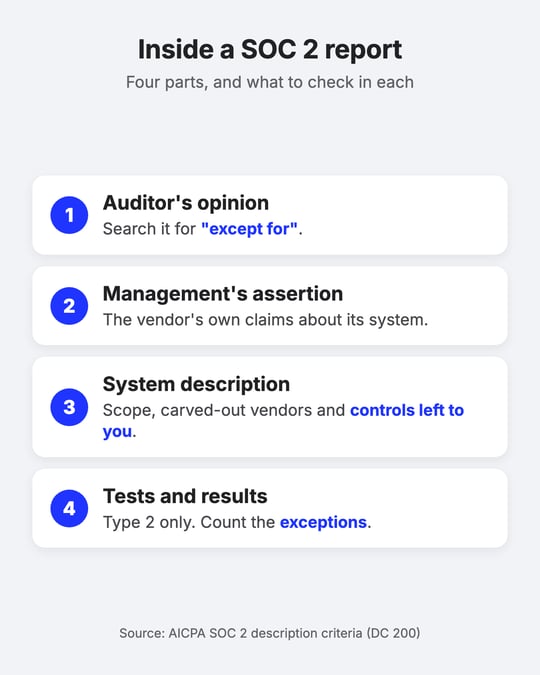
- The auditor’s opinion. Whether the description is fairly presented, whether the controls were suitably designed and, in a Type 2, whether they operated effectively.
- Management’s assertion. The vendor’s own written statement about its system and controls.
- The system description. The services and systems in scope, the vendors the vendor relies on, the controls expected of you, and any incidents or significant changes the vendor disclosed.
- Tests and results (Type 2 only). What the auditor tested and what they found, including exceptions.
Looking for a SOC 2 report example? Because the reports are restricted, real ones circulate on request, not in public. The AICPA lists an illustrative SOC 3 report among the resources on its SOC 3 page.
How to Read a SOC 2 Report: 7 Checks Before You Approve a Vendor
Read a vendor’s SOC 2 report in this order: type and dates, opinion, scope, exceptions, the vendor’s own vendors, your controls, then who signed it. The first four tell you whether the report backs up the sales deck. The last three tell you what it leaves to someone else, including you.
1. Check the type and the dates
A Type 2 report covers a period, and a Type 1 report covers a single date. Note when the period ended. The AICPA’s assurance lead has said SOC 2 work should be done annually “as things can change over time.”
2. Read the opinion, and search it for “except for”
A clean opinion states its conclusions without conditions. Under the AICPA’s attestation standards, anything else is a modified opinion: qualified, adverse or a disclaimer, with a separate paragraph explaining why. A qualified opinion uses the words “except for,” so searching for that phrase takes five seconds. It isn’t automatically a deal-breaker: read the paragraph and ask whether it touches the service you’re buying.
3. Match the scope to what you’re buying
The system description says which services, systems and trust services categories the report covers. If you’re buying the vendor’s API and the description only covers its web app, the report says nothing about the part you’ll use.
4. Read the exceptions in the test results
In a Type 2 report, each control comes with the auditor’s test and the result. An exception (auditors also say deviation) means the test found cases where the control didn’t work as described. One missed access review in a year reads differently from a pattern, so count them and look at which controls they hit. The AICPA’s description criteria also call for disclosing incidents caused by failed controls, and significant changes during a Type 2 period.
5. Find the vendors behind the vendor
Your vendor has vendors of its own, such as a cloud host. When a report uses the “carve-out method,” the AICPA’s description criteria say the subservice organization’s system is excluded from the description and the examination, and the description lists the controls expected of that provider instead. A carved-out host’s own report becomes part of your review.
6. Find the controls that are yours
Complementary user entity controls (CUECs) are the controls the vendor assumed its customers would run, and which are needed, alongside the vendor’s own controls, for the vendor to meet its commitments. They’re listed in the system description. Turn each one into a task with an owner on your team.
7. Check who signed it, and whether it reads like a template
A SOC 2 engagement must be performed by a licensed CPA, and the AICPA’s assurance lead has warned that unlicensed signers “representing themselves as CPAs” are violating state law. The AICPA’s SOC page also carries a notice that it is looking into allegations about a compliance vendor that offers SOC services. A member of the AICPA’s SOC 2 Working Group put the warning sign bluntly: “You can compare any five of their reports, and they’re all exactly the same, with a different client logo on it.” Does the description read like this vendor’s system, or like anyone’s?
Giftronaut’s SOC 2 Type 2 Report, Run Through the Same Checks
Giftronaut has completed a SOC 2® Type 2 audit, and anyone reviewing Giftronaut as a gift card platform can request the report from the Giftronaut Trust Center, linked from the Giftronaut security page. Here’s what it publishes against the seven checks, and what to confirm in the report.
| Check | What Giftronaut publishes | What to confirm in the report |
|---|---|---|
| Type and dates | Type 2, covering May 28, 2026 to August 28, 2026 | What has changed since August 28 |
| Scope | Self-serve portal, gift card ordering and delivery, recipient redemption, reporting, API-based gift card distribution | Which trust services categories are covered |
| Opinion, exceptions, signer | Not summarized here | Read them yourself, using checks 2, 4 and 7 |
| Your controls | In the system description | Who on your team owns each one |
The scope covers the parts of a rewards platform a reviewer worries about: where you fund and order, how rewards reach recipients, the page they redeem on, and the API. The period is three months, so put the end date in your review notes the way you would for any vendor.
To get it, go to the Trust Center, select the SOC 2® Type 2 report under Resources and submit the request form. Giftronaut’s team reviews each request and emails you when access is granted. The Trust Center also lists the security controls Giftronaut monitors.
Then map your side of the line. The AICPA’s own example of a customer responsibility is a delivery-service customer who must provide “complete and accurate recipient information.” For rewards, that’s your recipient list, plus who on your team can fund the account and approve orders.
Some answers sit outside any SOC 2 report, so Giftronaut publishes them directly:
- Business verification: a new business account’s first deposit is held while the business is verified, and most reviews finish within one business day.
- Sanctions: access is blocked from 12 US-sanctioned countries across the portal, redemption pages and API, enforced by IP address.
- Recipients: recipients confirm their email address through a one-time verification step before the redemption page opens.
- Payments and records: card funding runs through PCI DSS-compliant payment processors, Giftronaut doesn’t store cardholder data, and Account Balance entries are read-only.
Does a SOC 2 Report Cover a Vendor’s Gift Card API?
A SOC 2 report covers a vendor’s gift card API only if the system description names it, so check the scope before your developers build anything. Giftronaut’s report names “API-based gift card distribution” in its scope. For the integration itself (sandbox, tokens, catalog calls and order status), see our guide to the gift card API.
A security reviewer will also want to know how the API is locked down. Giftronaut publishes these answers:
- Authentication: OAuth 2.0 tokens that expire after one hour in production.
- Connections: every request goes over HTTPS with TLS 1.2 or higher.
- Production access: enabled after business verification and IP allowlist registration, typically within one business day.
- Webhooks: signed with HMAC-SHA256, so you can verify each event came from Giftronaut.
SOC 2 Type 1 vs Type 2: Which Should You Accept?
Accept a SOC 2 Type 2 report when one exists, because only a Type 2 tests whether controls worked over a period. A Type 1 report gives the auditor’s opinion on the description and the design of the controls as of one date. That shows the controls exist on paper, not that anyone followed them.
| Question | Type 1 | Type 2 |
|---|---|---|
| Covers | One date | A period of time |
| Design of controls | Yes | Yes |
| Controls worked over time | No | Yes, with tests and results |
A Type 1 can be a fair stopgap for a young vendor in its first audit cycle, as long as the Type 2 date goes into your contract or review calendar.
What If the SOC 2 Report Is Months Old?
When a SOC 2 report’s period ended months ago, ask the vendor for a bridge letter (also called a gap letter) and the date of the next report. A PCAOB release describes a bridge letter as covering “the period from the date of the service auditor’s SOC report through a subsequent date, typically the most recent calendar year end.”
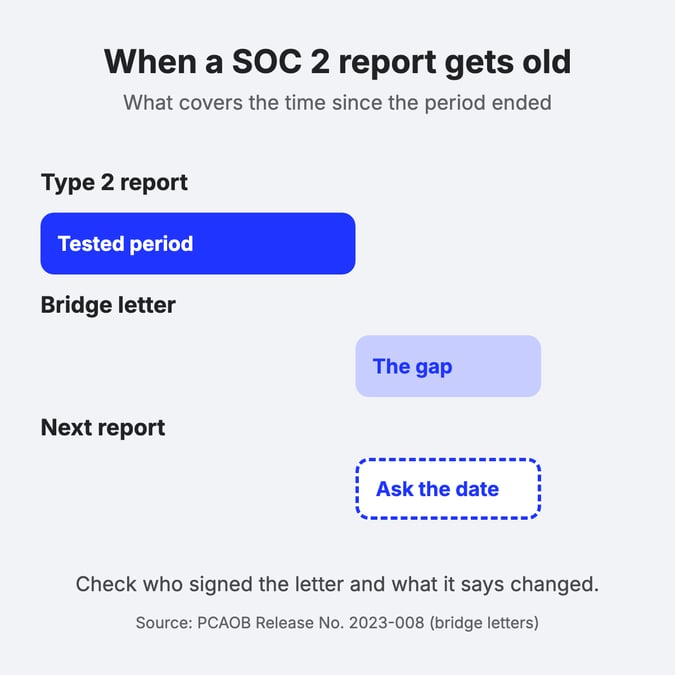
Read who signed the bridge letter and what it says about changes. The same PCAOB release notes that its standard “does not specify an appropriate window of time” for one, so the call is yours.
Before You Sign Off on a Vendor’s SOC 2 Report
I still read the “not inspected” column first, on a car or a report. With SOC 2, that means the scope, the carved-out vendors and the controls handed back to me, and only then the opinion. My mechanic calls that first car “the driveway special,” which is fair.
Before your next vendor approval, ask for the latest SOC 2 report and any bridge letter in the same email. Give the seven checks to one owner, with a list of the CUECs that are now theirs, and put the next report date on the calendar next to the contract renewal. If you’re still comparing rewards platforms, our guide on how to compare business gift card platforms covers the rest of the evaluation.
Frequently Asked Questions
Is a SOC 2 report a certification?
No. A SOC 2 report is an attestation: a licensed CPA’s examination of a vendor’s controls, with an opinion attached. The AICPA says plainly that SOC 2 is not a certification.
Does Giftronaut have a SOC 2 Type 2 report?
Yes. Giftronaut has completed a SOC 2® Type 2 audit covering May 28 to August 28, 2026. You can request the report from the Giftronaut Trust Center, and the team reviews each request.
Does Giftronaut’s SOC 2 report cover its gift card API?
Yes. The report’s scope includes API-based gift card distribution, along with the self-serve portal, ordering and delivery, recipient redemption and reporting.
Can I share a vendor’s SOC 2 report with my own clients?
Usually not. SOC 2 reports are restricted to specified parties agreed with the auditor. If you need something you can share freely, ask whether the vendor has a SOC 3, which is a general use report.
What does “except for” mean in a SOC 2 opinion?
It marks a qualified opinion. The auditor found a problem that is material but not pervasive, and describes it in a separate paragraph. Read that paragraph against the services you use.
What are complementary user entity controls?
They are controls a vendor assumed its customers would run. They’re needed alongside the vendor’s own controls for the vendor to meet its commitments, and they’re listed in the report’s system description.
Is SOC 2 required by law?
SOC 2 is a professional attestation standard set by the AICPA, not a government regulation. Many companies get a SOC 2 report to meet contract requirements with customers and business partners.